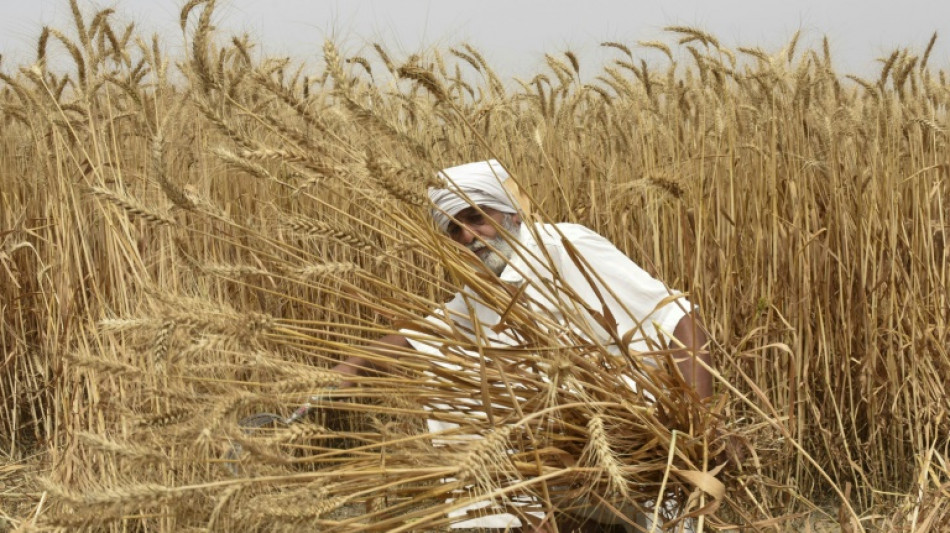
Wheat prices hit record high after Indian export ban / Photo: NARINDER NANU - AFP/File

 Nintendo producer 'all nervous' as Zelda classic remake hits shelves

 Three killed by storm in southern India

 Two hundred 'Cruise for life' passengers stranded in Cambodia

 Billionaire Ambani's Jio jumps 21% in market debut after record India IPO

 Sri Lanka's Tamil farmers fight to reclaim land after civil war

 'They don't care about us': Trump food aid cuts leave Americans struggling and angry

 Palestinian activist Khalil returns to Columbia after US detention

 Youths testify about 'despair' in unprecedented Canadian climate trial

 Storied Paris department store seeks bankruptcy protection

 Boeing shares tumble after it releases cautious growth forecast

Wheat prices surged to a new record high in European trading on Monday after India decided to ban exports of the commodity as a heatwave hit production.
The price jumped to 435 euros ($453) per tonne as the Euronext market opened, up from the previous record of 422 euros reached on Friday.
Global wheat prices have soared on supply fears since Russia's February invasion of agricultural powerhouse Ukraine, which previously accounted for 12 percent of global exports.
The spike, exacerbated by fertiliser shortages and poor harvests, has fuelled inflation globally and raised fears of famine and social unrest in poorer countries.
India, the world's second-largest wheat producer, said on Saturday that it was banning exports after its hottest March on record, with traders needing express government approval to enter into new deals.
New Delhi said the move was needed to protect the food security of its own 1.4 billion people in the face of lower production and sharply higher global prices.
Some parts of India have seen prices in wheat and flour jump 20 to 40 percent in recent weeks, Commerce Secretary BVR Subrahmanyam said on Sunday.
Because of the sharp rise in global prices, some farmers were selling to traders and not to the government.
This got the government worried about its buffer stock of almost 20 million tonnes -- depleted by the pandemic -- needed for handouts to millions of poor families and to avert any possible famine.
- 'Worsen the crisis' -
Export deals agreed before the directive issued on May 13 could still be honoured but future shipments needed government approval, it said.
However, exports could also take place if New Delhi approved requests from other governments "to meet their food security needs".
India, which possesses major buffer stocks, previously said it was ready to help fill some of the supply shortages caused by the Ukraine war.
Only last week India said it would send delegations to Egypt, Turkey and elsewhere to discuss boosting wheat exports. It was unclear whether these visits will now go ahead.
The export ban drew sharp criticism from the Group of Seven industrialised nations, which said that such measures "would worsen the crisis" of rising commodity prices.
India recorded its warmest March on record -- blamed on climate change -- and in recent weeks has seen a scorching heatwave with temperatures upwards of 45 degrees Celsius (113 Fahrenheit).
This hit farmers in wheat-producing northern India, prompting the government to predict output would fall at least five percent this year from 109 million tonnes in 2021.
Y.Jeong--CPN

