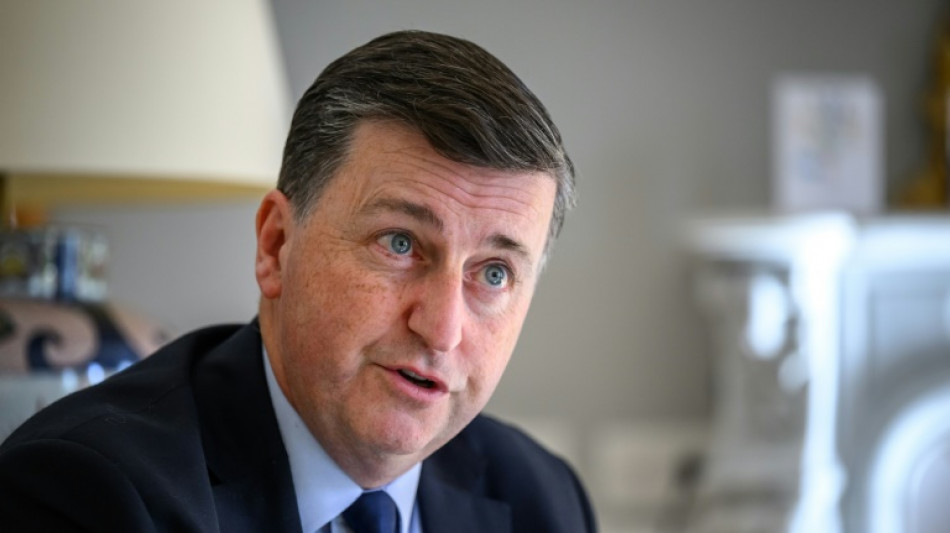
Britain seeking EU trade reset: minister / Photo: Fabrice COFFRINI - AFP

 Capital-markets shares rally as Motilal Oswal and Angel One lead gains

 Reliance rally puts historical one-year return pattern in focus

 Saudi Aramco quarterly profit climbs 34.6% amid elevated oil prices

 Australia raises benchmark rate to highest level in 18 years

 Asian stocks retreat as AI worries outweigh steep oil-price drop

 Hamad International Airport stages emergency drills during WATAN 2026
 Qatar solar expansion opens scope for technical performance gains
Britain is urgently looking to reset its trading relationship with the European Union, and sees international commerce as key to reviving UK growth, trade minister Douglas Alexander told AFP.
Alexander said Britain's 2016 vote to leave the EU caused "significant disruption" to its trade policy and the country needed to recalibrate its global trade outlook.
He was in Geneva on Monday to meet the head of the World Trade Organization, as part of a plan to piece together a revamped, long-term UK trade strategy to be published in spring 2025.
"The fact that this is my first European visit is an indication of the strength of commitment of the incoming government, both to the WTO and to the multilateral trading system," said Alexander.
British Prime Minister Keir Starmer's centre-left Labour Party swept to power with a huge parliamentary majority in July elections that ousted the Conservatives after 14 years and five premiers.
Alexander said that Britain would therefore be "the most politically stable democracy in the G7" over the coming years, and while that "doesn't guarantee economic stability and progress, it certainly helps".
"We are very keen as a new government to both reset our relationship with our friends and partners in the EU and also to continue to pursue free trade agreements and new opportunities with markets around the world," he said.
- Formulating new trade strategy -
Alexander said trade growth had a "critical role" to play in the Starmer government's "defining mission" of growing the British economy.
"Trade is one of the tools in the toolkit as we look both to bring economic stability and fiscal stability," he said.
Britain's economy grew by 0.5 percent in the second quarter of 2024, having suffered a shallow and short-lived recession in the second half of last year.
"The numbers continue to be very tough in terms of the immediate post-Brexit trade consequences -- but it's a reality that 47 percent of the UK's trade is still with the EU. So there is an urgency to resetting our relationship," said Alexander.
"Part of the reason for my visit to Geneva was to listen and to learn, and to frame in my own mind how to think about the place of the WTO in my emerging thinking around the trade strategy," he said.
The EU is one of the 166 WTO members, but after Britain finally left the bloc in 2020, London now negotiates for itself at the Geneva-based global trade body.
"We've got an ambitious agenda to unlock opportunities beyond the EU at the same time as seeking to reset a relationship with the EU," said Alexander.
He said Britain was an 81-percent services-based economy with a "huge national interest" in growing digital trade.
- 'Significant headwinds' -
The minister said he saw the WTO as an "indispensable institution of international cooperation", and strongly supports director-general Ngozi Okonjo-Iweala's bid for a second four-year term when her mandate expires in August.
Alexander said he was "huge admirer" of her stewardship of the WTO, saying the Nigerian former finance minister had brought "authority, credibility and capability" to an organisation often branded as sclerotic.
He said the multilateral trading system would be "the foundation of a great deal of what we're aiming to do in our trade strategy, moving forward".
Earlier this month, the WTO lowered its global goods trade growth forecast for 2025 to three percent from 3.3 percent.
Alexander said though international trade had faced "significant headwinds" in recent years, "global growth has still been more anaemic than any of us would have wished to see".
M.Mendoza--CPN
