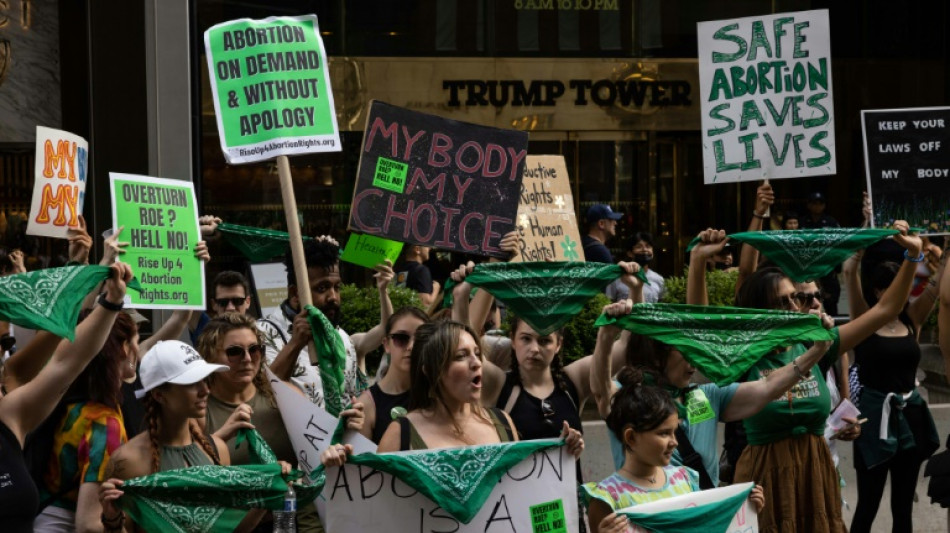
US infant mortality spiked after right to abortion overturned: study / Photo: Yuki IWAMURA - AFP/File

 Capital-markets shares rally as Motilal Oswal and Angel One lead gains

 Reliance rally puts historical one-year return pattern in focus

 Saudi Aramco quarterly profit climbs 34.6% amid elevated oil prices

 Australia raises benchmark rate to highest level in 18 years

 Asian stocks retreat as AI worries outweigh steep oil-price drop

 Hamad International Airport stages emergency drills during WATAN 2026

 Qatar solar expansion opens scope for technical performance gains
US infant mortality surged in the months following the Supreme Court decision to overturn the national right to abortion, driven by a rise in the number of babies with birth defects, a study said Monday.
The findings highlight the consequences of restricting abortion access across much of the country, according to the study's authors. They also align with previous research published earlier this year, which focused specifically on Texas, a state that implemented a six-week abortion ban in 2021.
Restoring abortion protections dismantled by a Supreme Court shaped during Donald Trump's presidency has emerged as a cornerstone in Vice President Kamala Harris's campaign for the November 5 election.
Researchers Maria Gallo and Parvati Singh of The Ohio State University analyzed a national database of birth outcomes, examining historical trends and comparing them to data from the 18 months following the June 2022 Dobbs v. Jackson ruling.
Birth outcomes in large populations such as the entire US are generally stable except for predictable seasonal peaks and valleys which they accounted for in their analysis, the authors said.
"We found that in the months after the Dobbs decision, infant mortality in the United States was higher than that we would have expected," Gallo, a professor at the university's division of epidemiology, told AFP.
In three months -- October 2022, March 2023 and April 2023 -- the rates of infant mortality were about seven percent higher than typical, leading to an average of 247 more infant deaths in each of those months.
The majority of the increase was attributed to congenital anomalies. These include things like heart defects, neural tube defects, chromosomal abnormalities, and other organ system malformations.
"These are cases in which before Dobbs, people would have been able to have an abortion rather than have to continue the pregnancy and go through the experience of having an infant die," Gallo added.
The period since the Dobbs decision has been marked by rapid changes in state-level abortion laws.
At present, 21 states either ban terminating pregnancies or restrict the procedure to gestational limits of 18 weeks or fewer.
Abortion is on the ballot in 10 states when voters go to the polls for the presidential and congressional elections, with activists hoping to secure new legal protections for the procedure.
Next, the researchers hope to establish whether the infant mortality rise was seen in all states or whether it was concentrated most among those with state policies or laws that restrict access to abortion.
"There's a broader human toll to consider, including mental health consequences of being denied abortion care or being forced to carry a fetus with a fatal genetic abnormality to term," added co-author Singh, in a statement.
P.Kolisnyk--CPN
