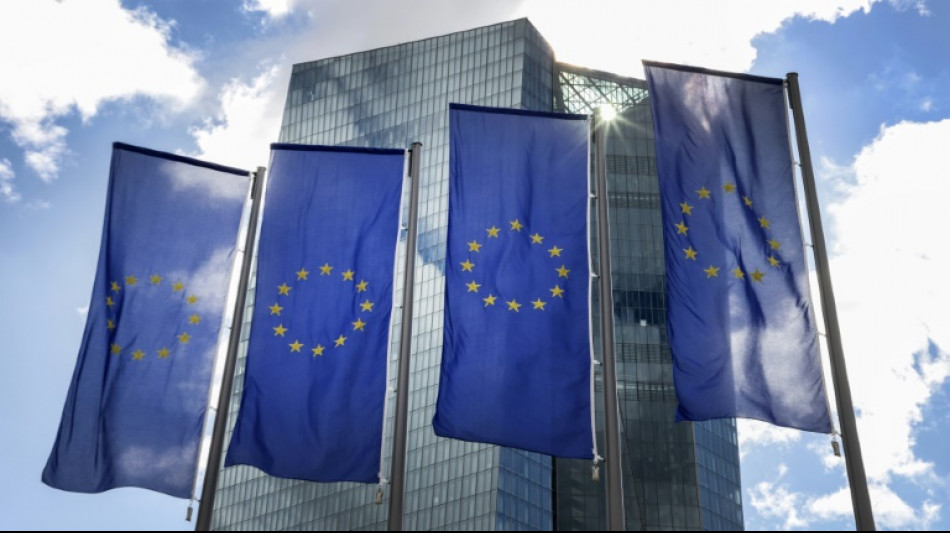
ECB makes back-to-back interest rate cuts as inflation falls / Photo: Daniel ROLAND - AFP

 Petrol and diesel prices remain broadly steady across major Indian cities

 Derek Tierney Outlines Ten-Year Strategy for National Digital Health System

 BLS Polymers shares open 65.3% above IPO price

 ITC shares rise as analysts anticipate gradual cigarette-business recovery

 The Digital Burden: Why Instant Messaging Feels Like a Full-Time Job

 Korea’s Labor Share of GDP Hits Record Low Amid Semiconductor Boom

 littlefish and Halo Dot Partner to Replace Payment Terminals with SoftPOS

 Egypt Accelerates Construction of 341km Sinai Railway Linking Arish and Taba

 Web Summit Qatar 2026 generated QR1 billion economic impact, report says

 OMP Extends UnisonIQ with Agent Library and Agent Studio: AI Agents that Produce Executable Supply Chain Plans
The European Central Bank cut interest rates again Thursday, upping the tempo at which it is lowering borrowing costs as inflation in the eurozone cools faster than expected.
The Frankfurt-based institution reduced rates by a quarter point, following a cut of the same size at its last meeting in September.
Thursday's move was the first time that the ECB has cut rates back to back since it started its cycle of easing rates in response to declining inflation.
After peaking at four percent, the ECB's benchmark deposit rate sits at 3.25 percent following the latest cut.
The decision came after a late downwards revision to September's inflation data in the eurozone on Thursday.
Consumer prices in the bloc rose by 1.7 percent year on year in September, according to the EU's data agency Eurostat, 0.1 percentage points less than the inital estimate.
Before the change, September's reading was already the first time in three years that inflation in the eurozone had dipped below the ECB's two-percent target.
The incoming data showed that the process of cooling consumer prices was "on track", the ECB said in a statement.
"Inflation is expected to rise in the coming months, before declining to target in the course of next year," the ECB said.
- Slovenia meeting -
ECB rate-setters met in Slovenia to discuss their next move, as they made one of their regular tours away from the institution's headquarters in Frankfurt.
Thursday's decision was the third time that they have cut since rates reached their peak.
The bank cranked rates up higher and faster than ever before in response to soaring inflation in the wake of the coronavirus pandemic and the Russian invasion of Ukraine.
But recent, lower-than-expected inflation figures have added to the sense among policymakers that consumer prices are back under control.
Weakness in the eurozone economy gave the ECB a further reason to lower borrowing costs and bring some relief to households and businesses.
"Recent downside surprises in indicators of economic activity" supported confidence that inflation was heading durably towards two percent, the ECB said.
The move to follow up September's cut with another reduction suggested the ECB was "much more concerned about the eurozone's growth outlook" than before, ING analyst Carsten Brzeski said.
With that came the risk of "inflation undershooting the target", Brzeski said.
"It's hard to see how today's rate cut cannot be seen as a signal that the ECB is now in a hurry to bring interest rates down," he said.
- 'Data-dependant' -
The ECB itself said it would "continue to follow a data-dependent and meeting-by-meeting approach". The bank was not "pre-committing to a particular rate path", it added.
Lagarde was due to speak following the decisions, with analysts eager to parse through her comments in Slovenia for an indication of the thinking among ECB policymakers about the future path of rates.
Lagarde was unlikely to "correct market expectations for another 25 basis point move" at the ECB's next meeting in December, Berenberg bank analyst Holger Schmieding said.
Going into next year, observers expected the ECB to keep lowering interest rates at a steady pace with a string of cuts.
The ECB might even provide a hint that it would pursue further reductions "until they reach a neutral rate of two percent to 2.5 percent by the middle of next year", said Eric Dor, director of economic studies at IESEG business school in France.
Y.Ibrahim--CPN