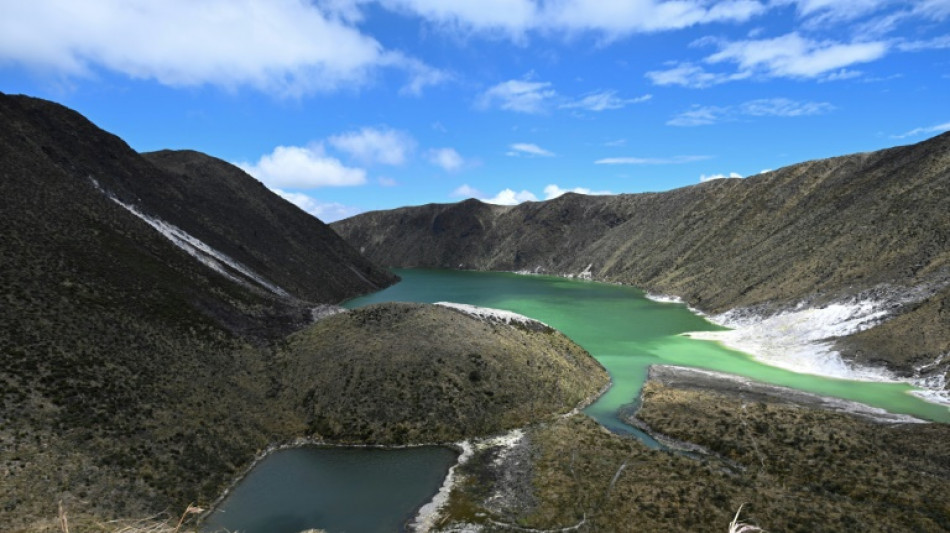
How Indigenous guards saved a Colombian lake from overtourism / Photo: JOAQUIN SARMIENTO - AFP

 Petrol and diesel prices remain broadly steady across major Indian cities

 Derek Tierney Outlines Ten-Year Strategy for National Digital Health System

 BLS Polymers shares open 65.3% above IPO price

 ITC shares rise as analysts anticipate gradual cigarette-business recovery

 The Digital Burden: Why Instant Messaging Feels Like a Full-Time Job

 Korea’s Labor Share of GDP Hits Record Low Amid Semiconductor Boom

 littlefish and Halo Dot Partner to Replace Payment Terminals with SoftPOS

 Egypt Accelerates Construction of 341km Sinai Railway Linking Arish and Taba

 Web Summit Qatar 2026 generated QR1 billion economic impact, report says

 OMP Extends UnisonIQ with Agent Library and Agent Studio: AI Agents that Produce Executable Supply Chain Plans
In the crater of a semi-dormant volcano in southwest Colombia lies a sacred lake of startling green which used to draw a steady stream of garbage-tossing tourists before Indigenous leaders took back control.
Ascending the Azufral volcano which rises to 4,070 meters (2.5 miles) in the western Colombian Andes is not for the faint-hearted.
It's also not for the uninvited. Only those who receive the nod from the governor of the local Indigenous Pastos community may pass.
"The spirits of the lake don't like to be disturbed. We have to ask their permission," Jorge Arevalo, a 41-year-old member of the lake's Indigenous guard, said.
A handful of guards accompanied AFP last month on a rare visit to the lake -- a shimmering body of water three kilometers wide in ever-changing hues of emerald, olive and turquoise, surrounded by sandy beaches.
Before the two-hour ascension, the guards performed a ritual led by a taita (shaman) in praise of the cycle of life.
Each member of the party then asked the spirits for permission to climb the volcano to contemplate the beauty of the lake and apologized for disturbing the flora, fauna and the tranquility of a site that is sacred to the Pastos.
A prayer each to Pacha Mama -- the Mother Earth goddess revered by Andean peoples -- and the Virgin Mary, a sprinkle of perfume for "spiritual cleansing" and the climb began.
- Not-so-hidden treasure -
For a long time the Laguna Verde (Green Lake) was one of Colombia's best-kept secrets, with the country's El Tiempo daily in 2011 describing it as a hidden treasure.
But once the secret was exposed, the lake was overrun with tourists.
"There were up to 1,500 people per day, it was really invasive," Diego Fernando Bolanos, head of tourism for Narino, told AFP.
Some tourists began roaring up the volcano by motorbike, fecal matter was found in the drinking water and some of the reserve's tall espeletia plants, emblematic of the local paramo ecosystem, were trampled.
In September 2017, the Pastos, who own the land, took the ultimate step to close off the lake and surrounding 7,503-hectare reserve in order to save it -- a decision approved by local authorities in 2018.
The cleanup took weeks.
"There was rubbish everywhere," Arevalo said with disgust.
- Sustainable tourism -
Seven years later, the reserve is pristine again, with no sign of human presence beyond the climbing path.
The guard carries out regular patrols to ward off intruders.
Those who fail to observe the ban generally get off with a warning.
"I didn't know it was forbidden," Inga, a Dutch hiker in her forties who climbed the volcano and camped at the entrance to the reserve, told AFP.
"It's beautiful up there. They're right to close it," she said.
The Pastos' management of the site is set to be spotlighted at the upcoming UN COP16 biodiversity conference in the Colombian city of Cali starting on Sunday.
The European Union has invited the Indigenous guard to the summit for a discussion about sustainable tourism management.
"The Pastos are protecting a sacred site that is essential for their culture but also a high mountain ecosystem that is fundamental for the conservation of water and the cycle of the seasons in the Amazon region," the EU ambassador to Colombia, Gilles Bertrand, told AFP.
He added that the work helps preserve "the climate equilibrium of Europe and the whole world."
Among the Pastos, and in the wider Narino department, one of Colombia's poorest, some however are keen to see the lake reopen, as a potential money spinner.
Bolanos, the area's tourism chief, called for a more sustainable model.
"The idea is to conduct a study on carrying capacity, so that only ten or twenty people can visit in a day," he said.
Arevalo said he was "not opposed" to the idea.
"We're opposed to uncontrolled tourism," he said.
L.K.Baumgartner--CPN