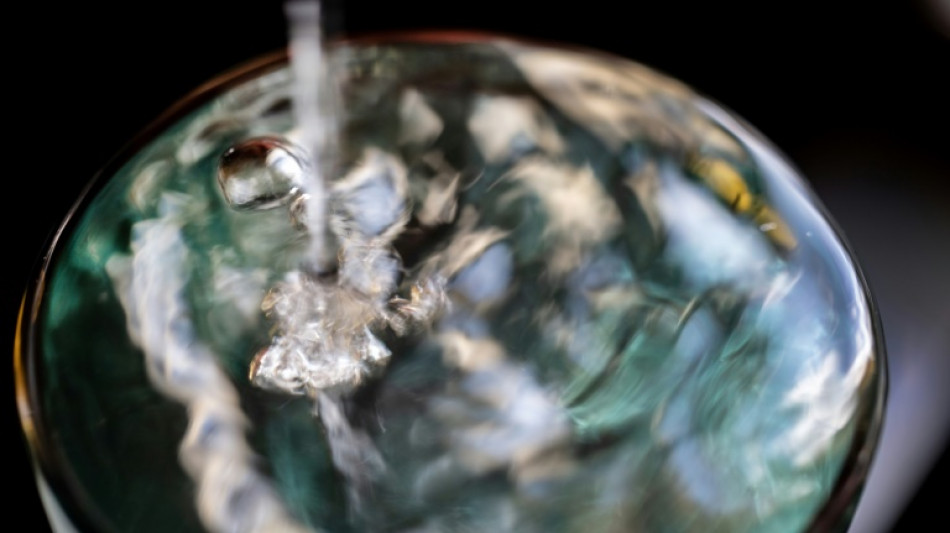
Water crisis threatening world food production: report / Photo: Fred TANNEAU - AFP

 Petrol and diesel prices remain broadly steady across major Indian cities

 Derek Tierney Outlines Ten-Year Strategy for National Digital Health System

 BLS Polymers shares open 65.3% above IPO price

 ITC shares rise as analysts anticipate gradual cigarette-business recovery

 The Digital Burden: Why Instant Messaging Feels Like a Full-Time Job

 Korea’s Labor Share of GDP Hits Record Low Amid Semiconductor Boom

 littlefish and Halo Dot Partner to Replace Payment Terminals with SoftPOS

 Egypt Accelerates Construction of 341km Sinai Railway Linking Arish and Taba

 Web Summit Qatar 2026 generated QR1 billion economic impact, report says
 OMP Extends UnisonIQ with Agent Library and Agent Studio: AI Agents that Produce Executable Supply Chain Plans
Inaction on the water crisis could put more than half of the world's food production at risk by 2050, experts warned in a major report published Thursday.
"Nearly 3 billion people and more than half of the world's food production are now in areas where total water storage is projected to decline," said the report by the Global Commission on the Economics of Water (GCEW).
The report also warned the water crisis could lead to an eight percent drop in GDP on average for high-income countries by 2050 and as much as 15 percent for lower-income countries.
Disruptions of the water cycle "have major global economic impacts," said the report.
The economic declines would be a consequence of "the combined effects of changing precipitation patterns and rising temperatures due to climate change, together with declining total water storage and lack of access to clean water and sanitation".
Facing this crisis, the report called for the water cycle to be viewed as a "global common good" and for a transformation of water governance at all levels.
"The costs entailed in these actions are very small in comparison to the harm that continued inaction will inflict on economies and humanity," it said.
While water is often perceived as "an abundant gift of nature", the report stressed it was scarce and costly to transport.
It called for the elimination of "harmful subsidies in water-intensive sectors or redirecting them towards water-saving solutions and providing targeted support for the poor and vulnerable".
"We have to couple the pricing of water with appropriate subsidies," said the World Trade Organization's Director-General Ngozi Okonjo-Iweala, a co-chair of the GCEW, during an online briefing.
Another co-chair, Singaporean President Tharman Shanmugaratnam, insisted on the need to see water as a global problem, to "innovate and invest" to solve the crisis and "stabilise the global hydrological cycle".
Y.Tengku--CPN