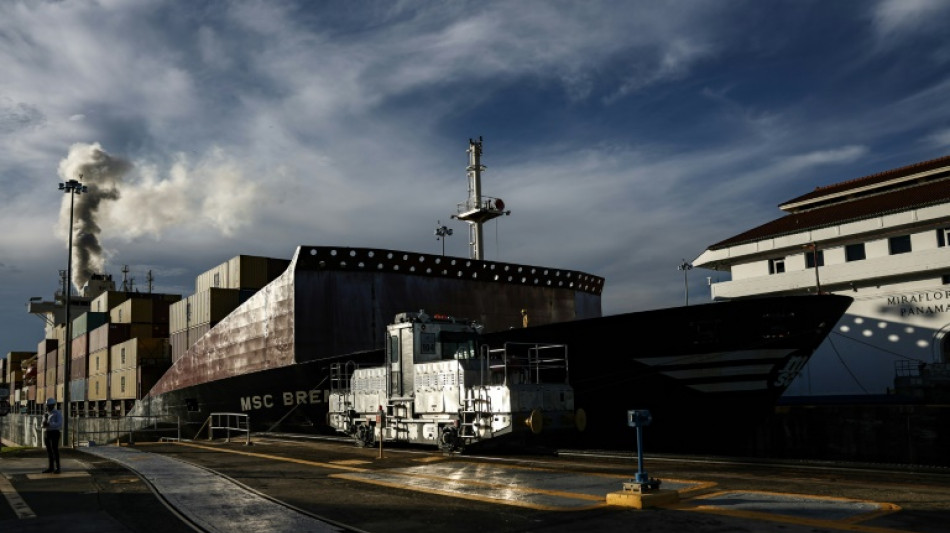
Panama Canal crossings down 29 percent due to drought / Photo: MARTIN BERNETTI - AFP

 Petrol and diesel prices remain broadly steady across major Indian cities

 Derek Tierney Outlines Ten-Year Strategy for National Digital Health System

 BLS Polymers shares open 65.3% above IPO price

 ITC shares rise as analysts anticipate gradual cigarette-business recovery

 The Digital Burden: Why Instant Messaging Feels Like a Full-Time Job

 Korea’s Labor Share of GDP Hits Record Low Amid Semiconductor Boom

 littlefish and Halo Dot Partner to Replace Payment Terminals with SoftPOS

 Egypt Accelerates Construction of 341km Sinai Railway Linking Arish and Taba

 Web Summit Qatar 2026 generated QR1 billion economic impact, report says

 OMP Extends UnisonIQ with Agent Library and Agent Studio: AI Agents that Produce Executable Supply Chain Plans
Traffic in the Panama Canal fell by 29 percent over the past year due to a severe drought linked to climate change, the canal's operator said late Tuesday.
The volume of cargo shipped through the canal, which links the Atlantic and Pacific oceans, was down by 17 percent in a year to 423 million tons, the canal authority of the central American country added.
It did not release revenue figures for the year.
Unlike the Suez Canal, the Panama Canal is a freshwater canal fed by two reservoirs.
Last year, the region was hit by the worst drought in decades, partly fuelled by the ocean-warming El Nino phenomenon, causing the levels of the reservoirs to fall.
Faced with the water shortage, the canal authority cut the number of ships that could cross each day from 38 to 22.
The situation has eased since the start of the rainy season in May.
An estimated five percent of global maritime traffic passes through the Panama Canal, which was built by the United States between 1904 and 1914 to allow ships travelling beween Asia and the east coast of the United States avoid the long, hazardous route around the southern tip of South America.
The canal authority expects business to recover in 2025.
It has forecast record revenues of 5.62 billion dollars for the coming year, based on 13,900 ships carrying 520 million tons of goods.
T.Morelli--CPN