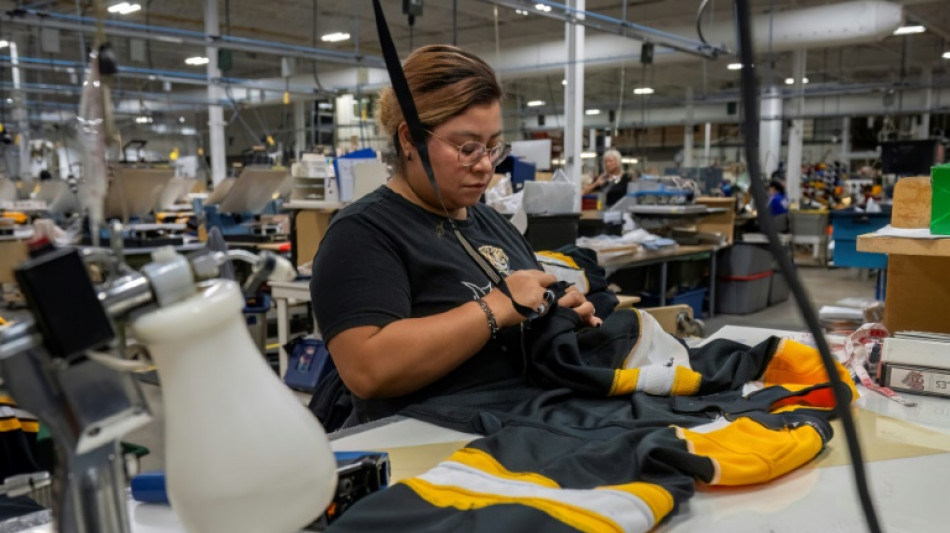
Small Quebec company dominates one part of NHL hockey: jerseys / Photo: Sebastien ST-JEAN - AFP

 Petrol and diesel prices remain broadly steady across major Indian cities

 Derek Tierney Outlines Ten-Year Strategy for National Digital Health System

 BLS Polymers shares open 65.3% above IPO price

 ITC shares rise as analysts anticipate gradual cigarette-business recovery

 The Digital Burden: Why Instant Messaging Feels Like a Full-Time Job

 Korea’s Labor Share of GDP Hits Record Low Amid Semiconductor Boom

 littlefish and Halo Dot Partner to Replace Payment Terminals with SoftPOS

 Egypt Accelerates Construction of 341km Sinai Railway Linking Arish and Taba

 Web Summit Qatar 2026 generated QR1 billion economic impact, report says

 OMP Extends UnisonIQ with Agent Library and Agent Studio: AI Agents that Produce Executable Supply Chain Plans
As a sport that involves men colliding at high speeds, bare-knuckle brawls, and a fair number of players with missing front teeth, ice hockey is not commonly linked to high fashion.
But SP Apparel, a Canadian company based east of Montreal that makes the jerseys worn by all 32 National Hockey League (NHL) teams, says superior material and meticulous craftmanship have kept it at the top of the game.
"It's like haute couture," Steve Berard, president of the company with 260 employees in the city of Saint-Hyacinthe in Quebec province, told AFP.
SP Apparel has been making jerseys for the NHL for 50 years, through nearly half the league's 107-year history.
For the last 25 years, it has also made the uniforms for all national ice hockey teams competing at the Olympics.
Being based in a hockey-mad nation, which has consistently produced many of the sport's top stars, has helped SP Apparel retain its primacy in hockey apparel, Berard said.
But the quality of the product is paramount, he stressed.
"These are not jerseys made on a production line," Berard said. "There are 90 pieces to assemble, with different colors and materials."
- Brutal wear and tear -
The company says its products are made to withstand particularly brutal wear and tear.
So, while there are a few industrial machines like laser fabric cutters at its 9,000-square meter (97,000-square foot) factory, seamstresses with simple sewing machines do the assembly work.
An NHL jersey is worn only five to 20 times on average. That depends partly on the individual player's amount of ice time, and partly on his style of play in a sport where fights can involve grabbing or even tearing an opponent's jersey.
The company estimates that it makes 300,000 to 500,000 units per year, including hockey jerseys and socks, as well as the uniforms it makes for major junior Canadian Hockey League and baseball teams (but not those in the major leagues).
During past Winter Olympics, SP Apparel sent tailors on site to make any repairs or adjustments required during the Games.
Tania Berlinguette, SP Apparel's executive director, told AFP the company also accommodates "special requests for certain players," notably Pittsburgh Penguins star Sidney Crosby.
"We make his socks slightly larger because his calves are a little bigger than average," Berlinguette said.
- 'Through our hands' -
Staff said the most popular jersey on the factory floor belongs to the Vegas Golden Knights, with fine detailing that nods to a knight's mesh armor, and the words "Always Advance. Never Retreat" on the inner collar.
Lyne Gagne, who has worked at SP Apparel for 35 years and now oversees a department responsible for a jersey's final detailing, said the work has changed considerably over the years.
Jerseys are now "much more adapted to the players' movements," she said.
"They used to be straight cut, with big sleeves, with five to 10 pieces. Now they hug the body and the material is different," she said.
The predominance of SP Apparel's jerseys at hockey's highest levels is a "source of pride" for employees, she told AFP.
"When you watch a hockey game, you know that the jersey has passed through our hands."
A.Mykhailo--CPN



