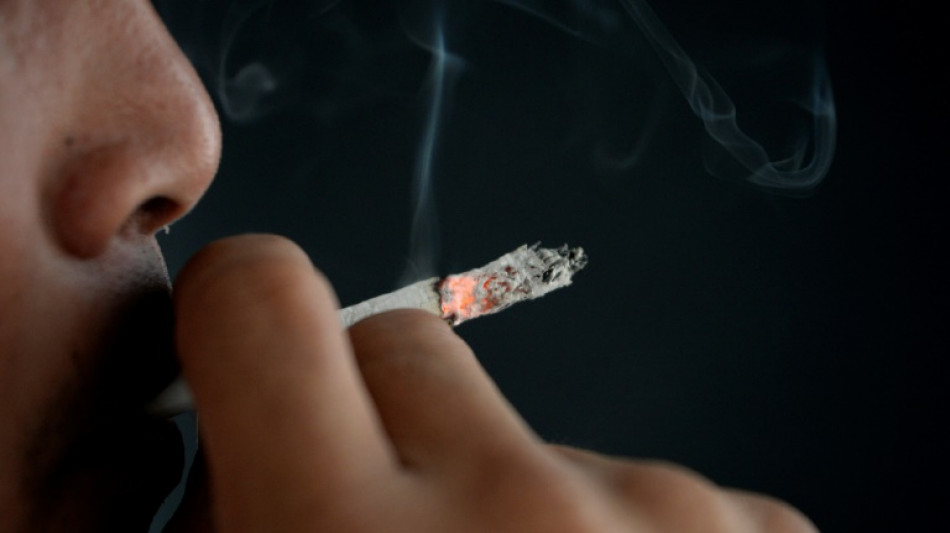
Phasing out teen smoking could save 1.2 mn lives: study / Photo: NOEL CELIS - AFP/File

 Bezos grant helps Seattle nonprofit move thousands of families toward housing

 US stocks fall before midterm Election Day as technology shares weaken

 BLS Polymers makes strong market debut at ₹248 per share

 Petrol and diesel prices remain broadly steady across major Indian cities

 Derek Tierney Outlines Ten-Year Strategy for National Digital Health System

 BLS Polymers shares open 65.3% above IPO price

 ITC shares rise as analysts anticipate gradual cigarette-business recovery

 The Digital Burden: Why Instant Messaging Feels Like a Full-Time Job

 Korea’s Labor Share of GDP Hits Record Low Amid Semiconductor Boom

 littlefish and Halo Dot Partner to Replace Payment Terminals with SoftPOS

 Egypt Accelerates Construction of 341km Sinai Railway Linking Arish and Taba

 Web Summit Qatar 2026 generated QR1 billion economic impact, report says

 OMP Extends UnisonIQ with Agent Library and Agent Studio: AI Agents that Produce Executable Supply Chain Plans
Banning the sale of tobacco to people born between 2006 and 2010 could prevent around 1.2 million deaths from lung cancer by the end of the century, said a modelling study released Thursday.
Smoking is responsible for roughly 85 percent of all cases of lung cancer, the deadliest cancer worldwide, according to the World Health Organization.
If current trends continue, there will be nearly three million lung cancer deaths among people born from 2006 to 2010, said the new study from the WHO's International Agency for Research on Cancer (IARC).
But if tobacco sales were banned for these 650 million people, around 1.2 million deaths could be prevented by 2095, estimated the modelling research published in The Lancet Public Health journal.
The study, one of the first studies aiming to assess the impact of a tobacco-free generation, drew on data about cancer cases and deaths from 185 countries.
More than 45 percent of lung cancer deaths among men around the world could be prevented, and nearly 31 percent among women, the research found.
"This difference is linked to the tobacco industry's gender-targeted marketing over the past few decades," IARC researcher and study co-author Isabelle Soerjomataram said in a statement.
- Schemes already underway -
But in some regions -- North America and parts of Europe, Australia and New Zealand -- ending tobacco sales could prevent more deaths among women than men, the modelling suggested.
The most lives -- 78 percent -- could be saved among women in western Europe, while the highest rate for men was nearly 75 percent in central and eastern Europe.
The study cautioned that the "deaths that we estimated could not be prevented could be due to other risk factors associated with lung cancer", such as air pollution or exposure to second-hand smoke.
Tobacco-free generation initiatives have already been implemented in some countries, such as New Zealand and parts of Australia and the United States.
In 2022, New Zealand became the first country to ban cigarette sales to people born after 2008. But late last year, the country's new conservative government announced it planned to scrap the measure.
In contrast, the UK's new Labour government has been supportive of former Conservative prime minister Rishi Sunak's plan to ban cigarette sales to anyone born after January 2009.
The authors of the IARC study nevertheless stressed that tobacco-free generation policies were not enough to tackle the health scourge of tobacco, particularly for current smokers.
They also called for proven measures such as increasing taxes on cigarettes, and more smoke-free environments as well as support for efforts to quit.
D.Philippon--CPN