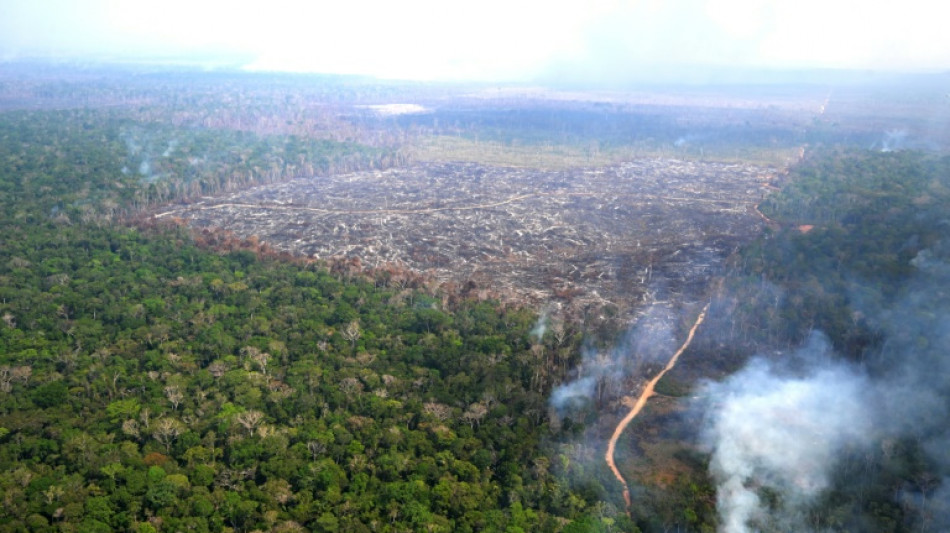
Facing backlash, EU moves to delay deforestation rules / Photo: EVARISTO SA - AFP/File

 Vessel operator seeks witnesses after Vancouver grounding

 Shrini Srivastava joins crew of Varanasi-Delhi Vande Bharat Sleeper service

 Nearly Half of Australian Workers Overqualified, Survey Finds

 RBI eases export-declaration compliance for individual service exporters

 Reliance shares remain in focus after near-12% surge

 Coal India prepares possible $1 billion Mahanadi Coalfields listing

 Capital-markets shares rally as Motilal Oswal and Angel One lead gains

 Reliance rally puts historical one-year return pattern in focus

 Saudi Aramco quarterly profit climbs 34.6% amid elevated oil prices

 Australia raises benchmark rate to highest level in 18 years

 Asian stocks retreat as AI worries outweigh steep oil-price drop

 Hamad International Airport stages emergency drills during WATAN 2026

 Qatar solar expansion opens scope for technical performance gains

The European Commission on Wednesday proposed to delay by a year a ban on imports of products driving deforestation that has faced pushback from countries around the world.
The move triggered an immediate outcry from environmental groups, which had hailed the unprecedented law as a major breakthrough in the fight to protect nature and the climate.
The legislation, which will bar a vast range of goods -- from coffee to cocoa, soy, timber, palm oil, cattle, printing paper and rubber -- if produced using land that was deforested after December 2020, was set to take effect at the end of this year.
Citing "feedback received from international partners about their state of preparations", the commission said it was proposing a delay to "give concerned parties additional time to prepare".
The "extra 12 months" would serve as a "phasing-in period to ensure proper and effective implementation" of the law adopted in mid-2023, it said.
- 'Nature vandalism' -
EU imports are responsible for 16 percent of global deforestation, according to WWF data.
Forests absorb carbon and are a vital ally in fighting climate change. They are also critical for the survival of endangered plants and animals, such as orangutans and lowland gorillas.
Environmental group Mighty Earth said it was "aghast" at the proposed delay, describing it as an "act of nature vandalism".
"Delaying... is like throwing a fire extinguisher out of the window of a burning building," said the group's senior policy director Julian Oram.
The EU's top executive body had been under mounting pressure to postpone the ban after numerous countries inside and outside the bloc spoke out against it.
Germany became the latest nation to do so in September, saying the conditions were not yet there for it to be efficiently applied.
Brazil, the United States and other countries in Asia, Africa and Latin America complained the rules increased production and export costs, especially for smallholders.
Others fretted that with only a few months to go, the EU was yet to issue compliance guidelines it had promised as well as a clear benchmarking system to divide countries into different risk categories.
- 'Low risk' -
The commission addressed the latter concern on Wednesday, publishing documents it said will provide additional clarity to companies and enforcing authorities -- as well as the methodology it will use for the benchmarking system.
A large majority of countries worldwide will be classified as "low risk", it said.
The postponement, which needs to be approved by the European Parliament and member states, will see the rules enter into force for large companies on December 30, 2025.
"Micro- and small enterprises" will have until June 30, 2026 to comply, the commission said.
"The extension proposal in no way puts into question the objectives or the substance of the law," it added.
But Luciana Tellez Chavez, a senior researcher on the environment at Human Rights Watch, accused EU chief Ursula von der Leyen of sabotaging "the most significant environmental legislation passed during her previous term."
The delay punished "all the companies and EU trading partners who deployed efforts and resources to comply" on time, and contradicted European commitments to end forest loss, she said.
The EU is the second-biggest market for the targeted products after China.
Under the law, firms importing the merchandise in question to the 27-nation EU will be responsible for tracking their supply chains to prove goods did not originate from deforested zones, relying on geolocation and satellite data.
Exporting countries considered high-risk would have at least nine percent of products sent to the EU subjected to checks, with the proportion falling for lower-risk ones.
burs-ub/ec/cw
A.Leibowitz--CPN