
US Senate confirms Powell for second term as central bank chief / Photo: Jim WATSON - AFP/File

 Nintendo producer 'all nervous' as Zelda classic remake hits shelves

 Three killed by storm in southern India

 Two hundred 'Cruise for life' passengers stranded in Cambodia

 Billionaire Ambani's Jio jumps 21% in market debut after record India IPO

 Sri Lanka's Tamil farmers fight to reclaim land after civil war

 'They don't care about us': Trump food aid cuts leave Americans struggling and angry

 Palestinian activist Khalil returns to Columbia after US detention

 Youths testify about 'despair' in unprecedented Canadian climate trial

 Storied Paris department store seeks bankruptcy protection
 Boeing shares tumble after it releases cautious growth forecast
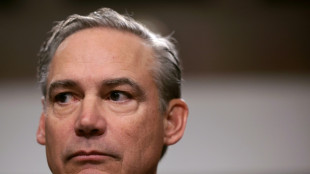
The US Senate on Thursday confirmed Jerome Powell to a second term as head of the Federal Reserve, as the central bank fights to crush soaring inflation.
The 80-19 vote came amid inflation that has hit a 40-year high, fueled by the conflict in Ukraine and ensuing sanctions imposed on Russia, as well as Covid-19 restrictions in China that have raised concerns the global supply snarls may worsen.
Powell, a Republican who enjoyed broad bipartisan support, had continued at the helm of the central bank although his first four-year term officially expired February 4.
His confirmation was delayed by a drawn-out process to approve Lisa Cook to join the Fed board -- the first Black woman to serve in the post -- who was finally confirmed on Tuesday with only Democratic votes.
The vote on Powell came the day after the upper house of Congress approved the nomination of Philip Jefferson of Davidson College, marking the first time the Fed board has had more than one Black governor.
US President Joe Biden, whose popularity has taken a hit from the soaring inflation and record gasoline prices, has repeatedly said that tackling the issue is primarily a job for the Fed.
"I am pleased to see the Senate take a step forward on my agenda to get inflation under control by confirming my nominees to the Fed," he said in a statement after the vote.
- Bringing down inflation -
Powell, who first joined the Fed board in 2012, led the central bank as it slashed the benchmark interest rate to zero at the start of the pandemic in March 2020 and pumped money into the financial system to prevent a severe downturn in the world's largest economy.
Now he is overseeing efforts to cool price pressures impacting American families.
The Fed last week announced its largest rate hike since 2000 and signaled similar increases were likely in the coming months.
The challenge for Powell and the Fed is to turn down the heat on inflation without tipping the United States into recession, but he has expressed confidence that the economy is strong enough to withstand the tighter monetary policy.
With the latest additions, the Fed board will be just one short of its full complement of seven governors.
The Senate last month confirmed longtime Fed governor Lael Brainard as vice chair of the board.
In his statement, Biden urged the Senate to confirm his final nominee, Michael Barr, as vice chair for supervision.
The US president's initial nominee for the role of top Fed banking cop, Sarah Bloom Raskin, withdrew her name from consideration in March when it became clear she would not have sufficient support.
She had previously won bipartisan approval for senior roles at the Fed and Treasury, but faced opposition from Republicans and from a key Democratic lawmaker over her stance on climate change issues in banking supervision.
The Republican opposition in the Senate boycotted a committee vote on her nomination and the four other top Fed positions, which she cited as the main factor in her decision to drop out.
Cook and Jefferson each have researched inequality in the labor market.
Powell has repeatedly stressed the importance of ensuring economic opportunities extend to disadvantaged groups -- a notable change of focus in an economy where Black workers face far higher unemployment rates than other racial groups.
Cook, a professor of economics and international relations at Michigan State University, has focused her research on how discrimination has harmed the American economy and the damage downturns do to the poor.
Jefferson, also an economics professor, is only the fourth Black man to serve as a Fed governor.
H.Meyer--CPN

