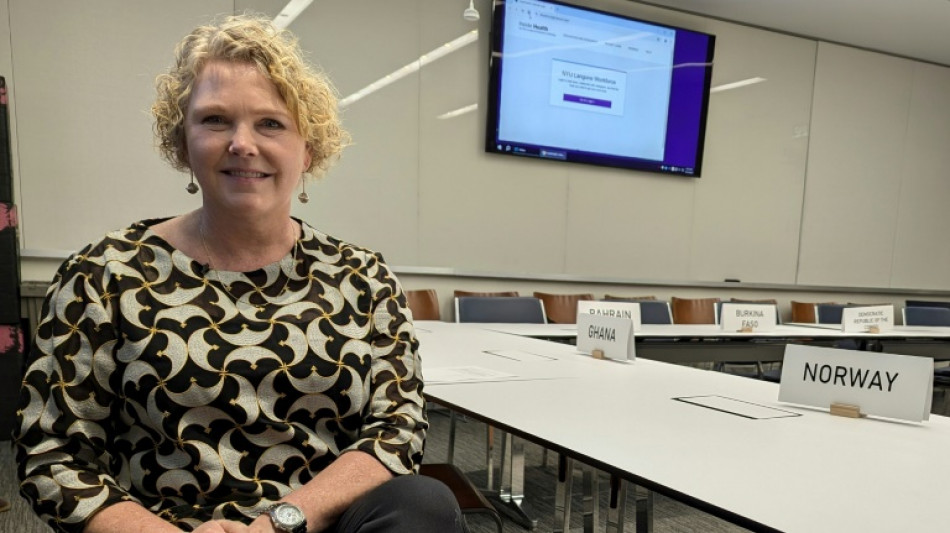
Key negotiator Norway sees 'positive signals' ahead of plastic talks / Photo: Issam AHMED - AFP

 Vessel operator seeks witnesses after Vancouver grounding

 Shrini Srivastava joins crew of Varanasi-Delhi Vande Bharat Sleeper service

 Nearly Half of Australian Workers Overqualified, Survey Finds

 RBI eases export-declaration compliance for individual service exporters

 Reliance shares remain in focus after near-12% surge

 Coal India prepares possible $1 billion Mahanadi Coalfields listing

 Capital-markets shares rally as Motilal Oswal and Angel One lead gains

 Reliance rally puts historical one-year return pattern in focus

 Saudi Aramco quarterly profit climbs 34.6% amid elevated oil prices

 Australia raises benchmark rate to highest level in 18 years

 Asian stocks retreat as AI worries outweigh steep oil-price drop

 Hamad International Airport stages emergency drills during WATAN 2026

 Qatar solar expansion opens scope for technical performance gains

In the single week that world leaders convened for high-level UN talks in New York, nearly 100,000 water bottles' worth of microplastics swirled through the city's air, posing known and still unknown risks to human health.
"We talk a lot about plastic in the marine environment, but it's all around," Anne Beathe Tvinnereim, the Norwegian international development minister who is helping lead the charge to seal a global plastics treaty in South Korea later this year, told AFP Wednesday.
The treaty aims to marshal an international response to the plastic trash that is choking the environment, from oceans and rivers to mountains and sea ice, moving up food webs as it is ingested by animals.
Some nations want the agreement to restrict how much plastic can be made while others -- particularly oil- and gas-producing countries that provide the raw materials to make plastic -- want a focus on recycling.
Despite several rounds of talks, progress has lagged, and time is running out to reach a consensus before the final make-or-break session in Busan starting November 25.
But "I'm more optimistic now than I was a few weeks ago, because we feel that there are some positive signals from various countries," Tvinnereim said in an interview on the margins of the UN General Assembly, where she is working to build support for an ambitious agreement.
- 'New signals' from US -
She pointed to "new signals" from the United States, one of the world's largest plastic producers, indicating a willingness to cap new plastic production.
Beyond that, she pointed to a tough new statement published Wednesday by the so-called High Ambition Coalition to End Plastic Pollution (HAC), a group of more than 60 countries and the European Union that make up the majority of plastic consumption globally.
Co-chaired by Norway and Rwanda, the coalition affirmed its commitment to legally binding measures such as reducing plastic production and consumption, and phasing out certain toxic polymers -- a stance welcomed by conservation group WWF.
"We cannot accept that vested interests from a few parties stop the whole agreement," Tvinnereim stressed, speaking ahead of a ministerial meeting where all countries were invited.
Notably, China and India were absent, while the United States was among the 40 that participated.
"We don't want to put a ban on plastics," she added, acknowledging its many essential uses. "But we want to stop the plastic that is getting lost in nature."
Several ideas are under consideration for how to finance the end of plastic pollution.
Norway pioneered an innovative deposit return scheme for all single-use beverage containers that imposes a base tax along with a variable environmental tax that decreases as return rates improve -- and is eliminated entirely when the return rate is 95 percent or higher.
It is an approach that holds producers accountable for the entire life cycle of their products, and a lesson Norway could offer others, said Tvinnereim, even as she acknowledged direct financial assistance from wealthy countries would have to play a major part for developing countries.
Recognizing the gaps that still need to be bridged, Tvinnereim admitted the agreement might not be the "final perfect deal," but emphasized that the door must remain open for further progress.
"Our plan is to land a text in Busan, but this text must include some mechanisms on how to improve the deal as we go," she stressed, adding that any agreement would still be a "landmark."
A.Agostinelli--CPN