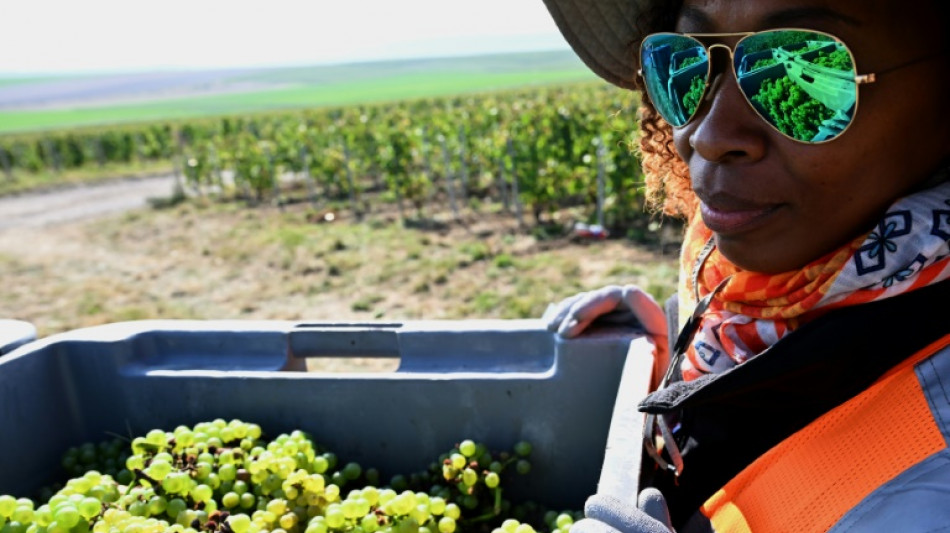
French champagne makers bid to protect seasonal workers from abuse / Photo: FRANCOIS NASCIMBENI - AFP

 Vessel operator seeks witnesses after Vancouver grounding

 Shrini Srivastava joins crew of Varanasi-Delhi Vande Bharat Sleeper service

 Nearly Half of Australian Workers Overqualified, Survey Finds

 RBI eases export-declaration compliance for individual service exporters

 Reliance shares remain in focus after near-12% surge

 Coal India prepares possible $1 billion Mahanadi Coalfields listing

 Capital-markets shares rally as Motilal Oswal and Angel One lead gains

 Reliance rally puts historical one-year return pattern in focus

 Saudi Aramco quarterly profit climbs 34.6% amid elevated oil prices

 Australia raises benchmark rate to highest level in 18 years

 Asian stocks retreat as AI worries outweigh steep oil-price drop

 Hamad International Airport stages emergency drills during WATAN 2026

 Qatar solar expansion opens scope for technical performance gains

French champagne producers are looking to restore their damaged reputations after four workers died last year amid hot weather, as authorities closed squalid housing and launched probes into suspected human trafficking.
This harvest, the vineyards are taking steps to better protect workers from abuse, in a bid to uphold the reputation of the renowned sparkling wines.
"We have called for the entire sector to mobilise," said Maxime Toubart, who heads the Champagne growers' association.
Since the grape harvest kicked off in early September, members of the CGT trade union have been handing out flyers to grape-pickers, many of whom are Eastern Europeans.
The leaflets come in eight languages including Polish, Russian, Ukrainian, Italian and French, and inform labourers of their rights, including the minimum hourly wage, the limit on working hours and mandatory breaks.
"Hello, we have come to inform you of your rights," CGT trade unionists told a gaggle of workers picking Pinot Noir grapes in the small village of Igny-Comblizy on a recent morning.
As they spoke, representatives of the Veuve Clicquot Champagne house kept a close eye on their subcontractor providing temporary labour.
This year, 22 labour inspectors and 84 police have been deployed to oversee the harvest on a daily basis, according to the Marne prefecture in northeastern France.
- 'Camps in the woods' -
Every year around 120,000 seasonal workers are brought in to handpick grapes that are grown across 34,000 hectares (84,000 acres) in eastern France and used to make its iconic bubbly.
The reputation of the famed winemakers took a hit last year when reports emerged of migrant workers living in appalling conditions and other labour violations.
Three temporary housing facilities were shut down for being "dirty" and "unfit for habitation".
Authorities also launched an investigation into the deaths of four grape harvesters in the Champagne region, believed to have suffered sunstroke in scorching heat.
The industry group Union of Champagne Houses has sought to distance itself from the violations, with its co-head David Chatillon blaming contractors hiring seasonal workers.
"Rogue actors have threatened the image of Champagne," said Chatillon, fuming.
Last October, the industry group launched an action plan vowing to improve existing practices.
Prosecutors in November 2023 opened two probes into suspected human trafficking after around 200 Ukrainian and other foreign workers were found living in poor conditions during routine checks.
One contractor will be taken to court in March 2025 as a result of the first probe. The second investigation is still underway.
Jose Blanco, general secretary of the CGT-Champagne trade union, said that despite improvements, a lack of proper housing was "the big problem of Champagne".
"We are still finding camps in the woods," he said.
Blanco said the new generation of winegrowers has "failed in their mission", adding that many lamented strict housing standards for migrant workers.
Champagne houses "ought to keep an eye on their subcontractors, but many bury their heads in the sand", added Blanco.
- 'Wake-up call' -
Maxime Mainguet, vice-president of the freshly created federation of subcontractors in Champagne, said problems had piled on for some time before they came to a head last year.
"I think it was a real wake-up call," Mainguet said, adding that growers were now more careful when signing contracts. "The subject has been taken very seriously."
A winery that does not pinch pennies, Moet & Chandon Champagne houses 1,900 of its 3,500 seasonal workers.
In the town of Pierry, around 100 employees stay in a modern residence in the middle of the vineyards -- a small two-storey building complete with dormitories, bathrooms, a laundry room and a canteen.
Workers are offered physical therapy sessions and stretching classes.
"We need to make people want to come and keep coming to harvest," said Frederic Gallois, vineyard and supply director at Moet & Chandon.
On average, workers there earn between 1,200 and 2,000 euros ($1,340-$2,230) for a 10-day stint.
While the CGT trade union has criticised the massive use of migrant workers, which it says drives down wages, Toubart insisted that both French nationals and foreigners receive equal pay and pointed to recruitment difficulties.
"The Champagne name has no interest whatsoever in poor welcome and poor pay," Toubart said.
"It's also a question of image, and we don't want to play games with that."
M.Mendoza--CPN