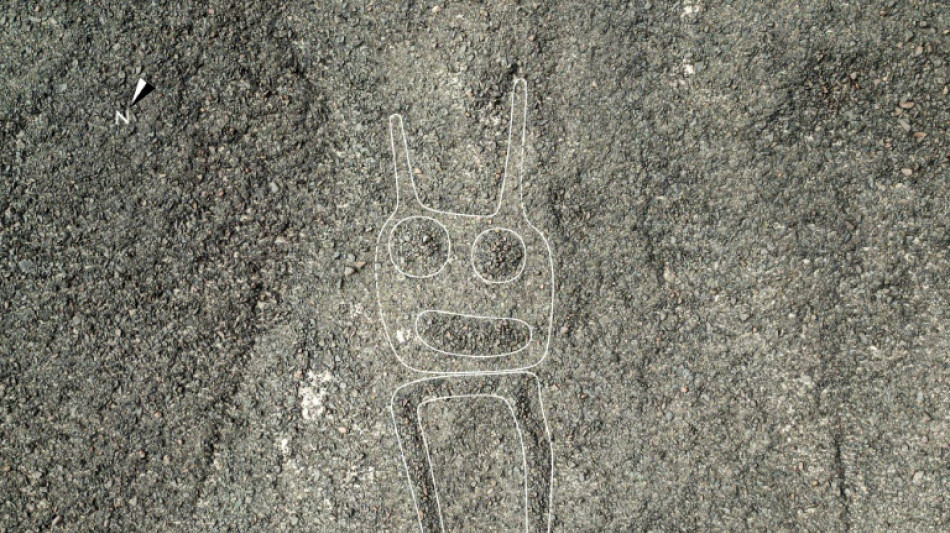
AI research uncovers 300 ancient etchings in Peru's Nazca desert / Photo: Handout - Yamagata University Institute of Nasca/AFP

 Vessel operator seeks witnesses after Vancouver grounding

 Shrini Srivastava joins crew of Varanasi-Delhi Vande Bharat Sleeper service

 Nearly Half of Australian Workers Overqualified, Survey Finds

 RBI eases export-declaration compliance for individual service exporters

 Reliance shares remain in focus after near-12% surge

 Coal India prepares possible $1 billion Mahanadi Coalfields listing

 Capital-markets shares rally as Motilal Oswal and Angel One lead gains

 Reliance rally puts historical one-year return pattern in focus

 Saudi Aramco quarterly profit climbs 34.6% amid elevated oil prices

 Australia raises benchmark rate to highest level in 18 years

 Asian stocks retreat as AI worries outweigh steep oil-price drop

 Hamad International Airport stages emergency drills during WATAN 2026

 Qatar solar expansion opens scope for technical performance gains

Japanese scientists have used artificial intelligence to uncover 303 new etchings in Peru's Nazca desert -- doubling the amount of known geoglyphs made some 2,000 years ago by a pre-Inca civilization.
The fabled Nazca lines, a series of massive incisions on the desert floor depicting animals, plants, imaginary beings and geometric figures, have fascinated scientists ever since they were first discovered around a century ago.
Best viewed from the air, the lines situated some 220 miles (350 kilometers) south of Lima are one of Peru's top tourist attractions.
Announcing the new discoveries in Lima on Monday, archaeologist Masato Sakai, from Yamagata University, said: "The use of AI in research has allowed us to map the distribution of geoglyphs in a faster and more precise way."
He said the findings were the fruit of collaboration between his university's Nazca Institute and the research division of the technology company IBM.
"The traditional method of study, which consisted of visually identifying the geoglyphs from high-resolution images of this vast area, was slow and carried the risk of overlooking some of them," he added.
The study was also published on Monday in the prestigious Proceedings of the National Academy of Sciences (PNAS) journal, describing how AI can be used to accelerate discoveries in archeology even in well-known sites.
The paper said it had taken nearly a century to discover 430 figurative Nazca geoglyphs.
Using AI, scientists found 303 more during only six months of field surveys.
The AI model was particularly good at picking up smaller relief-type geoglyphs which are harder to spot with the naked eye.
Among the new figures discovered were giant linear-type geoglyphs, mainly representing wild animals, but also smaller ones with motifs of abstract humanoids and domesticated camelids, a mammal from the camel family.
Scientists used AI to analyze a vast amount of geospatial data produced by aircraft to identify areas where they might find more geoglyphs.
The people that formed the Nazca civilization lived in the area of southwestern Peru from 200 BC to 700 AD.
What drove them to create the lines, designated a UNESCO World Heritage site, is a mystery.
Some scientists believe they have astrological and religious significance.
The first geoglyphs were discovered in 1927.
J.Bondarev--CPN