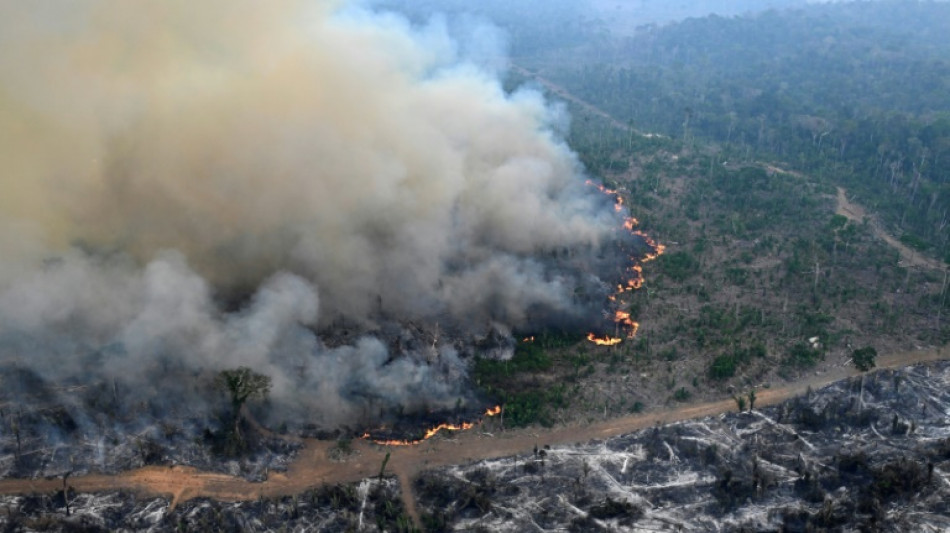
Amazon forest has lost an area the size of Germany and France / Photo: EVARISTO SA - AFP/File

 Vessel operator seeks witnesses after Vancouver grounding

 Shrini Srivastava joins crew of Varanasi-Delhi Vande Bharat Sleeper service

 Nearly Half of Australian Workers Overqualified, Survey Finds

 RBI eases export-declaration compliance for individual service exporters

 Reliance shares remain in focus after near-12% surge

 Coal India prepares possible $1 billion Mahanadi Coalfields listing

 Capital-markets shares rally as Motilal Oswal and Angel One lead gains

 Reliance rally puts historical one-year return pattern in focus

 Saudi Aramco quarterly profit climbs 34.6% amid elevated oil prices

 Australia raises benchmark rate to highest level in 18 years

 Asian stocks retreat as AI worries outweigh steep oil-price drop

 Hamad International Airport stages emergency drills during WATAN 2026

 Qatar solar expansion opens scope for technical performance gains

The world's biggest rainforest, the Amazon, has lost an area about the size of Germany and France combined to deforestation in four decades, a study showed Monday.
The South American jungle, spanning nine countries, is seen as crucial to the fight against climate change due to its ability to absorb planet-warming carbon dioxide from the atmosphere.
Deforestation, mainly for mining and agricultural purposes, has led to the loss of 12.5 percent of the Amazon's plant cover from 1985 to 2023, according to RAISG, a collective of researchers and NGOs.
This amounts to 88 million hectares (880,000 square kilometers, 339,773 square miles) of forest cover lost across Brazil, Bolivia, Peru, Ecuador, Colombia, Venezuela, Guyana, Suriname and French Guiana.
RAISG experts reported an "accelerated transformation" of the Amazon, with an "alarming increase" in the use of land previously occupied by forest for mining, crops, or livestock.
"A large number of ecosystems have disappeared to give way to immense expanses of pastures, soybean fields or other monocultures, or have been transformed into craters for gold mining," they said.
"With the loss of the forest, we emit more carbon into the atmosphere and this disrupts an entire ecosystem that regulates the climate and the hydrological cycle, clearly affecting temperatures," Sandra Rio Caceres, from the Institute of the Common Good -- a Peruvian association that took part in the study -- told AFP.
She said she believes the loss of vegetation in the Amazon is directly linked to severe drought and wildfires affecting several South American countries.
The World Weather Attribution network of scientists said Sunday that climate change was increasing the risk and severity of fires in the Amazon and Pantanal wetlands which are releasing "massive amounts" of carbon dioxide into the atmosphere.
"Never-ending heat has combined with low rainfall to turn these precious ecosystems into highly flammable tinderboxes," said Clair Barnes, a researcher from Imperial College London.
"As long as the world burns fossil fuels, the risk of devastating wildfires will continue to increase in the Amazon and Pantanal," she added.
The drought has placed some Amazon rivers at their lowest level in decades, threatening the lifestyle of some 47 million people who live on their banks.
The dry spell has sent fires -- often lit to clear land for farming -- burning out of control in Brazil, Ecuador, Colombia, and Peru.
St.Ch.Baker--CPN