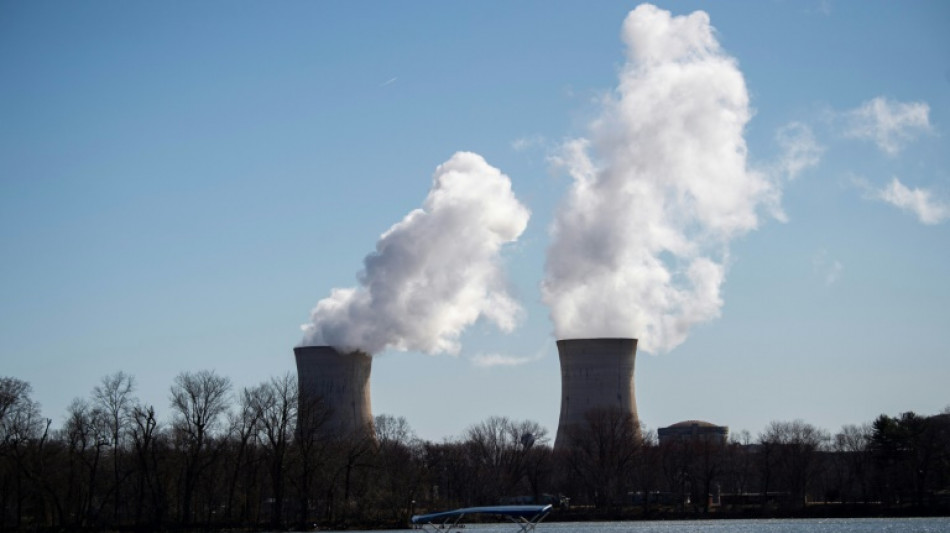
US nuclear plant Three Mile Island to reopen to power Microsoft / Photo: Andrew CABALLERO-REYNOLDS - AFP

 Vessel operator seeks witnesses after Vancouver grounding

 Shrini Srivastava joins crew of Varanasi-Delhi Vande Bharat Sleeper service

 Nearly Half of Australian Workers Overqualified, Survey Finds

 RBI eases export-declaration compliance for individual service exporters

 Reliance shares remain in focus after near-12% surge

 Coal India prepares possible $1 billion Mahanadi Coalfields listing

 Capital-markets shares rally as Motilal Oswal and Angel One lead gains

 Reliance rally puts historical one-year return pattern in focus

 Saudi Aramco quarterly profit climbs 34.6% amid elevated oil prices

 Australia raises benchmark rate to highest level in 18 years

 Asian stocks retreat as AI worries outweigh steep oil-price drop

 Hamad International Airport stages emergency drills during WATAN 2026

 Qatar solar expansion opens scope for technical performance gains

Three Mile Island, the site of America's worst nuclear accident, will restart operations to provide power to Microsoft, Constellation Energy announced Friday.
The 20-year agreement involves restarting Unit 1, which "operated at industry-leading levels of safety and reliability for decades before being shut down for economic reasons exactly five years ago," the company said in a statement.
Unit 1 was not involved in the 1979 partial nuclear meltdown at the Pennsylvania site.
Before its premature retirement in 2019, the plant could power over 800,000 average homes.
Microsoft will use this energy to support power grids in the mid-Atlantic states around Washington DC, a region considered an internet crossroads.
This area faces severe strain from data centers' massive energy consumption, raising concerns about grid stability as AI demands increase.
Tech giants like Microsoft, Amazon, and Google are rapidly expanding their data center capabilities to meet the AI revolution's computing and electricity needs.
Microsoft told US media that Three Mile Island's nuclear energy will bolster grids for data center expansion in Chicago, Virginia, Pennsylvania, and Ohio.
Many tech companies are betting on nuclear power's rapid development to meet AI's electricity demands.
Amazon's AWS agreed in March to invest $650 million in a data center campus powered by another 40-year-old Pennsylvania nuclear plant, further highlighting tech companies' growing interest in nuclear energy.
They are also interested in small modular reactors (SMRs), which are more compact and potentially easier to deploy.
However, this technology is still in its infancy and lacks regulatory approval, leading companies to seek out existing nuclear power options.
Constellation Energy expects the Three Mile Island reactor to go back online in 2028.
Bobby Hollis, Microsoft's vice president of energy, called the agreement "a major milestone in Microsoft's efforts to help decarbonize the grid in support of our commitment to become carbon negative."
The 1979 partial meltdown of Unit 2 at Three Mile Island caused panic in the United States and brought the deployment of nuclear energy to a standstill for a generation.
The Nuclear Regulatory Commission deemed it the "most serious accident in US commercial nuclear power plant operating history," though it noted no detectable health effects on workers or the public from the small radioactive releases.
S.F.Lacroix--CPN