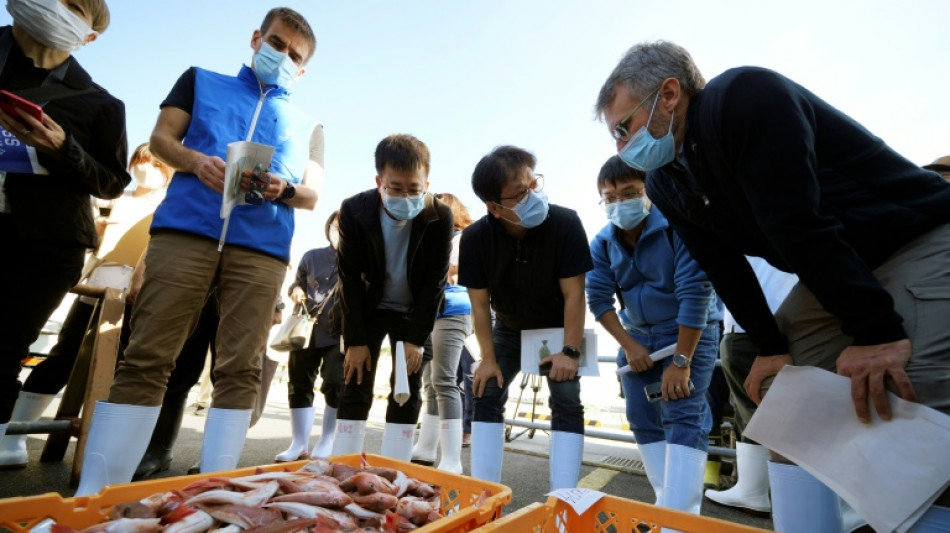
China to 'gradually resume' seafood imports from Japan after Fukushima ban / Photo: Eugene Hoshiko - POOL/AFP/File

 Vessel operator seeks witnesses after Vancouver grounding

 Shrini Srivastava joins crew of Varanasi-Delhi Vande Bharat Sleeper service

 Nearly Half of Australian Workers Overqualified, Survey Finds

 RBI eases export-declaration compliance for individual service exporters

 Reliance shares remain in focus after near-12% surge

 Coal India prepares possible $1 billion Mahanadi Coalfields listing

 Capital-markets shares rally as Motilal Oswal and Angel One lead gains

 Reliance rally puts historical one-year return pattern in focus

 Saudi Aramco quarterly profit climbs 34.6% amid elevated oil prices

 Australia raises benchmark rate to highest level in 18 years

 Asian stocks retreat as AI worries outweigh steep oil-price drop

 Hamad International Airport stages emergency drills during WATAN 2026

 Qatar solar expansion opens scope for technical performance gains

China said Friday that it would "gradually resume" importing seafood from Japan after imposing a blanket ban in August last year over the release of water from the disabled Fukushima nuclear plant.
"China will begin to adjust the relevant measures based on scientific evidence and gradually resume imports of Japanese aquatic products that meet the regulation requirements and standards," a foreign ministry statement said.
Chinese and Japanese officials recently conducted "multiple rounds of consultations" on the discharge of water from the stricken Fukushima Daiichi nuclear power station, the ministry said.
It said Japan had committed to "fulfilling its obligations under international law, doing its utmost to avoid leaving (a) negative impact on human health and the environment, and conducting continuous evaluations of the impact on the marine environment and marine ecosystems".
In 2011, three reactors at the Fukushima-Daiichi facility in northeastern Japan went into meltdown following a massive earthquake and tsunami that killed around 18,000 people.
Since then, plant operator TEPCO collected water contaminated as it cooled the wrecked reactors, along with groundwater and rain that has seeped in.
- Fierce backlash -
Japan in late August 2023 began discharging treated contaminated water from the Fukushima plant into the Pacific Ocean in an operation it insists is safe, a view backed by the UN atomic agency.
The release, however, generated a fierce backlash from China, which branded it "selfish" and banned all Japanese seafood imports.
China's foreign ministry said in its statement Friday that Tokyo welcomed the establishment of a "long-term international monitoring arrangement within the International Atomic Energy Agency (IAEA) framework covering key stages in the discharge of the nuclear-contaminated water".
"Both sides agree to continue to have constructive, science-based dialogue with a great sense of responsibility for the ecosystem, the environment, and human life and health," it added.
Around the same time as the announcement, Japanese Prime Minister Fumio Kishida said Tokyo had "informed the Chinese side of its readiness to carry out additional monitoring of the... treated water, while the Chinese side has decided to... steadily restore imports of Japanese fishery products that meet certain standards".
Despite the gradual resumption of seafood imports, a spokeswoman for Beijing's foreign ministry said China still "resolutely opposes" Japan's discharge of water from Fukushima.
"First of all, China resolutely opposes the Japanese side's arbitrary discharge (of contaminated water) into the sea," spokeswoman Mao Ning told a regular press conference, adding: "This position has not changed."
China imported over $500 million worth of seafood from Japan in 2022, according to customs data.
Y.Uduike--CPN