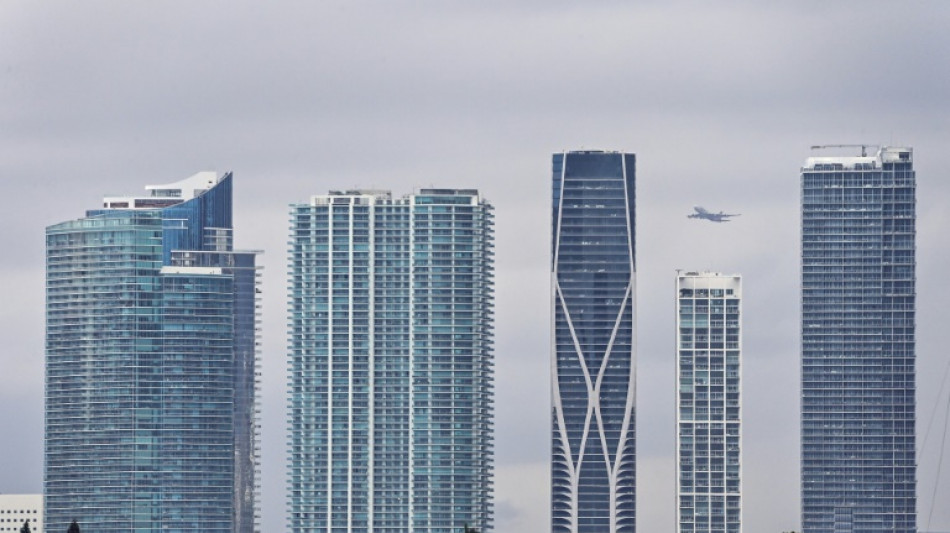
Miami's lure during Covid sends housing prices through the roof

 Lights out in Laos as electricity exports surge

 Steven Strogatz weighs AI mathematics advances and their consequences for researchers

 Anthropic boss calls for AI slowdown, Altman and Musk agree

 French IT giant Capgemini sells subsidiary after row over ICE links

 Quebec Brokerage Qubit Insurance Announces New Data on Coverage Shortfalls as Rebuilding Costs Rise

 Lady Gaga welcomes first child with fiance: US media

 Bhutan business bets on hazelnuts for farming future

 'Widow's Bay' and 'The Pitt' are favorites for Emmys night

 Coastal erosion forces cancellation of California music festival

 Argentina's Dirty War rears its head in Venice film

 UK lawmakers throw out bill to legalise assisted dying

 US inflation steady in August, fueling Fed rate hike expectations

 New York marks 25th anniversary of 9/11 attacks

 Nepal flood reconstruction bill to be $4.78 bn: foreign ministry

 JUMO and Standard Bank launch Social Finance Framework to scale inclusive finance in Africa

 Doomsday tech: could AI really kill us all?

 French comedy show 'Call my agent' makes film comeback

 It's all coming back: Celine Dion fans gear up for Paris return

 Researchers eye AI revolution in natural disaster forecasts

 US braces for inflation report that may push Fed to hike rates

 Musk threatens legal action over documentary

 Latin America fact-check group asks Meta not to replace verification practice

 AI Risks to Enter 60–80% of Liability and Cyber Insurance Underwriting by 2028, ScienceSoft Predicts

 Tribal Launches Campfire, Letting Business and Technical Teams Build on Salesforce Together

 Stocks fall as fresh oil surge fans inflation fears

Miami resident Maria Ruby learned last month that her rent will shoot up 65 percent in February. She cannot afford it and does not know where to go.
Her plight illustrates an unexpected effect of the coronavirus pandemic: Miami is seeing some of the highest housing cost increases anywhere in the United States.
Metropolitan Miami was already a lure even before Covid, with its warm weather, white sand beaches and absence of state -- though not federal -- income tax.
It is a sophisticated, cosmopolitan city that is attractive to European and Latin American investors.
But the pandemic made Miami even more of a mecca. Strict lockdown rules in other parts of the United States and the rise of working from home for a company that could be far away caused many people to up and move to the south of Florida.
They flocked from northeastern cities such as New York and Boston, as well as from California, and found cheaper rent and Republican politicians eager to get the state economy running again after the ravages of Covid lockdowns.
"They started coming to South Florida in droves," said Jennifer Wollmann, board chair of the Miami Association of Realtors.
"Our weather, business-friendly state and open spaces are very attractive for people coming from states that were cold and shut down," she said.
The effect quickly became apparent. People with better paying jobs than the going rate in south Florida caused housing prices to shoot up.
A study released in December by Realtor.com said metropolitan Miami saw the steepest rent hikes last year in America.
Median rent in November -- it did not specify what kind of dwelling -- was $2,800, up a whopping 44 percent from the same month of 2020.
- Sleepless nights -
For Ruby, a 57-year-old cashier, this change has been very painful.
For the past quarter-century, she has lived in an apartment in a 20-unit building in Hialeah, a town next to Miami with a majority population of people of Cuban descent.
The building has new owners, a company called Eco Stone Group, and they told the tenants their rent is going from $1,000 a month to $1,650.
Ruby earns $14 an hour, lives with her daughter and son-in-law, and cannot afford that big jump. She does not know what to do.
"We don't sleep well at night," Ruby said. "I do not know what will become of us."
The huge rise in demand in Florida has surprised experts such as Ned Murray, who teaches economics at Florida International University.
"It was unprecedented," Murray said of the increase, which has also involved home sale prices.
The real estate portal RealtyHop says Hialeah is the fifth-least affordable real estate market in America. A family of average income seeking to buy a house there would have to spend nearly 60 percent of its yearly revenue on that acquisition.
Miami is second on that list of pricey digs, behind New York.
Murray says Miami needs to beef up its scant supply of housing over the short term. Looking ahead, it needs to diversify the economy, which is now based largely on services, so people have better paying jobs.
Last week, Ruby and her daughter took part in a rally outside the offices of Eco Stone Group in a posh part of Miami to demand a solution to their dilemma.
They and other tenants want the rent to increase only to $1,200, for at least six months.
But the company will not even talk to them.
And the day of the demonstration, they could not even get near the entrance of the skyscraper housing their landlord. Police barred them on grounds it is private property.
S.F.Lacroix--CPN