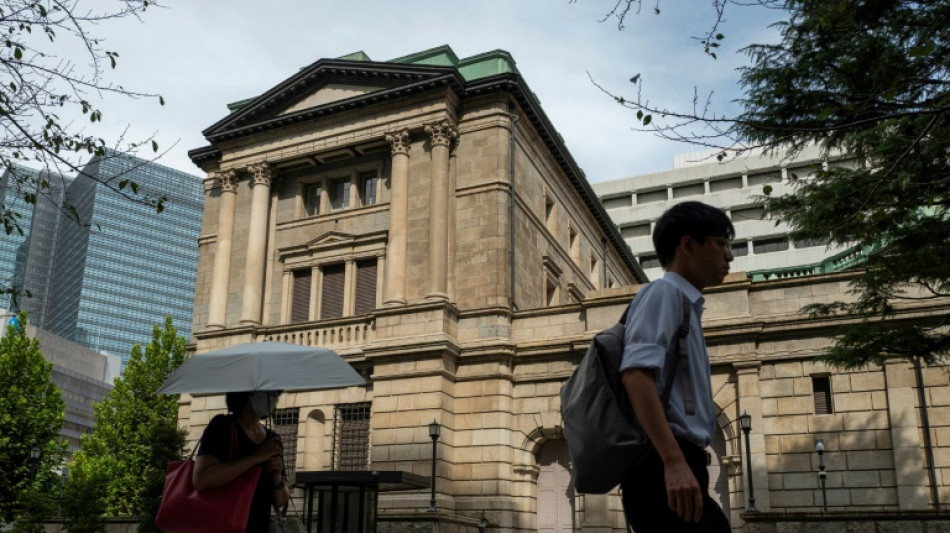
Bank of Japan leaves key interest rate unchanged / Photo: Kazuhiro NOGI - AFP

 Vessel operator seeks witnesses after Vancouver grounding

 Shrini Srivastava joins crew of Varanasi-Delhi Vande Bharat Sleeper service

 Nearly Half of Australian Workers Overqualified, Survey Finds

 RBI eases export-declaration compliance for individual service exporters

 Reliance shares remain in focus after near-12% surge

 Coal India prepares possible $1 billion Mahanadi Coalfields listing

 Capital-markets shares rally as Motilal Oswal and Angel One lead gains

 Reliance rally puts historical one-year return pattern in focus

 Saudi Aramco quarterly profit climbs 34.6% amid elevated oil prices

 Australia raises benchmark rate to highest level in 18 years

 Asian stocks retreat as AI worries outweigh steep oil-price drop

 Hamad International Airport stages emergency drills during WATAN 2026

 Qatar solar expansion opens scope for technical performance gains

The Bank of Japan left interest rates unchanged on Friday, after a decision to hike them in July pushed the yen sharply higher and fuelled turmoil across world markets.
Two days after the US Federal Reserve slashed rates for the first time since the start of the pandemic, the BoJ's stasis came as data showed inflation in the world's fourth-largest economy picked up as expected in August.
Japanese central bank officials said borrowing costs would be left at 0.25 percent, a policy decision widely predicted after the fallout from the previous hike.
UBS economists Masamichi Adachi and Go Kurihara said this week that they saw "no reason for the Bank to raise its rate, which could surprise the market and public again, especially when market sentiment is still cautious".
The BoJ was for a long time an outlier among major central banks -- sticking to an ultra-loose monetary policy in an attempt to see demand-driven inflation of two percent fuelled by wage increases.
Price rises have been above this target since April 2022 -- accelerating slightly to 2.8 percent in August -- but the BoJ questioned the extent to which this was caused by temporary factors such as the war in Ukraine.
The BoJ raised borrowing costs in March for the first time since 2007 and again in July, signalling that more were on the cards.
That move, which surprised investors, came on the same day the Fed indicated it was ready to start cutting, and was followed by a big miss on US jobs creation.
This sent markets into a tailspin on US recession worries and as traders unwound huge "carry trades" in which they used the yen to buy higher-yielding assets such as stocks.
The yen, which in July had just hit a four-decade low against the dollar, rocketed and the global stocks sell-off on August 5 saw Tokyo's Nikkei 225 dive more than 12 percent -- its worst day since Black Monday in 1987.
Japanese stocks have since recovered but remain volatile.
The sharp slide prompted the BoJ's deputy governor Shinichi Uchida to signal that there would be no more interest rate hikes until financial markets had stabilised.
But around 70 percent of economists surveyed by Bloomberg expect another increase by December.
Capital Economics predicted the next rate hike would come in October as inflation was likely to stay close to the BoJ's two percent target "until early 2025".
Stefan Angrick at Moody's Analytics sounded a note of caution as "deeper price metrics have been slowing for most of the past year given the virtual absence of demand-driven price pressures".
"The central bank has made clear that it will raise interest rates. At best, rate hikes will be an added drag on growth. At worst, they could precipitate a broader downturn," he warned.
P.Petrenko--CPN