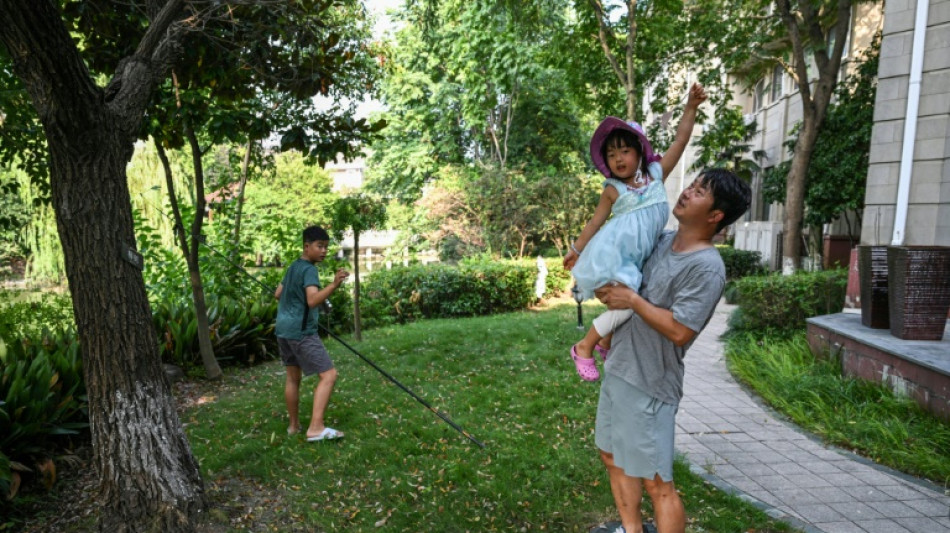
China's 'full-time dads' challenge patriarchal norms / Photo: Hector RETAMAL - AFP

 Vessel operator seeks witnesses after Vancouver grounding

 Shrini Srivastava joins crew of Varanasi-Delhi Vande Bharat Sleeper service

 Nearly Half of Australian Workers Overqualified, Survey Finds

 RBI eases export-declaration compliance for individual service exporters

 Reliance shares remain in focus after near-12% surge

 Coal India prepares possible $1 billion Mahanadi Coalfields listing

 Capital-markets shares rally as Motilal Oswal and Angel One lead gains

 Reliance rally puts historical one-year return pattern in focus

 Saudi Aramco quarterly profit climbs 34.6% amid elevated oil prices

 Australia raises benchmark rate to highest level in 18 years

 Asian stocks retreat as AI worries outweigh steep oil-price drop

 Hamad International Airport stages emergency drills during WATAN 2026

 Qatar solar expansion opens scope for technical performance gains

Cooking, cleaning, caring for the kids during the day, Chen Hualiang takes on household tasks many Chinese fathers tend to leave to their wives, bucking a deep-rooted patriarchal tradition and even inspiring a hit TV show.
The former project manager gave up the rat race to join a growing number of "full-time dads", as they are known in China.
"When you work, you dream of a great career and that this money will help your family," he told AFP from a villa in the suburbs of Shanghai, his four-year-old daughter and 11-year-old son playing nearby.
"But nothing is certain, and a salary is not necessarily what your family needs the most."
Social norms in China have for centuries dictated that men are the breadwinners, while women take care of the household and children.
"My father was just a father. I never felt like he could help me, except financially," said Chen.
"I want to be like a friend to my children, so they can share things with me."
Over half of Chinese men now say they would agree to become a stay-at-home dad, a 2019 survey cited by state media suggested -- up from just 17 percent in 2007.
That has coincided with a broader recognition of women's rights and their access to higher education, though they are still under-represented in senior roles.
"The increase in the number of stay-at-home dads is due to the fact that women have a higher status today," Pan Xingzhi, founder of an online psychological counselling platform, told AFP.
People also see "value for money" -- for a couple, foregoing a salary and taking care of their baby themselves is often less expensive than hiring a nanny or a childminder, Pan said.
- 'Super helpful' -
For Chen, his decision to stay home frees up time for his wife Mao Li, author of a bestselling book on stay-at-home fathers.
"At the beginning of our marriage, I wondered about his helpfulness as a spouse," she said.
"He worked a lot, so he didn't help me with the children and didn't pay me much attention. But now he takes care of the children and stays at home, I find him super helpful," she said.
"I give him 9.5 out of 10."
On Xiaohongshu, China's equivalent of Instagram, other young stay-at-home dads proudly promote their lifestyle choice.
Chang Wenhao, 37, a content creator and education entrepreneur from the southern Chinese city of Zhuhai, is one convert.
He adjusted his working hours to be available 80 percent of the time for his seven-year-old daughter and five-year-old son, taking them camping, horse riding, cycling and hiking.
"In terms of educational methods, encouragement, how to build self-confidence, develop their skills, their independence in life, I bring them things they don't learn at school or from other adults," he said.
Mao's book has inspired a 36-episode television series called "Husband and Wife" on the theme of full-time dads, rekindling the sometimes-heated debate about the role of men in the home in China.
"My parents are a little concerned that I am a stay-at-home dad," Chen said.
"Some people, especially on social media, say that I live off my wife."
- 'You have to work' -
Plenty of other stay-at-home dads also report pushback from their families.
Xu Xiaolin, 34, from the eastern Chinese of Xiamen, has been a stay-at-home dad since the company he worked for went bankrupt.
"In the beginning, my parents and grandparents often said: you have to work," Xu told AFP.
"Elderly neighbours sometimes make comments to them. It bothers them, so they put pressure on me."
Passers-by sometimes make fun of him when he walks his two-year-old son alone, he said.
"But people under 35 no longer have that mentality."
Chang, the entrepreneur, also said he has noticed the beginnings of a change in recent years.
"Many fathers are starting to value the company and education of their children" and listening to their needs.
"This will continue to develop," he said.
"But profound change will still take time."
Y.Uduike--CPN