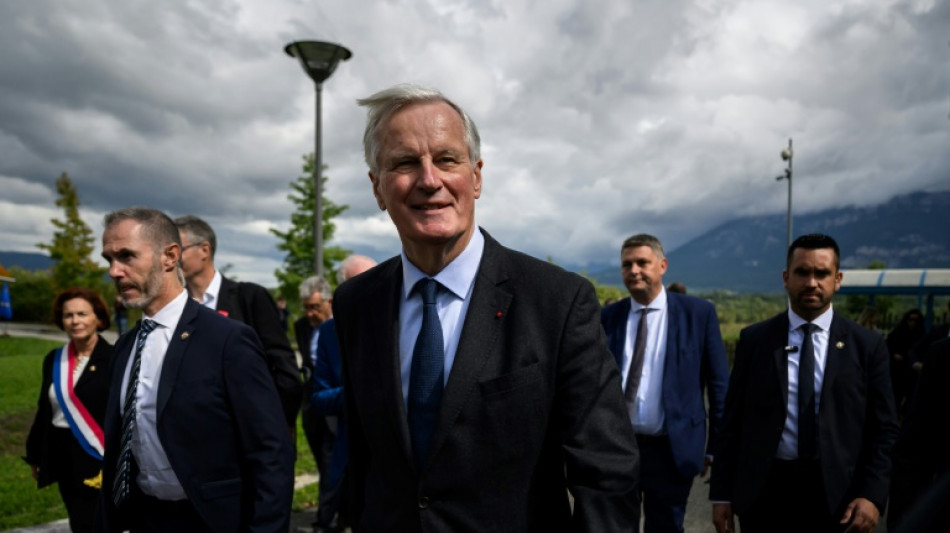
France's new PM warns of 'very serious' financial situation / Photo: JEFF PACHOUD - POOL/AFP

 Vessel operator seeks witnesses after Vancouver grounding

 Shrini Srivastava joins crew of Varanasi-Delhi Vande Bharat Sleeper service

 Nearly Half of Australian Workers Overqualified, Survey Finds

 RBI eases export-declaration compliance for individual service exporters

 Reliance shares remain in focus after near-12% surge

 Coal India prepares possible $1 billion Mahanadi Coalfields listing

 Capital-markets shares rally as Motilal Oswal and Angel One lead gains

 Reliance rally puts historical one-year return pattern in focus

 Saudi Aramco quarterly profit climbs 34.6% amid elevated oil prices

 Australia raises benchmark rate to highest level in 18 years

 Asian stocks retreat as AI worries outweigh steep oil-price drop

 Hamad International Airport stages emergency drills during WATAN 2026

 Qatar solar expansion opens scope for technical performance gains

France's budgetary situation is "very serious", Prime Minister Michel Barnier told AFP on Wednesday, saying more information was needed to gauge the "precise reality" of French public finances.
France was placed on a formal procedure for violating European Union budgetary rules before Barnier was picked as head of government this month by President Emmanuel Macron.
And the Bank of France warned this week that a projected return to EU deficit rules by 2027 was "not realistic".
France's public-sector deficit is projected to reach around 5.6 percent of GDP this year and go over six percent in 2025, which compares with EU rules calling for a three-percent ceiling on deficits.
"I am discovering that the country's budgetary situation is very serious," Barnier said in a statement to AFP.
"This situation requires more than just pretty statements. It requires responsible action," he said.
The new prime minister, who has yet to appoint a cabinet, is scheduled to submit a 2025 budget to parliament next month, in what is expected to be the first major test for the incoming administration.
- 'Out of the question' -
Within days of taking office in early September, Barnier said in an interview that "French people want more justice" in terms of fiscal policy, while several politicians have reported the prime minister mentioning possible tax increases in private conversations.
Such a move would be a red rag to allies of Macron, who oversaw cuts in the corporate tax rate from 33.3 percent to 25 percent as well as tax reductions for households, including the wealthiest taxpayers.
Macron has claimed a reduction in the overall tax burden by 50 billion euros ($56 billion) since he became president in 2017.
Interior Minister Gerald Darmanin, a staunch Macron ally, said Wednesday that it was "out of the question" to join, or even back, a government that raised taxes.
But years of extra spending during the Covid pandemic combined with sluggish growth have caused the French deficit to balloon, sparking the "excessive deficit procedure" by the EU, which is designed to force a country to negotiate a plan with Brussels to get their deficit or debt levels back on track.
Finance Minister Bruno Le Maire, who is to be replaced soon, promised to bring the deficit back below three percent by 2027 but many analysts have dismissed the plan as implausible.
France's central bank governor, Francois Villeroy de Galhau, said this week that the objective was "not realistic" unless the government was willing to risk "stopping growth in its tracks".
Apparently backing Barnier's approach, Villeroy de Galhau called for an "exceptional and reasonable effort asked of some major companies and wealthy taxpayers" to help a recovery in finances. France, he said, could no longer afford "unfunded" tax cuts.
But tighter fiscal policies could put Barnier on a collision course with Macron, who appointed the experienced politician -- best known internationally as the EU's former chief Brexit negotiator -- in the hope that he can survive an early no-confidence vote in parliament.
- 'Dreadful error to go back' -
"We want a stable fiscal policy that does not undermine policies that caused unemployment to fall and our country's attractiveness to rise," said Jean-Rene Cazeneuve, a National Assembly deputy and Macron ally. "It would be a dreadful error to go back on this."
Laurent Wauquiez, head of the conservative Les Republican (LR) parliamentary group on whom Barnier will depend for support, said last week that "our conviction is that in a certain number of areas we need rightist policies". This, he said, meant "no tax rises".
The tax question is likely to deepen budding tensions between Macron and Barnier, who is said to have been irritated that the president did not consult him about nominating Foreign Minister Stephane Sejourne to the EU Commission.
"Knowing where Michel Barnier stands on Europe and the loss of French influence, I think he's just suffered his first humiliation," said one LR deputy on condition of anonymity.
burs-jh/sjw/js
St.Ch.Baker--CPN