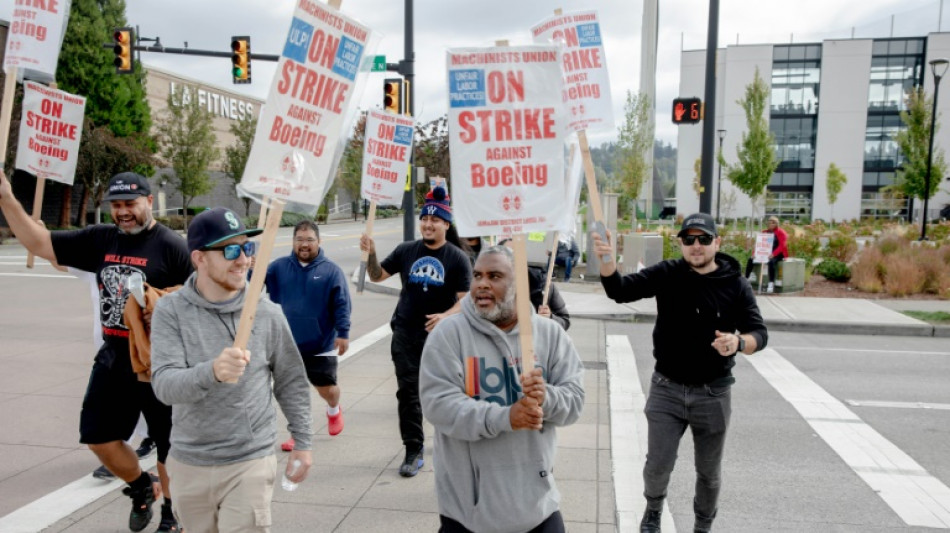
Boeing, union resume talks as strike empties Seattle plants / Photo: Yehyun Kim - AFP

 Vessel operator seeks witnesses after Vancouver grounding

 Shrini Srivastava joins crew of Varanasi-Delhi Vande Bharat Sleeper service

 Nearly Half of Australian Workers Overqualified, Survey Finds

 RBI eases export-declaration compliance for individual service exporters

 Reliance shares remain in focus after near-12% surge

 Coal India prepares possible $1 billion Mahanadi Coalfields listing

 Capital-markets shares rally as Motilal Oswal and Angel One lead gains

 Reliance rally puts historical one-year return pattern in focus

 Saudi Aramco quarterly profit climbs 34.6% amid elevated oil prices

 Australia raises benchmark rate to highest level in 18 years

 Asian stocks retreat as AI worries outweigh steep oil-price drop

 Hamad International Airport stages emergency drills during WATAN 2026

 Qatar solar expansion opens scope for technical performance gains

Negotiators from Boeing and the machinists union representing its workers resumed talks Tuesday after some 33,000 employees went on strike late last week, effectively shutting down two Seattle-area factories.
Talks got underway Tuesday morning, said a person familiar with the matter.
The objective is "to reestablish the relationship" between the union and Boeing, said a second person close to the discussions.
Members of the International Association of Machinists and Aerospace Workers District 751 have been picketing 24 hours a day following the walkout early Friday morning, shuttering factories in Renton and Everett that assemble the 737 MAX and 777.
"We stand united, stronger than ever, because we fight side by side with an unwavering belief in our cause," the IAM said late Monday on its website.
The IAM, which has touted support from peer unions and political figures, began surveying the members to rank their priorities as the negotiations enter the next phase.
Meanwhile, Boeing announced Monday a hiring freeze and cutbacks in supplier expenditures and cautioned that it was considering staff furloughs.
"Our business is in a difficult period," Chief Financial Officer Brian West said in a memo to staff. "We must take necessary actions to preserve cash and safeguard our shared future."
West told an investor conference Friday that the company was eager to get back to the bargaining table and "hammer out a deal."
The talks, which will be assisted by federal mediators, aim to speed a resolution to Boeing's first strike since 2008 at a time when the aviation giant has been losing money and faces scrutiny from regulators and customers after safety incidents.
- Quick resolution possible? -
Boeing had been hopeful about averting a strike after reaching a preliminary deal with IAM leadership on September 8 that included a 25 percent general wage increase over four years, reduced mandatory overtime and a pledge to build the next new airplane in the Puget Sound.
But rank-and-file workers blasted the deal as insufficient, dismissing the 25 percent figure as misleading and inadequate in light of the agreement's elimination of an annual bonus for workers.
Workers also were displeased with other elements of the agreement, including its failure to reinstate pensions. And they said the pledge on building the new airplane in the Puget Sound needed to be strengthened beyond the four-year lifespan of the contract.
Underlying the fury has been a more than decade-long period of essentially stagnant wages at a time when consumer inflation has stressed budgets.
Workers late Thursday overwhelmingly rejected the deal and voted 96 percent to strike.
Analysts at Bank of America noted that Boeing strikes have historically lasted about 60 days on average, but said there was also a chance of it being as short as a week.
"We see it likely Boeing would have to make further concessions and move closer to the IAM's initial proposal of 40 percent wage gains," Bank of America said in a note.
TD Cowen also said a "quick resolution" was a possibility, but pointed to the chance of a protracted stoppage because of the "loss of credibility" of Jon Holden, head of the IAM's Seattle district, who initially supported then pivoted away from the deal.
"Boeing will be leery of getting a yes vote just on his support, and the union is unlikely to accept a revised Boeing offer on his say so," TD Cowen said. "If Boeing's second offer fails, we see both sides digging in."
Holden has said his initial support for the deal was because he believed it was the best agreement possible without a strike and that a better deal could not be guaranteed in a strike.
But the "real power" of the IAM rests with workers, Holden said at a news conference last week announcing the strike.
Joining the talks will be three officials from the Federal Mediation & Conciliation Service (FMCS), which had been monitoring the talks, reached out to the parties right after the strike began and will facilitate negotiations.
Javier Ramirez, deputy director of field operations for the FMCS, said the plan Tuesday will be to meet with the two sides together before speaking individually with each and sometimes conducting shuttle diplomacy.
"We reached out to have them meet and talk sooner rather than later," said Ramirez, who described the FMCS' role as open ended and day-by-day.
H.Müller--CPN