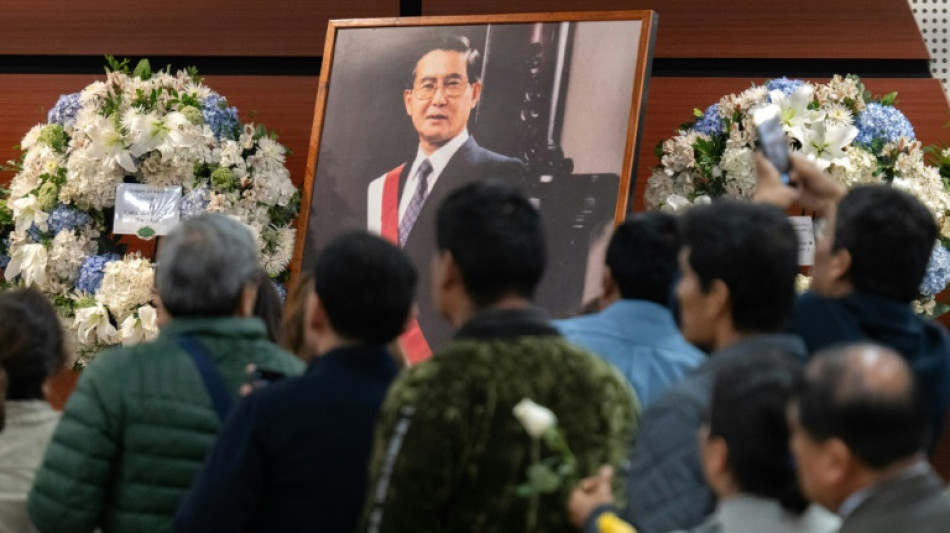
Peru bids farewell to polarizing ex-president Fujimori / Photo: Cris BOURONCLE - AFP

 Vessel operator seeks witnesses after Vancouver grounding

 Shrini Srivastava joins crew of Varanasi-Delhi Vande Bharat Sleeper service

 Nearly Half of Australian Workers Overqualified, Survey Finds

 RBI eases export-declaration compliance for individual service exporters

 Reliance shares remain in focus after near-12% surge

 Coal India prepares possible $1 billion Mahanadi Coalfields listing

 Capital-markets shares rally as Motilal Oswal and Angel One lead gains

 Reliance rally puts historical one-year return pattern in focus

 Saudi Aramco quarterly profit climbs 34.6% amid elevated oil prices

 Australia raises benchmark rate to highest level in 18 years

 Asian stocks retreat as AI worries outweigh steep oil-price drop

 Hamad International Airport stages emergency drills during WATAN 2026

 Qatar solar expansion opens scope for technical performance gains

The state funeral of Peru's divisive ex-president Alberto Fujimori, a major figure in Latin American politics, began Saturday in Lima, capping three days of national mourning.
Fujimori was revered by many for crushing a bloody leftist insurgency and helping shore up the economy during his 1990-2000 rule.
He "had the guts to fight terrorism," Edgar Grados, a 43-year-old businessman, who travelled more than 100 kilometers to attend the funeral, told AFP, vowing "Fujimorism never dies."
But for others Fujimori was a power-hungry autocrat, who signed off on gross human rights abuses, for which he spent 16 years in prison.
He died on Wednesday, aged 86, after a long battle with cancer.
As his funeral mass got underway in a packed 1,500-capacity National Theatre in Lima, mourners clapped and chanted "Chino, Chino", as Fujimori was nicknamed after his Japanese roots.
A large portrait of Fujimori stood on the altar, next to his coffin, which was draped in the Peruvian flag.
Hundreds of people followed the proceedings on a giant screen erected outside.
While nearly a quarter of a century have passed since he dramatically faxed in his resignation from Japan in the midst of a corruption scandal, Fujimori loomed large over public life in Peru right until his death.
Thousands of people queued for hours on Thursday and Friday to pay their respects at his open casket at the culture ministry where he lay in state.
He will be buried later Saturday with full state honors at the capital's Huachipa cemetery.
"We're very nostalgic," 30-year-old Jesus Neyra told AFP on Friday night as he waited in line at the culture ministry to pay his respects.
"A president who brought peace, economic stability, freedom and democracy to the country is gone. He left a great legacy."
But relatives of the victims of army massacres carried out on his watch lamented that he went to the grave without showing remorse for their deaths.
"He left without asking forgiveness from their families, he made a mockery of us," Gladys Rubina, the sister of one of the civilian victims, told AFP.
- Crimes against humanity -
An engineer by training, Fujimori worked as a university math professor before entering politics.
In 1990, he defeated writer Mario Vargas Llosa to win the presidency -- a surprise result.
His neoliberal economic policies won him the support of the ruling class and international financial institutions.
He also won praise for crushing a brutal insurgency by Shining Path and Tupac Amaru leftist rebels in a conflict that left more than 69,000 people dead and 21,000 missing between 1980 and 2000, according to a government truth commission.
But the brutal tactics employed by the military saw him spend his twilight years in jail.
In 2009, he was sentenced to 25 years in prison over two massacres of civilians by an army death squad tasked with fighting the Shining Path -- one at a house party, the other in a university dormitory. In all 25 people were killed.
As recently as July, Fujimori had been considering a comeback attempt in the 2026 election, according to his daughter Keiko, also a politician.
But his health took a turn for the worse as he battled tongue cancer.
- Hostage crisis -
One of the most dramatic episodes of his presidency was a four-month hostage ordeal at the Japanese embassy in Lima in late 1996 and early 1997.
It ended with him sending in special forces, who saved nearly all 72 hostages and killed the 14 rebel hostage-takers.
His downfall began in 2000 after his spy chief was exposed for corruption.
Fujimori fled to Japan and sent a fax announcing his resignation. Congress voted to sack him instead.
He was eventually arrested when he set foot in Chile and was extradited to Peru, where he was put on trial and jailed.
In December 2017, then-president Pedro Pablo Kuczynski pardoned him on health grounds.
The Supreme Court later annulled the pardon and in 2019 he was returned to jail before finally being released nearly five years later.
St.Ch.Baker--CPN