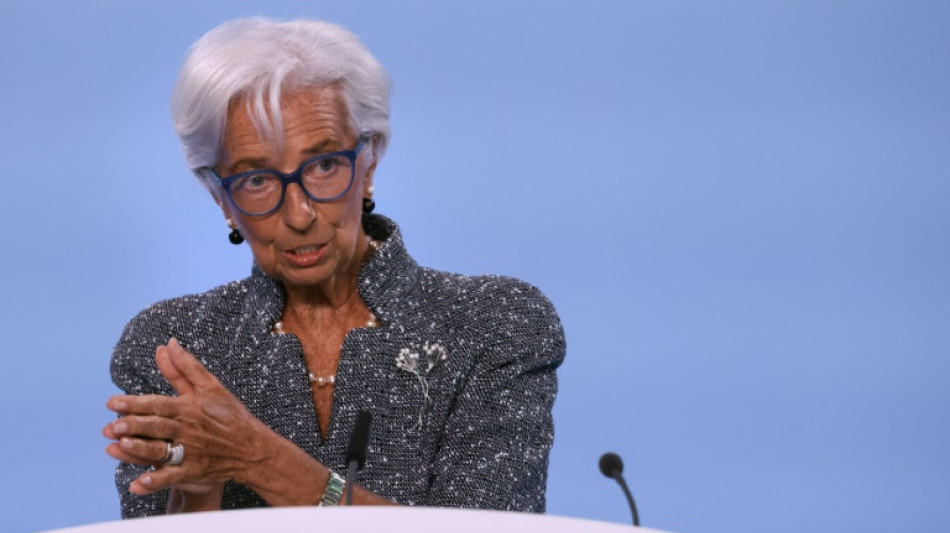
ECB cuts rates again, Lagarde backs EU reform call / Photo: Daniel ROLAND - AFP

 Vessel operator seeks witnesses after Vancouver grounding

 Shrini Srivastava joins crew of Varanasi-Delhi Vande Bharat Sleeper service

 Nearly Half of Australian Workers Overqualified, Survey Finds

 RBI eases export-declaration compliance for individual service exporters

 Reliance shares remain in focus after near-12% surge

 Coal India prepares possible $1 billion Mahanadi Coalfields listing

 Capital-markets shares rally as Motilal Oswal and Angel One lead gains

 Reliance rally puts historical one-year return pattern in focus

 Saudi Aramco quarterly profit climbs 34.6% amid elevated oil prices

 Australia raises benchmark rate to highest level in 18 years

 Asian stocks retreat as AI worries outweigh steep oil-price drop

 Hamad International Airport stages emergency drills during WATAN 2026

 Qatar solar expansion opens scope for technical performance gains

The European Central Bank cut its key interest rate again Thursday as inflation cools while president Christine Lagarde urged EU governments to institute sweeping reforms proposed in a "formidable" report by her predecessor Mario Draghi.
The Frankfurt-based central bank reduced its key deposit rate a quarter point to 3.5 percent, as expected, providing further relief to eurozone households and businesses.
It was policymakers' second cut, after a move in June, which ended a record hiking cycle that began in mid-2022 to tame a surge in consumer prices.
Inflation rates have been easing, and are now only a whisker off the ECB's two-percent target. The eurozone economic outlook meanwhile has worsened in recent weeks, with the ECB on Thursday slightly trimming its growth forecasts for the coming years.
After the ECB unveiled only its second rate reduction since 2019, Lagarde stressed that progress was being made in the fight against inflation, which was on a "declining path".
But she warned that the battle was far from over, with inflation likely to tick up again later this year and fast-rising wages still a threat.
She again insisted that the rate path ahead was "not pre-determined".
"We shall be data dependent, we shall decide meeting by meeting," she told a press conference.
The central bank for the 20 countries that use the euro left its inflation forecasts unchanged from its last projections in June, forecasting the figure would drop below two percent in 2026.
LBBW bank analyst Jens-Oliver Niklasch said the latest data justified the ECB "taking a slow approach", and he believed the central bank would pause in October before cutting again at its meeting in December.
- 'Severe but just' -
The central bank's latest meeting came the week that a key report by Lagarde's predecessor at the ECB, Mario Draghi, was released, with a call for sweeping reforms to boost the EU economy.
"It's a formidable report in that it poses a diagnosis which is severe but which is just in our view," Lagarde said.
The report urged the 27-country bloc to ramp up industrial investment by hundreds of billions of euros per year and boost innovation to keep pace with the United States and China.
"I very much hope that the executive authorities in charge will actually take it to heart and will see a path towards those structural reforms," she said.
The ECB has been among central banks worldwide which have started cutting rates on the back of falling inflation, with the US Federal Reserve expected to join the movement at its meeting next week.
While eurozone inflation has been sticky, policymakers have in recent times grown more confident that it is now on a more sustained downward trajectory.
Eurozone inflation fell to its lowest level in more than three years in August, according to official data.
Consumer price rises slowed to 2.2 percent compared to the same month last year, down from 2.6 percent in July, leaving the figure just a whisker off the ECB's target.
Inflation rates had peaked at 10.6 percent in October 2022 after Russia's invasion of Ukraine and post-pandemic supply chain woes sent food and energy costs soaring.
A lacklustre performance in some parts of the eurozone has also fuelled calls for more cuts to take pressure off the single currency area.
While signs in the first half of the year were positive, recent indicators have pointed to a deteriorating outlook.
The eurozone's largest economy, Germany, shrank unexpectedly in the second quarter, adding to indications that a hoped-for rebound will fail to materialise this year.
Lagarde listed a series of risks for the eurozone economy, from a weakening global economy to trade tensions, and conflicts in Ukraine and the Middle East.
"Risks to economic growth remain tilted to the downside," she said.
H.Cho--CPN