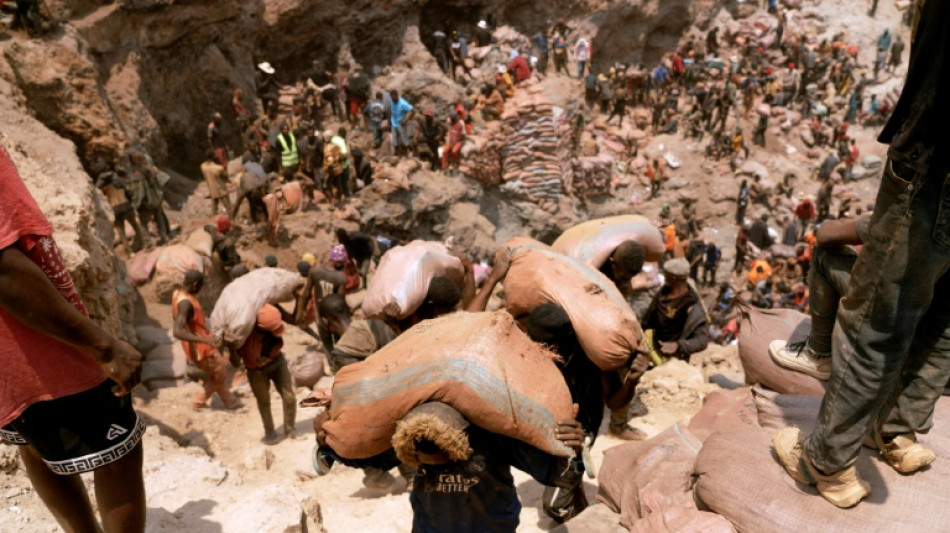
UN experts call for global system to trace critical minerals / Photo: Junior KANNAH - AFP

 Vessel operator seeks witnesses after Vancouver grounding

 Shrini Srivastava joins crew of Varanasi-Delhi Vande Bharat Sleeper service

 Nearly Half of Australian Workers Overqualified, Survey Finds

 RBI eases export-declaration compliance for individual service exporters

 Reliance shares remain in focus after near-12% surge

 Coal India prepares possible $1 billion Mahanadi Coalfields listing

 Capital-markets shares rally as Motilal Oswal and Angel One lead gains

 Reliance rally puts historical one-year return pattern in focus

 Saudi Aramco quarterly profit climbs 34.6% amid elevated oil prices

 Australia raises benchmark rate to highest level in 18 years

 Asian stocks retreat as AI worries outweigh steep oil-price drop

 Hamad International Airport stages emergency drills during WATAN 2026
 Qatar solar expansion opens scope for technical performance gains

UN experts called Wednesday for the creation of a global system to trace the extraction and production of critical minerals that are needed in the transition away from fossil fuels.
The massive effort to develop renewable energy, essential in the fight against climate change, requires minerals and metals such as copper, cadmium, nickel and lithium, necessary for electric vehicle batteries, solar panels and more.
Demand for such materials will quadruple by 2040 as nations race to limit global warming to +1.5 degrees Celsius, the International Energy Agency (IEA) has estimated.
The experts -- representatives from non-governmental organizations and various countries' mining and environment ministries -- are part of a UN committee set up in April by Secretary-General Antonio Guterres to draw up guardrails in the face of the looming energy revolution.
"We established the panel in response to calls from developing countries, amid signs that the energy transition could reproduce and amplify inequalities of the past," Guterres said Wednesday.
He asked the panel to share its recommendations with UN member states ahead of November's COP29 in Baku, Azerbaijan.
"We will bring the UN system together to support implementation of the panel's work, safeguarding and advancing human rights, including the rights of Indigenous Peoples, across the critical minerals value chain," Guterres said.
- Africa 'bleeding' -
In a report released Wednesday, the committee put forward seven guiding principles.
They include: putting human rights at the heart of the production chain; protecting the integrity of the planet; and ensuring that benefits are shared.
"The essence of this report is to inspire care and caution to avoid the mistakes of the past, where we are already seeing conflict generated by the scramble for these resources, particularly in my continent that is bleeding," said co-chair Joyce Mxakato-Diseko of South Africa.
More concretely, the experts, citing disparate existing initiatives, recommended the establishment of "global traceability, transparency and accountability framework along the entire mineral value chain -– from mining to recycling."
They called for the system to provide an independent assessment of the environmental and social performance of companies involved in the trade -- for example, their respect for human and labor rights, levels of corruption, level of greenhouse gas emissions, and so on.
They also suggested the creation of a global fund, financed by governments and companies, to fund the aftermath of mining operations -- particularly land rehabilitation and support for local communities.
And, with the IEA fearing global supplies of such minerals are running out, the UN experts also called for investment in innovation and recycling to reduce the quantities needed.
The NGO coalition Climate Action Network, represented on the committee, welcomed the report.
But there "is still a long way to go in making these principles a reality," its director, Tasneem Essop, said in a statement.
Too often, "production of these minerals leaves a toxic cloud in its wake: pollution; wounded communities, childhoods lost to labor and sometimes dying in their work," Guterres said when he announced the committee in April.
Developing countries and communities have also not reaped the benefits of their production, he said, adding: "This must change."
D.Avraham--CPN