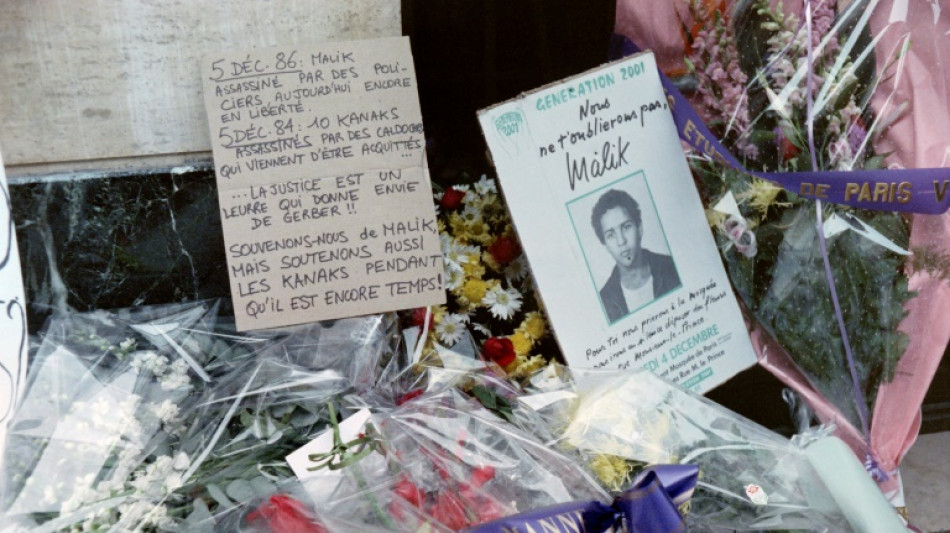
Decades on, 'France's George Floyd' gets screen treatment / Photo: Michel GANGNE - AFP

 Nintendo producer 'all nervous' as Zelda classic remake hits shelves

 Three killed by storm in southern India

 Two hundred 'Cruise for life' passengers stranded in Cambodia

 Billionaire Ambani's Jio jumps 21% in market debut after record India IPO

 Sri Lanka's Tamil farmers fight to reclaim land after civil war

 'They don't care about us': Trump food aid cuts leave Americans struggling and angry

 Palestinian activist Khalil returns to Columbia after US detention

 Youths testify about 'despair' in unprecedented Canadian climate trial

 Storied Paris department store seeks bankruptcy protection

 Boeing shares tumble after it releases cautious growth forecast

The name resonates deeply among French minorities as a symbol of police violence, but it has taken 35 years for the death of Malik Oussekine to be recounted on-screen.
On the night of December 6, 1986, two police officers beat to death the 22-year-old French-Algerian on the sidelines of a student protest in Paris.
He had not been involved in the demonstration, and his killing became a turning point -- triggering weeks of unrest and leading to the unprecedented conviction of the officers.
While Oussekine's name has continued to reverberate among minorities, his story has never been adapted for the screen until now.
As if making up for lost time, two versions are being released this month: a film, "Our Brothers", premieres at the Cannes Film Festival, and a Disney+ mini-series, "Oussekine", is released worldwide on Wednesday.
"He was attacked because of the colour of his skin. He is France's Arab George Floyd," historian Pascal Blanchard told AFP, referring to the African-American whose death at the hands of police in 2020 sparked massive international protests.
He said much of French society had allowed Oussekine's story to be brushed under the carpet as with so much of its troubled history with immigrant populations.
"It's not a question of whether Malik Oussekine has been forgotten, but by who?" said Blanchard.
- 'Historical cancers' -
France is still wrestling with the trauma of its colonial period, particularly the bloody war of independence in Algeria from 1954 to 1962.
Among its darkest moments was the massacre of up to 200 Algerian protesters by police in Paris on October 17, 1961 -- many of them shot dead and their bodies thrown into the Seine.
The events of that day went officially unacknowledged for decades until President Emmanuel Macron finally described them as "inexcusable crimes" at the 60th anniversary last year -- though without apologising.
Oussekine's death was crucial in marking the end of total police impunity -- the first time that officers were convicted for this type of crime, according to the family's lawyer, Georges Kiejman.
It has taken until now, as the grandchildren of the original wave of North African immigrants comes of age, for there to be enough distance and confidence to address the past.
"For our generation, it is important to say that these individual stories form part of the French national story. They are not separate. These are French stories," said Faiza Guene, 36 and born to Algerian parents, who helped write the screenplay for "Oussekine".
Its director, Antoine Chevrollier, was part of the team behind hit spy series "The Bureau", and the lauded political saga "Baron Noir".
"The important thing is to make this name and this story resonate so that we never forget," he told AFP.
Chevrollier, who grew up in a small village in the Loire Valley, says he only became fully aware of the power of Oussekine's name when he moved to Paris and began to hang out with people from different backgrounds.
"I hope the series will help ease the tensions that are unsettling the country. It is time that we in France begin to treat these historical cancers."
D.Avraham--CPN
