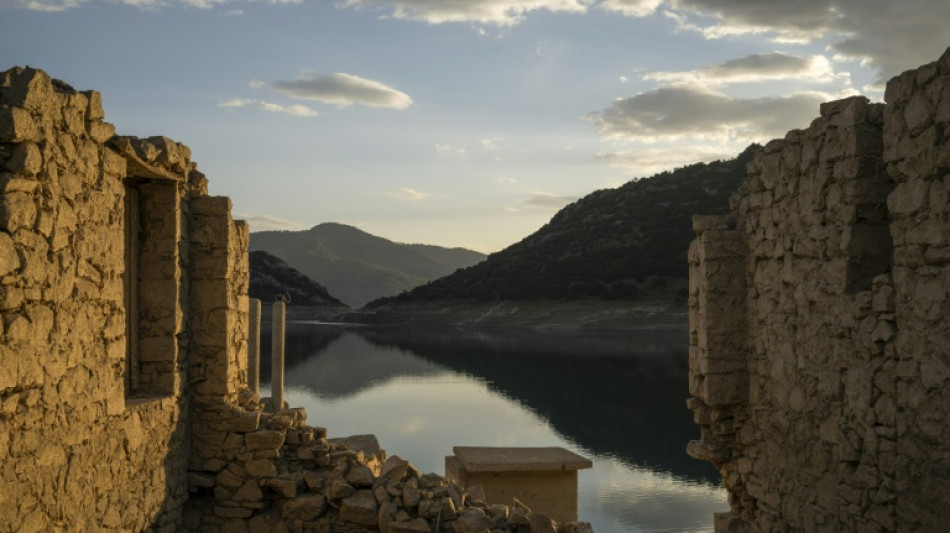
Sunken village emerges as Greek drought bites / Photo: Angelos TZORTZINIS - AFP

 Vessel operator seeks witnesses after Vancouver grounding

 Shrini Srivastava joins crew of Varanasi-Delhi Vande Bharat Sleeper service

 Nearly Half of Australian Workers Overqualified, Survey Finds

 RBI eases export-declaration compliance for individual service exporters

 Reliance shares remain in focus after near-12% surge

 Coal India prepares possible $1 billion Mahanadi Coalfields listing

 Capital-markets shares rally as Motilal Oswal and Angel One lead gains

 Reliance rally puts historical one-year return pattern in focus

 Saudi Aramco quarterly profit climbs 34.6% amid elevated oil prices

 Australia raises benchmark rate to highest level in 18 years

 Asian stocks retreat as AI worries outweigh steep oil-price drop

 Hamad International Airport stages emergency drills during WATAN 2026

 Qatar solar expansion opens scope for technical performance gains
Record-breaking temperatures and prolonged drought in Greece have exposed a sunken village in Athens' main reservoir for the first time in 30 years.
The village of Kallio was submerged in the late 1970s when the Mornos dam was built 200 kilometres (124 miles) west of the capital, the artificial lake fed by the Mornos and Evinos rivers.
With lake levels down by 30 percent in recent months according to state water operator EYDAP, the ruins of a school and houses have reappeared.
"The level of Lake Mornos has dropped by 40 metres (131 feet)," said Yorgos Iosifidis, a 60-year-old pensioner who had to leave his home as a young man along with the other villagers when the area was flooded.
"You see the first floor that remains of my father-in-law's two-storey house... and next to it you can see what's left of my cousins' house," Iosifidis, who now lives higher up the hill, told AFP.
Drought worsened this year in the Mediterranean country that is well accustomed to summer heat waves.
After the mildest winter on record, Greece had its hottest July on record, according to preliminary weather data from the national observatory. This came after similarly record-breaking temperatures in June.
Nearly 80 houses in Kallio, in addition to the church and school, were "sacrificed" to supply Athens with water, Kallio village chairman Apostolis Gerodimos told state agency ANA.
This is the second time Kallio has reappeared, after another period of drought in the early 1990s, said Iosifidis.
"If it doesn't rain soon, the level will drop further and the problem will be more acute than it was then," he said.
Anastasis Papageorgiou, 26, a doctor who lives in Amygdalia, a village near Mornos, said the area has seen very little rain or snow in the last two years.
"The situation is difficult at the moment, so we have to be careful with water," he said.
The Greek authorities called on the 3.7 million inhabitants of Attica, the region surrounding Athens and home to a third of the Greek population, not to waste water.
EYDAP has also tapped into additional reservoirs near the capital.
On a visit to neighbouring Thessaly on Monday to discuss reconstruction works after last year's destructive floods, Prime Minister Kyriakos Mitsotakis said Greece had to improve its water management.
"We don't have the luxury to waste water... at a time when we know with certainty that we will have less water, we must protect water resources more methodically than we have done so far," Mitsotakis said.
Greece uses 85 percent of its water for irrigation and needs to build more dams, the prime minister said.
M.P.Jacobs--CPN