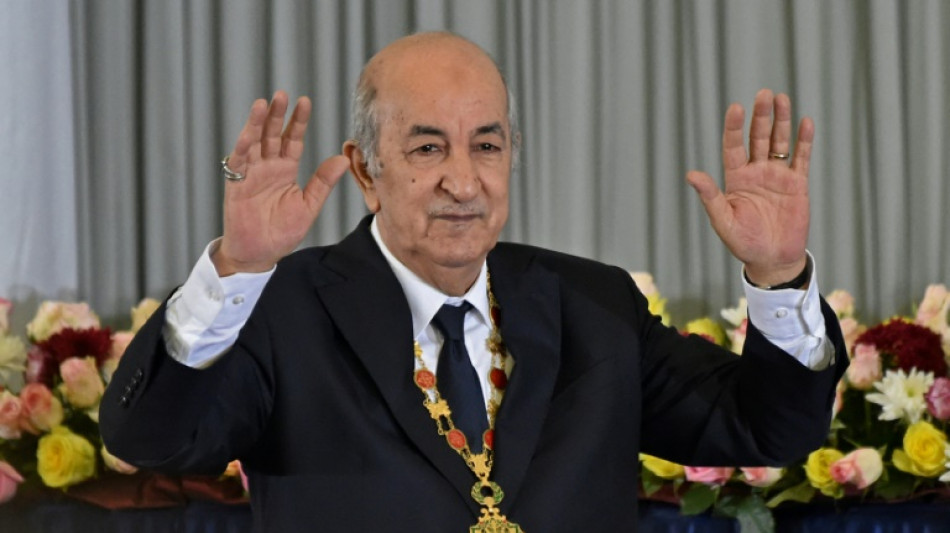
Seeking re-election, Algeria's Tebboune touts gains / Photo: RYAD KRAMDI - AFP/File

 Vessel operator seeks witnesses after Vancouver grounding

 Shrini Srivastava joins crew of Varanasi-Delhi Vande Bharat Sleeper service

 Nearly Half of Australian Workers Overqualified, Survey Finds

 RBI eases export-declaration compliance for individual service exporters

 Reliance shares remain in focus after near-12% surge

 Coal India prepares possible $1 billion Mahanadi Coalfields listing

 Capital-markets shares rally as Motilal Oswal and Angel One lead gains

 Reliance rally puts historical one-year return pattern in focus

 Saudi Aramco quarterly profit climbs 34.6% amid elevated oil prices

 Australia raises benchmark rate to highest level in 18 years

 Asian stocks retreat as AI worries outweigh steep oil-price drop

 Hamad International Airport stages emergency drills during WATAN 2026

 Qatar solar expansion opens scope for technical performance gains
Abdelmadjid Tebboune, who assumed Algeria's presidency during mass pro-democracy protests, is touting his achievements as he seeks another term. Yet, five years after the movement faded, some say real change remains elusive.
The Hirak protests, which led to the ousting of longtime autocratic president Abdelaziz Bouteflika in 2019, aimed for a comprehensive political overhaul.
Tebboune, a minister under Bouteflika, took over as president in December that year after widely boycotted elections, as the movement was stifled and its leaders were imprisoned.
Now, as he campaigns for the September 7 election, Tebboune says he has succeeded in rectifying the country's past wrongs with broad achievements and is promising more if re-elected.
Despite more than 100 weeks of demonstrations, Tebboune "dismissed the democratic transition demanded by millions of citizens", said Hasni Abidi, an Algeria analyst at the Geneva-based CERMAM Study Center.
Abidi said a change in leadership alone was insufficient to bring about a "new era", despite Tebboune's frequent references to a "new Algeria".
Even as his first term nears its end, Tebboune still faced the "difficulty of bringing about profound change", he said.
Algeria-based political commentator Mohamed Hennad said this change should primarily be political.
"As long as political questions are not legitimately resolved, any economic, cultural, or diplomatic discourse is pure diversion," he told AFP.
The Hirak movement withered away with the onset of the Covid-19 pandemic, coupled with a sweeping crackdown on protesters. Hundreds were arrested, and dozens remain behind bars or are still being prosecuted, according to prisoners' rights group CNLD.
- 'We suffered a lot' -
Since taking office, Tebboune has claimed to have put Algeria back on track, frequently referring to Bouteflika's last years in power as the "mafia decade" where control of the oil-rich country was concentrated in the hands of a "gang".
During his tenure, several businessmen, ministers and political figures from that era, including Bouteflika's brother Said, were convicted on corruption charges and imprisoned.
Tebboune also says he has successfully transformed Algeria into an emerging economy, now Africa's third-largest.
Abidi, however, points out that Tebboune's success has been aided by a "favourable international setting", with the Ukraine-Russia war driving up natural gas prices to the benefit of Algeria, the continent's top exporter.
This economic windfall has allowed Tebboune to deliver "local-interest speeches steeped in populism", said Abidi, with promises of free housing, raising the minimum wage and higher social pensions.
At a recent rally in Oran, Tebboune pledged to create 450,000 jobs and increase monthly unemployment benefits if re-elected.
Launched in 2022, unemployment benefits now provide 13,000 dinars ($97) to people aged 19 to 40, and Tebboune has promised to raise this to 20,000 dinars -- currently the minimum wage.
Despite these pledges, critics have said social and economic progress under Tebboune has been slow.
But the president often defends his record by saying his achievements have come despite "a war against Covid-19 and corruption" following the Hirak movement.
Abdelhamid Megunine, a 20-year-old student in Algiers, recalls that period with bitterness.
"We suffered a lot," he told AFP. "Prices and the cost of living have since increased."
Although Algeria's economy has grown at a rate of about four percent over the past two years, with foreign exchange reserves reaching $70 billion, it remains heavily dependent on oil and gas.
Hydrocarbon exports account for about 95 percent of the North African country's hard currency revenues, which are crucial for sustaining social assistance programmes.
- Diplomacy -
On foreign policy, Tebboune's tenure has seen a mix of successes and challenges.
Algeria gained international attention in January when it became a non-permanent member of the UN Security Council, where it has been a strong advocate for Palestinian rights.
However, relations with neighbouring countries, especially Morocco, have worsened, largely due to the ongoing dispute over Western Sahara.
Algeria, a strong supporter of the territory's pro-independence Polisario Front, severed diplomatic ties with Morocco in August 2021 following escalating tensions over Western Sahara and Rabat's decision to normalise relations with Israel.
Similarly, relations with France, already strained due to a history of colonialism, recently suffered a blow.
Last month, French President Macron said Morocco's autonomy plan was the only solution for Western Sahara, which the United Nations still considers as a "non-self-governing" territory.
In response, Algiers withdrew its ambassador to France, condemning the move as a "step that no other French government had taken before".
M.Mendoza--CPN