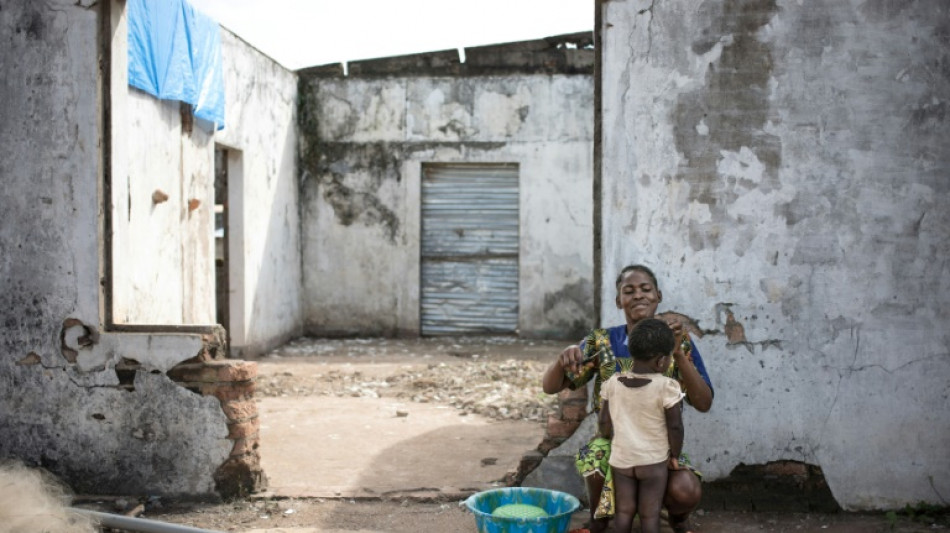
C.Africa's leap into bitcoin leaves its people bemused / Photo: FLORENT VERGNES - AFP

 Nintendo producer 'all nervous' as Zelda classic remake hits shelves

 Three killed by storm in southern India

 Two hundred 'Cruise for life' passengers stranded in Cambodia

 Billionaire Ambani's Jio jumps 21% in market debut after record India IPO

 Sri Lanka's Tamil farmers fight to reclaim land after civil war

 'They don't care about us': Trump food aid cuts leave Americans struggling and angry

 Palestinian activist Khalil returns to Columbia after US detention

 Youths testify about 'despair' in unprecedented Canadian climate trial

 Storied Paris department store seeks bankruptcy protection

 Boeing shares tumble after it releases cautious growth forecast

In the Central African Republic (CAR), nine out of 10 people do not have internet, and only one in seven has electricity -- that is, when there are no power cuts.
Yet the CAR has just followed El Salvador in adopting bitcoin as legal tender, a currency that requires access to the net to be bought, sold or used.
Foreign experts and CAR citizens themselves are struggling to understand why the world's second least developed economy has announced this leap into monetary hyperspace.
Among people queueing at one of the rare automatic teller machines (ATMs) in the capital Bangui, the word "bitcoin" stirred befuddlement.
"What is it?" asked Sylvain, a man in his 30s, waiting for his turn at the cash machine, which was operating thanks to a generator.
"I don't know what cryptocurrencies are -- I don't even have internet," said Joelle, a vegetable hawker nearby.
On April 28, President Faustin Archange Touadera announced that lawmakers had unanimously approved a bill that legalised the use of bitcoin alongside the CFA franc.
All transactions using the cryptocurrency, including payment of taxes, are being authorised.
Government spokesman Serge Ghislain Djorie told AFP: "We are going to launch an awareness campaign and shortly introduce fibre optic cable -- a low internet connection is enough to buy cryptocurrency."
But even among CAR's business community, which in theory is best placed to use bitcoin and other cryptocurrencies regulated by the new law, scepticism runs deep.
"I'm not interested in having bitcoin here -- we have no infrastructure and no knowledge for getting involved in this adventure and there's no cybercrime unit to ensure security," said an entrepreneur, who spoke on the condition of anonymity.
"There are other priorities, like security, energy, access to water, the internet, building roads..."
- Sickly economy -
Technical hurdles are just one of the questions raised by the bitcoin move.
Foreign analysts have been pondering why this deeply troubled economy should adopt a novel and volatile currency rather than a time-honoured stable unit such as the US dollar.
Just this week, Economy Minister Herve Ndoba said a shortfall in government income was so severe that without foreign help, spending cuts of up to 60 percent loomed for some ministries.
"CAR has many problems. Adding another currency like bitcoin as legal tender will unlikely meaningfully address those," said Ousmene Jacques Mandeng, a visiting fellow at the London School of Economics (LSE).
Bitcoin's "excess volatility... translates to fluctuations in household savings, consumption and wealth," warned Ganesh Viswanath-Nastraj, an assistant professor of finance at Warwick Business School in England.
Locked in a nine-year-old civil conflict, the CAR is heavily dependent on mineral extraction, much of which is informal, for its economy.
In a report in December 2020, a US watchdog called The Sentry said the CAR had become "a breeding ground for transnational criminal networks."
"Money laundering and the trafficking of natural resources, drugs, weapons, and diplomatic passports are rampant," it said.
The CFA franc that until now was the CAR's sole legal tender is a regional currency backed by France and pegged to the euro.
Other members of the currency are Cameroon, Chad, the Republic of Congo, Gabon and Equatorial Guinea.
Didier Loukakou, regulatory chief at the Central African Financial Market Surveillance Commission, said the six had been discussing plans to regulate crypto-currencies.
But, he said, "we were not warned by Bangui about its decision."
- Russian factor? -
Some experts see a possible explanation for Touadera's announcement in his entwinement with Russia, perceived as desperate for currency after Western countries imposed sanctions over its invasion of Ukraine.
In 2020, Russia sent paramilitaries to shore up Touadera as armed groups advanced on the capital.
France and rights campaigners describe these operatives as mercenaries from the Wagner group, which reputedly receives mineral wealth in exchange for their services.
"The context, given systemic corruption and a Russian partner facing international sanctions, does encourage suspicion," said Thierry Vircoulon, a specialist on Central Africa at the French Institute of International Relations (IFRI) think tank.
"Russia's search for ways to get around international sanctions is an invitation to be cautious."
But some voices, including the head of the International Monetary Fund, Kristalina Georgieva, have voiced doubts that digital currencies can be an effective tool for bypassing sanctions.
U.Ndiaye--CPN
