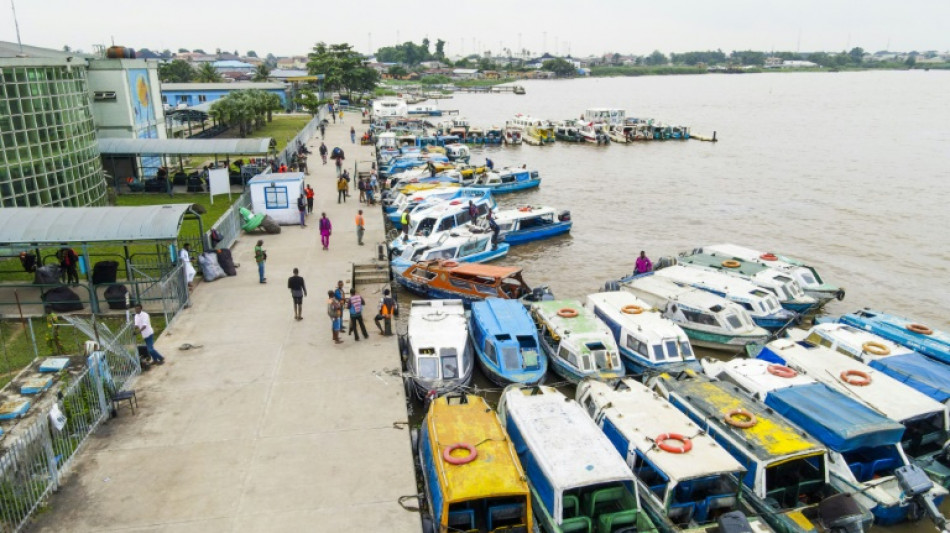
Nigeria's Lagos turns to waterways for green transport solution / Photo: OLUKA LEVI - AFP

 Vessel operator seeks witnesses after Vancouver grounding

 Shrini Srivastava joins crew of Varanasi-Delhi Vande Bharat Sleeper service

 Nearly Half of Australian Workers Overqualified, Survey Finds

 RBI eases export-declaration compliance for individual service exporters

 Reliance shares remain in focus after near-12% surge

 Coal India prepares possible $1 billion Mahanadi Coalfields listing

 Capital-markets shares rally as Motilal Oswal and Angel One lead gains

 Reliance rally puts historical one-year return pattern in focus

 Saudi Aramco quarterly profit climbs 34.6% amid elevated oil prices

 Australia raises benchmark rate to highest level in 18 years

 Asian stocks retreat as AI worries outweigh steep oil-price drop

 Hamad International Airport stages emergency drills during WATAN 2026

 Qatar solar expansion opens scope for technical performance gains
Nigerian saleswoman Ivy Junaid says her daily half-an-hour commute from mainland Lagos to the city's island business district has changed her life.
What was once often a three-hour nightmare drive to work with a pre-dawn start and gnarly traffic has become a quick sprint skimming across the waters of Lagos lagoon by boat.
"You can actually get out of bed when you need to. You have breakfast at home, strut in here, strut into the boat and 30 minutes across the water," the telecoms employee said.
"It's really a life-saving situation for most of us."
Flanked by lagoon waters and the Atlantic Ocean, Nigeria's economic capital Lagos has long used its waterways as an alternative to the megacity's chaotic roads.
But soon more commuters like Junaid in the city of 20 million could be travelling by boat under plans to massively expand waterway transport and multiply passenger numbers.
With an around 410-million-euro ($455-million) investment from France's AFD development agency and EU institutions, the progamme -- known as Omi Eko or Lagos Water in Yoruba language -- also aims to tackle carbon emissions with a fleet of electric-powered ferries.
Whereas most Lagosians live on the mainland part of the city, a lot of offices and workplaces are on the islands area -- Victory Island, Ikoyi, Lagos Island and Lekki -- linked by a series of bridges.
That means road traffic to the islands in the morning and back to the mainland after work can be heavy going. Even a small accident on a bridge or repair work can cause miles of tailback.
Bad roads and flooding during the rainy season coupled with the chaotic fleets of informal "Danfo" minibuses that pack the roads compound the difficulties.
The state government already has ambitious plans for more integrated public transport as Lagos barrels towards becoming the world's most populated city by the end of the century.
Intracity trainlines and dedicated bus lanes fed by smaller minibus routes aim to reduce traffic.
But only after years of delays, the first Blue Line train finally started running last year from a section of the mainland. Another Red Line is scheduled to open soon.
With water on all sides, however, boat transport is an obvious solution -- and one the project's funders believe could be replicated in Cameroon and Ivory Coast.
"We have viewed the waterways as the potential jewel in the crown to ensure we can unlock the traffic we see on the roads," General Manager of Lagos State Waterways Authority, Oluwadamilola Emmanuel, told AFP.
- Fuel and fear -
Transport and its costs are a major problem for Lagosians.
Nigeria faces its worst cost-of-living crisis in decades, with inflation at more than 30 percent and fuel costs more than triple the price of 18 months ago after government reforms.
That can mean a lot in a country where half the 200-million population lives in some form of poverty and where the minimum monthly wage is 70,000 naira or $46.
Nigerians have adapted. Some drive less, use public transport or work more from home. For Lagos boat operators, it often means cutting back to a single one-way trip a day.
Transport expert Samuel Odewumi at Lagos State University says the current Lagos administration will have to ensure the new development is sustainable.
"There are no cons, there are pros and pros for Lagos state with water transport," he said. "But over the years it has been in fits and starts."
Other problems such as dredging, fuel prices, jetty and boat quality and safety will need to be tackled, he said.
- Solar solution -
For the French agency AFD, already working with Lagos on bus systems, inland waterways were a clear solution to the oversaturated Lagos road network and a way to link up points around the city.
Over the next three years, the project aims to develop 15 ferry routes with more than 75 electric vessels, as well as upgrade the jetty system and dredge routes.
To overcome the city's feeble power grid, solar infrastructure and compressed natural gas generators will recharge the vessels at jetties.
"We already know that other countries are looking very closely at what we're doing with this project," David Margonsztern, chief of AFD's transport projects, told AFP.
Waterways authority chief Emmanuel hopes the project will increase boat passengers from around two percent of total commuters now to around 10 percent.
"We will be moving about 10 million people on a monthly basis," he said.
Cost and fear of water are concerns for many.
For first time boat rider Adeyemi Jagbojagbo, a driver, the novelty of arriving at a ferry terminal provided relief from the traffic but he was still unsure he would do it again.
"This is my first time, I'm so scared, like the way the boat was doing," he said. "So I just pray maybe I should come back."
M.P.Jacobs--CPN