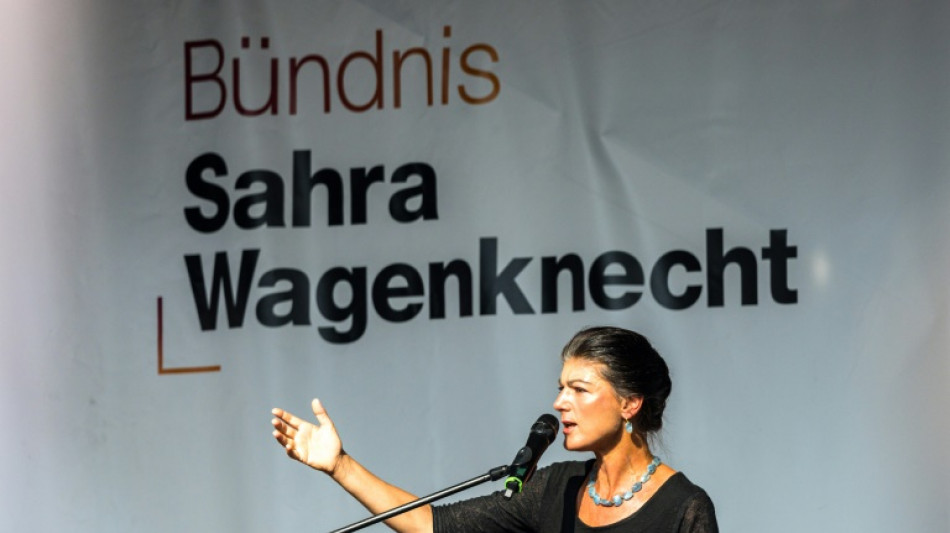
Far-left rebel seeking peace with Putin rocks German politics / Photo: JENS SCHLUETER - AFP/File

 Vessel operator seeks witnesses after Vancouver grounding

 Shrini Srivastava joins crew of Varanasi-Delhi Vande Bharat Sleeper service

 Nearly Half of Australian Workers Overqualified, Survey Finds

 RBI eases export-declaration compliance for individual service exporters

 Reliance shares remain in focus after near-12% surge

 Coal India prepares possible $1 billion Mahanadi Coalfields listing

 Capital-markets shares rally as Motilal Oswal and Angel One lead gains

 Reliance rally puts historical one-year return pattern in focus

 Saudi Aramco quarterly profit climbs 34.6% amid elevated oil prices

 Australia raises benchmark rate to highest level in 18 years

 Asian stocks retreat as AI worries outweigh steep oil-price drop

 Hamad International Airport stages emergency drills during WATAN 2026

 Qatar solar expansion opens scope for technical performance gains
A radical far-left politician who wants to make peace with Russia's Vladimir Putin looks set to play a key role in regional elections in the former East Germany on Sunday.
Sahra Wagenknecht, 55, born in communist East Germany to an Iranian father and a German mother, defected from the far-left Die Linke to form her own party, BSW, last year.
Wagenknecht has caused a stir in Germany by calling for negotiations with Putin, an end to the government's support for Ukraine and a radical crackdown on immigration.
But BSW won an impressive 6.2 percent in June's European Union elections and looks set to pick up between 15 and 20 percent of the vote on Sunday in Saxony and Thuringia.
At a rally in her hometown of Jena, Wagenknecht spoke passionately about her upbringing in East Germany and "the fear that nuclear bombs could fall here in Europe".
"Now the fear is back," she said.
BSW wants to stop weapons deliveries to Ukraine and rejects plans to allow the United States to periodically station long-range missiles in Germany.
Wagenknecht also called for tougher immigration laws, days after a Syrian man allegedly stabbed three people to death in the western city of Solingen.
BSW wants to "reverse" the current government's immigration policy, she said.
"We cannot welcome the whole world in Germany."
- Kingmaker? -
Opinion polls for Sunday's elections have the far-right AfD as the biggest party in Thuringia on around 30 percent, while in Saxony it is running neck-and-neck for first place with the conservative CDU.
The AfD is also leading the polls in a third former East German state, Brandenburg, set to hold an election later in September.
However, the AfD is unlikely to come to power in any of these states, even if it wins, as other parties have ruled out collaborating with it to form a majority.
This could leave the mainstream parties scrambling to form ruling coalitions -- and Wagenknecht's party could end up being the kingmaker.
Speaking to AFP, Wagenknecht said the upcoming elections would be "very important" for her party.
"If we make our entrance into each of these regional parliaments with a score in double figures, we will no longer be seen as just a media phenomenon but as a party destined to change our country's politics," she said.
Indeed, the "interesting question" about the regional elections will be "how strong the Sahra Wagenknecht alliance will be in the end", said Marianne Kneuer, a professor of politics at the Dresden University of Technology (TU Dresden).
"It is possible that BSW could become an important factor in forming a coalition in Brandenburg, Thuringia and Saxony," said Kneuer, predicting that the new party could also enter the national parliament for the first time next year.
- 'Completely absurd' -
Wagenknecht told AFP she accepted that "Putin started a war contrary to international law" but said the "West has its share of responsibility".
"We could have avoided this conflict if we had taken Russia's security concerns seriously," she said.
She rejected allegations of pro-Russian false information being spread by some members of her party, saying it was "shameful to accuse us of that".
"We are accused of being the voice of Moscow or of representing Russian positions because we are in favour of peace negotiations, which is completely absurd," she said.
On immigration, Wagenknecht pointed to Denmark's restrictive policy as an example Germany could follow.
"They have drastically reduced their numbers by signalling to the whole world that there is no hope of staying there if your asylum application is rejected," she said.
Some have pointed out that BSW's positions on Ukraine and immigration are broadly similar to those of the AfD, but Wagenknecht has ruled out any kind of collaboration with the far right.
"The AfD has a very radical right-wing faction, especially in the east," she said.
Her party cannot "go into coalition with people who have an ethnic nationalist ideology."
At the rally in Jena, 83-year-old retired nurse Margit Hoffmann said "the most important thing for me is peace".
"German public funds should go on other things, not weapons deliveries," Hoffmann said as she leaned on her walking frame.
A.Zimmermann--CPN