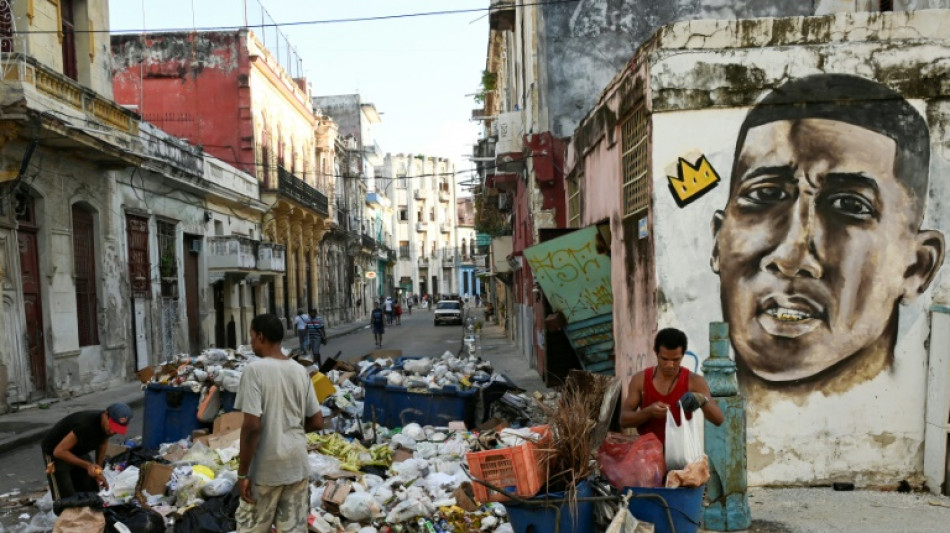
Trash overwhelms Havana as garbage trucks lack parts, fuel / Photo: YAMIL LAGE - AFP

 Vessel operator seeks witnesses after Vancouver grounding

 Shrini Srivastava joins crew of Varanasi-Delhi Vande Bharat Sleeper service

 Nearly Half of Australian Workers Overqualified, Survey Finds

 RBI eases export-declaration compliance for individual service exporters

 Reliance shares remain in focus after near-12% surge

 Coal India prepares possible $1 billion Mahanadi Coalfields listing

 Capital-markets shares rally as Motilal Oswal and Angel One lead gains

 Reliance rally puts historical one-year return pattern in focus

 Saudi Aramco quarterly profit climbs 34.6% amid elevated oil prices

 Australia raises benchmark rate to highest level in 18 years

 Asian stocks retreat as AI worries outweigh steep oil-price drop

 Hamad International Airport stages emergency drills during WATAN 2026

 Qatar solar expansion opens scope for technical performance gains
Cuba's iconic capital Havana is drowning in a sea of uncollected trash as a critical shortage of fuel and vehicle parts affects garbage collection on the island crippled by sanctions and economic woes.
Mountains of rubbish on the streets give off a foul odor and attract clouds of flies in several parts of the city of 2.1 million people, which has three open-air landfills.
For a lack of bins, residents leave their trash bags in the street, exacerbating the stench already emanating from overflowing sewage pipes.
"My kitchen looks out on the garbage dump," Lissette Valle, a 40-year-old homemaker, told AFP.
"We have to cover everything. If we don't, we end up eating flies, mosquitos..."
Official data show more than 30,000 cubic meters -- about 1,000, 20-foot shipping containers -- accumulate on the streets of Havana every day.
A year ago it was less than a third as much.
According to the provincial directorate of municipal services, the capital has just over half the equipment it needs for waste collection, with 100 garbage trucks.
But the vehicles, which were a donation from Japan, started breaking down last year.
Due to US sanctions, the communist country cannot obtain the parts it needs to repair its ramshackle fleet of trucks, local authorities were quoted as telling state mouthpiece Granma.
Add to this the fuel shortages that have plagued Cuba since 2023.
"This is something that hits us hard: fuel," municipal official Miguel Gutierrez Lara told Granma, also lamenting the shortage of workers in the sector due to low wages.
"We expose ourselves to bacteria" for a minimum monthly salary equivalent to $17, complained a 30-year-old garbage collector who did not want to give his name.
He said he does not even have gloves to do his work.
The city "is full of micro dumps," said the collector as he pushed a rickety garbage cart.
Health inspector Jesus Jiminez told AFP the problem "has become uncontrollable," with mosquitos and other carriers of diseases such as dengue and oropouche fever propagating freely.
- 'Abundant' trash -
Cuba's tourist-magnet waters are not faring much better.
On Guanabo beach outside the capital, Reinier Fuentes emerges from the crystal waves gripping his diving fins in one hand, with rusting tin cans and diverse waste in the other.
"On the beaches there are companies dedicated to cleaning... but in the ocean there is no one," said Fuentes, president of an NGO that removes rubbish from the seabed along the coast.
Havana's natural resources boss Solvieg Rodriguez conceded that an "abundant" accumulation of metal waste on beaches posed a major challenge.
For Dulce Buergo, president of the Cuban National Commission of UNESCO, part of the solution lies in greater individual responsibility.
"If you come to the beach with four bags, you should leave with all four bags -- even if the fourth bag is full of trash. And that should never be left on the beach," she said.
X.Cheung--CPN