China's underwhelming data dampens hope of economic recovery
/ Photo: STR - AFP

 Vessel operator seeks witnesses after Vancouver grounding

 Shrini Srivastava joins crew of Varanasi-Delhi Vande Bharat Sleeper service

 Nearly Half of Australian Workers Overqualified, Survey Finds

 RBI eases export-declaration compliance for individual service exporters

 Reliance shares remain in focus after near-12% surge

 Coal India prepares possible $1 billion Mahanadi Coalfields listing

 Capital-markets shares rally as Motilal Oswal and Angel One lead gains

 Reliance rally puts historical one-year return pattern in focus

 Saudi Aramco quarterly profit climbs 34.6% amid elevated oil prices

 Australia raises benchmark rate to highest level in 18 years

 Asian stocks retreat as AI worries outweigh steep oil-price drop

 Hamad International Airport stages emergency drills during WATAN 2026

 Qatar solar expansion opens scope for technical performance gains
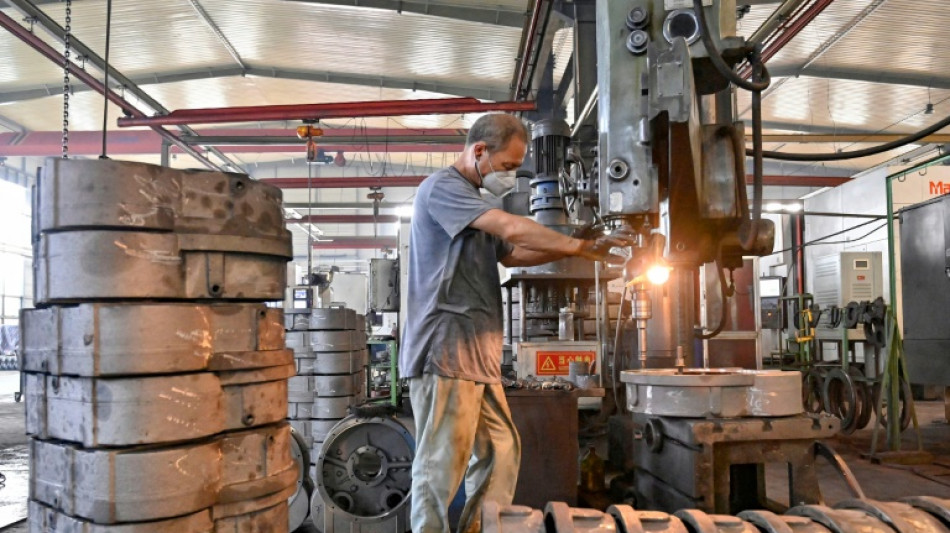
Chinese industrial production growth slowed in July while unemployment rose, official data showed Thursday, highlighting an uneven recovery in the world's second-largest economy despite recent government measures to try to stimulate expansion.
More than a year and a half after the lifting of stringent Covid-19 measures, the much-anticipated post-pandemic recovery has been brief and less robust than expected, while a property crisis and high unemployment have weighed on investor confidence.
Chinese leaders have called for "eliminating risks" in the economy following a key political meeting in July and introduced 20 measures earlier this month aimed at boosting consumption.
Still, industrial production growth weakened in July, with the month's 5.1 percent expansion inching down from 5.3 percent in June, according to the National Bureau of Statistics (NBS) -- its weakest growth since March.
It also fell short of the 5.2 percent increase that analysts surveyed by Bloomberg had predicted.
Meanwhile, the unemployment rate rose to 5.2 percent in July, from 5 percent in June.
However, the NBS figures paint an incomplete picture of China's overall employment situation, as they only take urban areas into account.
The unemployment rate for people aged 16 to 24 was 13.2 percent in June, according to a new calculation that now excludes students. July's figures have not yet been released.
It had skyrocketed to a record 21.3 percent last year, before authorities suspended the publication of figures for several months, citing a need to review methodology.
- 'Bleak picture' -
July data released over the past week "paints a bleak picture of the Chinese economy", said economist Larry Hu from Macquarie Group.
The data suggests that growth "edged down slightly" at the start of the third quarter, Capital Economics' Julian Evans-Pritchard said in a note.
But "the pace of decline appears to have eased and a cyclical turning point could be near", he added.
Retail sales -- a key indicator of consumer spending -- grew 2.7 percent year-on-year, climbing from June's 2.0 percent increase, and narrowly beating the 2.6 percent forecast in the Bloomberg survey.
Some sectors like the services industry in China have seen some recovery, driven largely by domestic tourism.
But significant hurdles remain for other sectors including the real estate industry, which long accounted for more than a quarter of China's GDP.
This sector has been under pressure with many housing developers on the brink of bankruptcy, discouraging Chinese from investing in property.
China's major cities recorded another decline in real estate prices in July, a sign of sluggish demand.
In July, demand for bank loans also contracted for the first time in nearly 20 years, according to official figures published earlier this week.
International challenges are also mounting, with the European Union and the United States increasingly imposing trade barriers to protect their markets from low-cost Chinese products and perceived unfair competition.
Ng.A.Adebayo--CPN