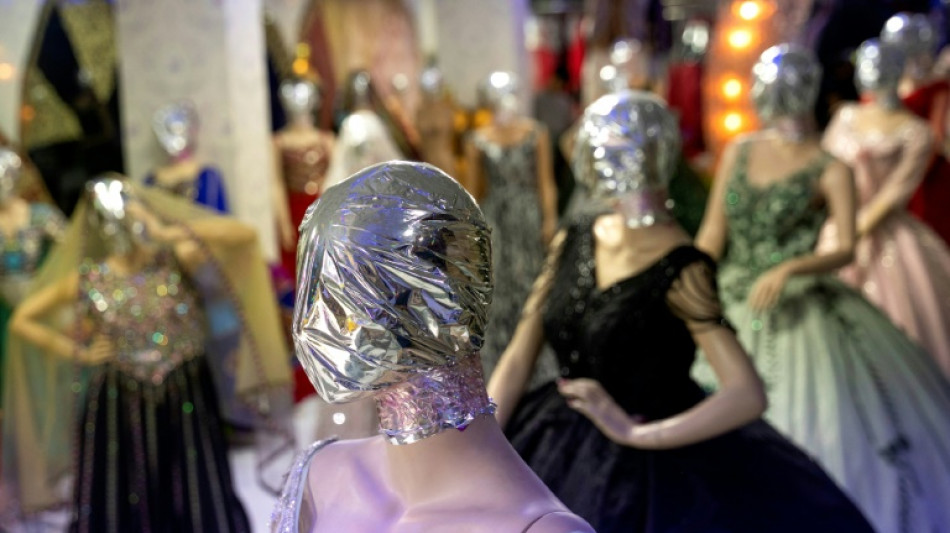
Faceless mannequins show off clothes in Afghanistan / Photo: Wakil KOHSAR - AFP

 Vessel operator seeks witnesses after Vancouver grounding

 Shrini Srivastava joins crew of Varanasi-Delhi Vande Bharat Sleeper service

 Nearly Half of Australian Workers Overqualified, Survey Finds

 RBI eases export-declaration compliance for individual service exporters

 Reliance shares remain in focus after near-12% surge

 Coal India prepares possible $1 billion Mahanadi Coalfields listing

 Capital-markets shares rally as Motilal Oswal and Angel One lead gains

 Reliance rally puts historical one-year return pattern in focus

 Saudi Aramco quarterly profit climbs 34.6% amid elevated oil prices
 Australia raises benchmark rate to highest level in 18 years

 Asian stocks retreat as AI worries outweigh steep oil-price drop

 Hamad International Airport stages emergency drills during WATAN 2026

 Qatar solar expansion opens scope for technical performance gains
In Afghanistan's capital, shop windows display dazzling ball gowns and three-piece wedding suits -- with the face of each mannequin covered.
The morality police have asked stores to hide the mannequins' faces and photographs of models, according to a clothes seller in Kabul.
"It makes the display a bit ugly," said the 22-year-old, but it "doesn't affect sales".
When the Taliban swept back to power in August 2021, it imposed its austere interpretation of Islamic law, including an edict against depicting human faces.
"The environment must be Islamic," said the salesman in Kabul, who asked not to be named for fear of reprisals.
Women's evening dresses come in bright colours, some styles leaving shoulders exposed or with plunging necklines -- almost all sparkling with sequins.
The dresses are bought to be worn only in private, at gender-segregated weddings or engagement parties.
The heads of the mannequins sporting each dress are wrapped in plastic, foil or black bags.
"Later, they may order that the arms are also covered in plastic," the salesman predicted.
Other shops display traditional Afghan wedding dresses with full-bodied skirts and intricate embroidery.
The Taliban government has told women to completely cover up in public.
Women running errands in Kabul's shopping district were seen wearing abaya robes and covering their faces with a medical mask.
- 'We make do' -
After the ban on depicting human faces was introduced in January 2022, religious police in Herat decapitated mannequins by cutting and snapping off the heads.
The rule is now enforced nationwide by teams from the Ministry for the Propagation of Virtue and the Prevention of Vice. Dressed in long white jackets, they visit Kabul's stores multiple times each week.
At a multistory Kabul shopping centre, the mannequins' heads are now mostly covered by plastic bags or wrapped in foil.
"In some areas, the 'Vice and Virtue' visit on certain days, so (the shopkeepers) cover and then uncover the faces of the mannequins," said Popalzai, a shopkeeper using a pseudonym.
"But here, there are between three and six guys who come two or three times a week. They check from a distance, they are much softer than before," added the shopkeeper, who experienced the Taliban government's first reign between 1996 and 2001.
At the entrance to his store, male mannequins in Western clothes such as jeans or three-piece suits -- discouraged by the Taliban authorities -- are all hooded. One of them is wearing sunglasses.
Customers and sellers seemed unfazed by the eerie, headless figures.
"There are more serious problems," said another shopkeeper, referencing the tough economic climate and the restrictions on women's education and work.
"This is not very important for Afghan people," he said.
"We make do with it."
Y.Uduike--CPN