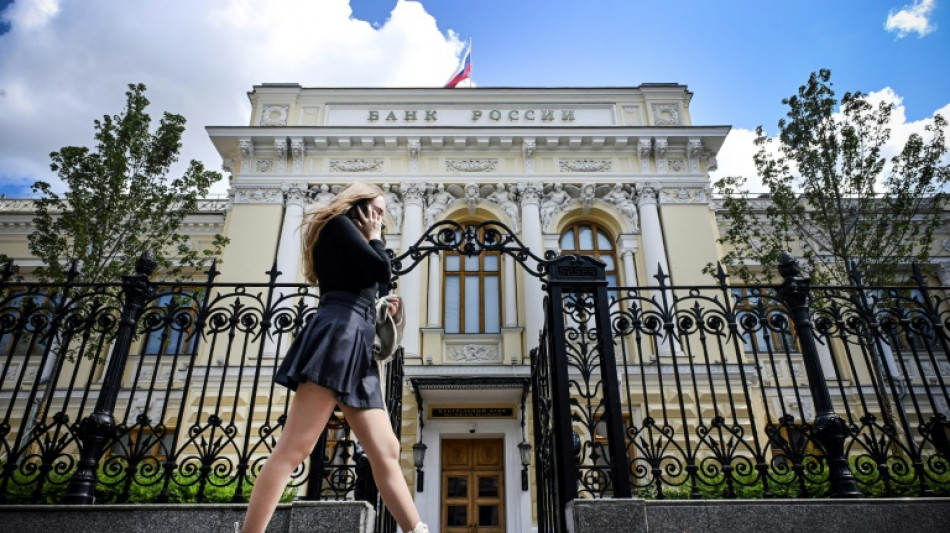
Russian economic growth dips in second quarter as inflation rises / Photo: Alexander NEMENOV - AFP

 Vessel operator seeks witnesses after Vancouver grounding

 Shrini Srivastava joins crew of Varanasi-Delhi Vande Bharat Sleeper service

 Nearly Half of Australian Workers Overqualified, Survey Finds

 RBI eases export-declaration compliance for individual service exporters

 Reliance shares remain in focus after near-12% surge

 Coal India prepares possible $1 billion Mahanadi Coalfields listing

 Capital-markets shares rally as Motilal Oswal and Angel One lead gains

 Reliance rally puts historical one-year return pattern in focus

 Saudi Aramco quarterly profit climbs 34.6% amid elevated oil prices
 Australia raises benchmark rate to highest level in 18 years

 Asian stocks retreat as AI worries outweigh steep oil-price drop

 Hamad International Airport stages emergency drills during WATAN 2026

 Qatar solar expansion opens scope for technical performance gains
The pace of Russia's economic growth slowed in the second quarter of 2024, official data showed Friday, amid concerns over stubborn inflation and warnings of "overheating".
Gross domestic product (GDP) dipped from 5.4 percent in the first quarter to four percent from April to June, the lowest quarterly result since the start of 2023 but still a sign the economy is expanding.
Inflation meanwhile showed no signs of easing, with consumer prices rising 9.13 percent year-on-year in July -- up from 8.59 percent in June and the highest figure since February 2023, according to data from the Rosstat statistics agency.
The Kremlin has heavily militarised Russia's economy since sending troops into Ukraine in February 2022, spending huge sums on arms production and on military salaries.
That spending boom has fuelled economic growth, helping the Kremlin buck initial predictions of a recession when it was hit with unprecedented Western sanctions in 2022.
But it has sent inflation surging at home, forcing the central bank to raise borrowing costs.
- 'Overheating' -
The central bank has aggressively raised interest rates in a bid to cool what it has warned is an economy growing at unsustainable rates due to the massive increase in government spending on the Ukraine offensive.
The bank raised its key interest rate to 18 percent last month -- the highest level since an emergency hike in February 2022 took it to 20 percent.
The bank's governor Elvira Nabiullina said the economy was showing signs of "overheating" and pointed to difficulties with international payments -- an effect of Western sanctions -- as another factor driving up inflation.
Russia is set to spend almost nine percent of its GDP on defence and security this year, a figure unprecedented since the Soviet era, according to President Vladimir Putin.
Moscow's federal budget has meanwhile jumped almost 50 percent over the last three years -- from 24.8 trillion rubles in 2021, before the Ukraine offensive, to a planned 36.6 trillion rubles ($427 billion) this year.
Since so much spending is being directed by the state, which is less responsive to higher borrowing costs, analysts fear interest rate rises may not be an effective tool against inflation.
Consumer prices are a sensitive topic in Russia, where many people have virtually no savings and memories of hyperinflation and economic instability run deep.
D.Philippon--CPN