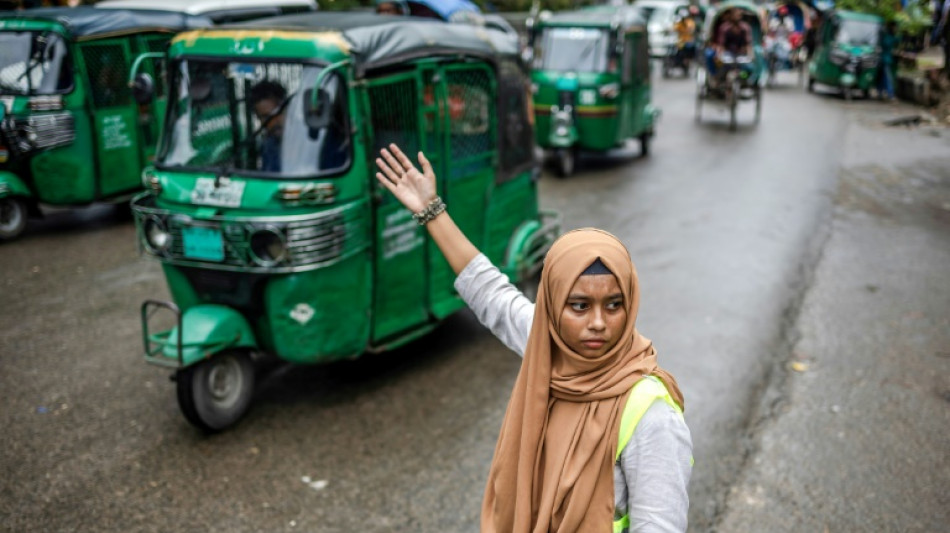
As police strike, Bangladesh students cop traffic duty / Photo: LUIS TATO - AFP

 Vessel operator seeks witnesses after Vancouver grounding

 Shrini Srivastava joins crew of Varanasi-Delhi Vande Bharat Sleeper service

 Nearly Half of Australian Workers Overqualified, Survey Finds

 RBI eases export-declaration compliance for individual service exporters

 Reliance shares remain in focus after near-12% surge

 Coal India prepares possible $1 billion Mahanadi Coalfields listing

 Capital-markets shares rally as Motilal Oswal and Angel One lead gains

 Reliance rally puts historical one-year return pattern in focus

 Saudi Aramco quarterly profit climbs 34.6% amid elevated oil prices
 Australia raises benchmark rate to highest level in 18 years

 Asian stocks retreat as AI worries outweigh steep oil-price drop

 Hamad International Airport stages emergency drills during WATAN 2026

 Qatar solar expansion opens scope for technical performance gains
Bangladeshi students battled police for control of the streets and won, but if their country is to embark on a new journey, someone has to clear the road ahead.
Gridlock is a fact of life in the capital Dhaka, a megacity of 20 million which relies on a corps of police wardens to clear long snarls of cars and pedal rickshaws through intersections.
With officers on strike after the resignation of ex-premier Sheikh Hasina, the students who forced her ouster have stepped up to do the job themselves.
"Our country can't remain in a standstill," Nasrin Akter Koly, 21, told AFP.
"We clashed with the police, that's why the police are not on duty," she added. "So instead of the police, our people must do the work."
Traffic control is a humdrum job at the best of times and many of Dhaka's usual wardens are known for a casual indifference to aggressive drivers zooming by out of turn.
But Koly and her classmates have brought a new enthusiasm to the vocation as they wave through cars at one of the downtown business district's busiest crossroads.
Drivers are in turn treating the volunteers with respect.
Nearly all are stopping on command and heeding polite but firm directions to fasten their seatbelts -- the kind of minor traffic infraction that would have previously been ignored.
"After a revolution, every country faces some difficulties," said Nahid Kalam Nabil, 22, while directing traffic alongside Koly.
"The students are handling the situation now, and they will keep the country safe," he added.
- 'Teaching the people' -
More than 450 people were killed during weeks of clashes between protesters and security forces before Hasina quit and fled to India on Monday.
Protests had been largely peaceful until police attempted to violently disperse them, setting in motion the chain of events that led to the end of Hasina's iron-fisted 15-year tenure.
Dozens of police officers were killed in the unrest, according to police and hospital figures given to AFP.
After her departure, vandalism and arson attacks hit roughly 450 of the country's 600 police stations, according to the force.
Police unions declared a national strike on Tuesday "until the security" of officers was assured, and a new police chief apologised for the conduct of officers under his sacked predecessor.
Unrest has since subsided, thanks in part to students volunteering for neighbourhood watch patrols and guarding houses of worship for minority religions, which were subjected to isolated looting attacks.
"They are safeguarding the houses at night, they are safeguarding the mosques, temples and churches," Nabil said.
"They are teaching the people law and order. They are designing the country in a new way."
Many police officers began returning to work Friday with soldiers -- held in high esteem for not intervening on Hasina's side during the unrest -- standing guard.
Farida Akhter, a member of the interim government tasked with steering democratic reforms, told AFP that restoring law and order was the "first priority" of the new dispensation.
The sudden collapse of Hasina's administration left a gaping vacuum in political administration, with many civil servants staying home waiting for the dust to settle.
The city government in Dhaka has also laid low, prompting other student volunteers to take on its duties.
"With this students' protest, we have made a fascist regime fall," 20-year-old Samanjar Chowdhury Mrittika told AFP while wielding a broom to sweep up garbage from a downtown sidewalk.
"The country is not in a good condition," she added. "Someone must take responsibility."
Ng.A.Adebayo--CPN