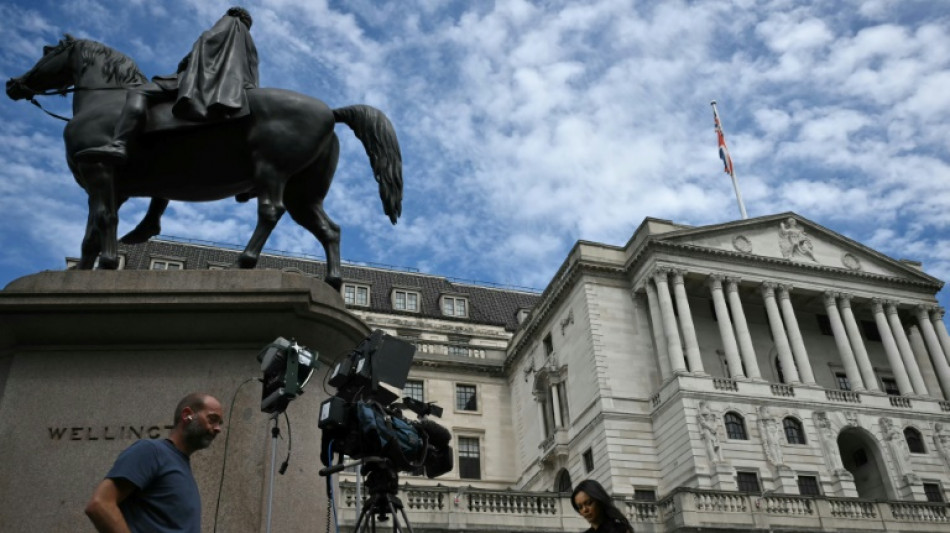
Bank of England to finally cut interest rate? / Photo: Ben Stansall - AFP

 Vessel operator seeks witnesses after Vancouver grounding

 Shrini Srivastava joins crew of Varanasi-Delhi Vande Bharat Sleeper service

 Nearly Half of Australian Workers Overqualified, Survey Finds

 RBI eases export-declaration compliance for individual service exporters

 Reliance shares remain in focus after near-12% surge

 Coal India prepares possible $1 billion Mahanadi Coalfields listing

 Capital-markets shares rally as Motilal Oswal and Angel One lead gains

 Reliance rally puts historical one-year return pattern in focus

 Saudi Aramco quarterly profit climbs 34.6% amid elevated oil prices

 Australia raises benchmark rate to highest level in 18 years

 Asian stocks retreat as AI worries outweigh steep oil-price drop

 Hamad International Airport stages emergency drills during WATAN 2026
The Bank of England announces its latest interest-rate decision Thursday, with analysts split on whether it will cut for the first time since the Covid pandemic after inflation's retreat.
The conclusion of a regular policy meeting will see whether the BoE trims borrowing costs, currently at a 16-year high of 5.25 percent, by a quarter point with Britain's annual inflation rate having returned to the central bank's two-percent target.
Ahead of the decision, the US Federal Reserve on Wednesday left its key lending rate unchanged, but noted "some further progress" had been made in bringing inflation down.
Other major central banks, including the European Central Bank, have started to trim rates as rises to global goods and services prices have largely slowed in recent months.
By contrast, the Bank of Japan on Wednesday hiked borrowing costs for only the second time in 17 years amid a pickup in the country's inflation.
- BoE call on 'knife edge' -
For the BoE, "the prospect of a rate cut is on a knife edge", noted Kathleen Brooks, research director at XTB trading group.
Analysts have said that while Britain's headline inflation rate has fallen sharply over the past year, prices are still rising for many goods and services -- evidence that the BoE could sit tight for a while longer.
They add that its decision could depend on the BoE's latest forecast for British economic growth, which is due alongside Thursday's rate call.
Britain's new Labour government has vowed to grow the country's economy but has already warned that state spending will be hampered by tight finances.
The country's new finance minister Rachel Reeves on Monday said Britain's state coffers faced an extra £22 billion ($28-billion) hole inherited from the previous Conservative administration.
Reeves said the scale of the overspend was "not sustainable", and that not acting was "simply not an option" for her newly elected government headed by Prime Minister Keir Starmer.
The Conservatives said this indicated tax rises were on the way.
The BoE, headed by governor Andrew Bailey, hiked borrowing costs 14 times between late 2021 -- when they stood at a record-low 0.1 percent -- and the second half of last year.
Supply-chain disruptions following Covid lockdowns in addition to soaring food and energy prices caused by Russia's invasion of Ukraine sent global inflation surging.
UK annual inflation hit a four-decade high above 11 percent in late 2022.
High interest rates boost savers but hurt borrowers, including businesses. British retail banks tend to mirror action by the BoE, resulting in big jumps in mortgage rates.
M.García--CPN