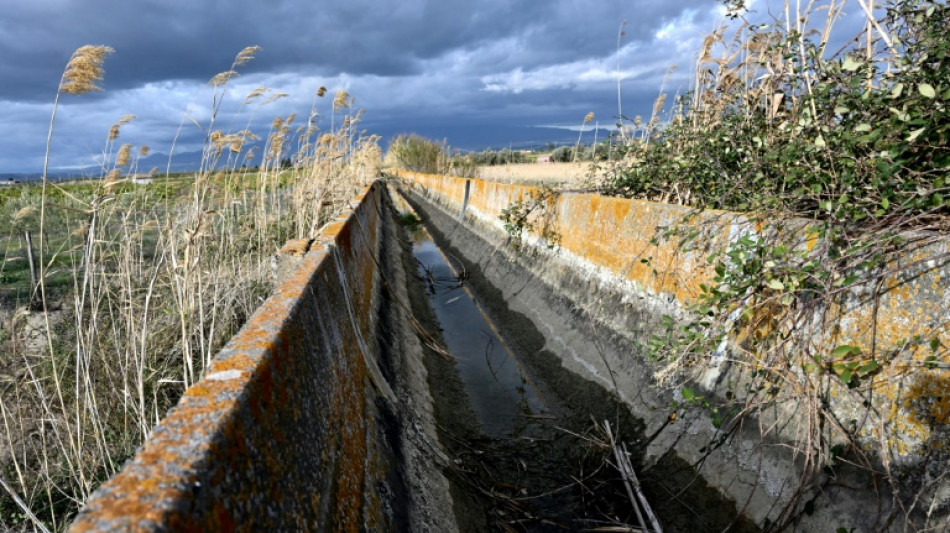
Drought in Sicily threatens grain fields, animal herds / Photo: Alberto PIZZOLI - AFP/File

 Vessel operator seeks witnesses after Vancouver grounding

 Shrini Srivastava joins crew of Varanasi-Delhi Vande Bharat Sleeper service

 Nearly Half of Australian Workers Overqualified, Survey Finds

 RBI eases export-declaration compliance for individual service exporters

 Reliance shares remain in focus after near-12% surge

 Coal India prepares possible $1 billion Mahanadi Coalfields listing

 Capital-markets shares rally as Motilal Oswal and Angel One lead gains

 Reliance rally puts historical one-year return pattern in focus

 Saudi Aramco quarterly profit climbs 34.6% amid elevated oil prices

 Australia raises benchmark rate to highest level in 18 years

 Asian stocks retreat as AI worries outweigh steep oil-price drop

 Hamad International Airport stages emergency drills during WATAN 2026
A crushing drought in Sicily has withered fields of grain, deprived livestock of pasture land and fanned a spate of wildfires, causing damage already estimated at 2.7 billion euros this year.
In an attempt to mitigate the effects of the water crisis, the Italian government in early May declared a state of emergency for the southern island, unblocking funds to purchase water tanker trucks, drill wells and renovate pumping and desalination stations.
But ensuing months of continued high temperatures have done nothing to ameliorate the already dire conditions, with farmers giving up on their harvests and now wondering how they'll feed and water their animals.
"There's no hope, because it hasn't rained since May of last year," said Salvatore Michele Amico, a farmer near the town of San Cataldo in Sicily's dry interior.
"All the planted fields have been lost: there is no wheat, no barley, no oats," Amico told AFP.
The land in these parts, deprived of vegetation, is bare and cracked. Rivers, ponds and watering holes are dried up and farming equipment sits idle on formerly productive land, as cows wander in search of a blade of grass.
Once the breadbasket of ancient Rome, Sicily is expected this year to see its wheat harvest collapse by more than 50 percent, according to agricultural lobby Coldiretti.
"It didn't rain this year, so we haven't harvested anything and we can't feed or water the animals," noted another nearby farmer, Beppe Palmieri, whose land formerly supported cattle and goats as well as fields of grain and feed.
Whereas efforts are being made to bring in feed from the outside, the water situation is "critical", Palmieri said.
"There is no water for the animals to drink, we don't know what to do. We have issues with accessibility, certain types of tankers can't come up and provide water to the animals," he said.
- 5,800 hectares burned -
Farmer Fabio Scarantino stands in front of his herd of cattle. Their light brown hides match the dry, dusty landscape behind them.
"Climate change in Sicily is real. In the past we talked about it but we could never have imagined experiencing it first hand," Scarantino said.
Unlike Sicily's coasts, which rely largely on tourism, "in the Sicilian hinterland, which depends on livestock and agriculture, climate change plays a considerable role," he said.
Families who have been farming for generations are left without prospects for the future, including cattle breeders who for decades have built up their animals' bloodlines, said Massimo Primavera, the Coldiretti director for the area around Caltanissetta, a town of 250,000 inhabitants in the centre of Sicily.
Besides the threat to livestock and fields of grain, the drought also impacts fruit trees, vineyards and olive groves to the total tune of more than 2.7 billion euros ($2.9 billion), Coldiretti says.
Meanwhile, 5,800 hectares (14,000 acres) of agricultural land have gone up in flames since the beginning of July due to wildfires that erupt with the dry conditions, said the group.
Exacerbating the effects of the drought is a lack of investment in infrastructure "to prevent water from being wasted," Coldiretti said.
According to Italy's National Institute of Statistics (Istat), Sicily has one of the country's highest rates of wasted drinking water, with 51.6 percent of water lost from distribution circuits in 2022.
Istat, which says that every day in Italy 157 litres per person are lost, blames the waste on "the persistent state of inefficiency of many distribution networks".
C.Peyronnet--CPN