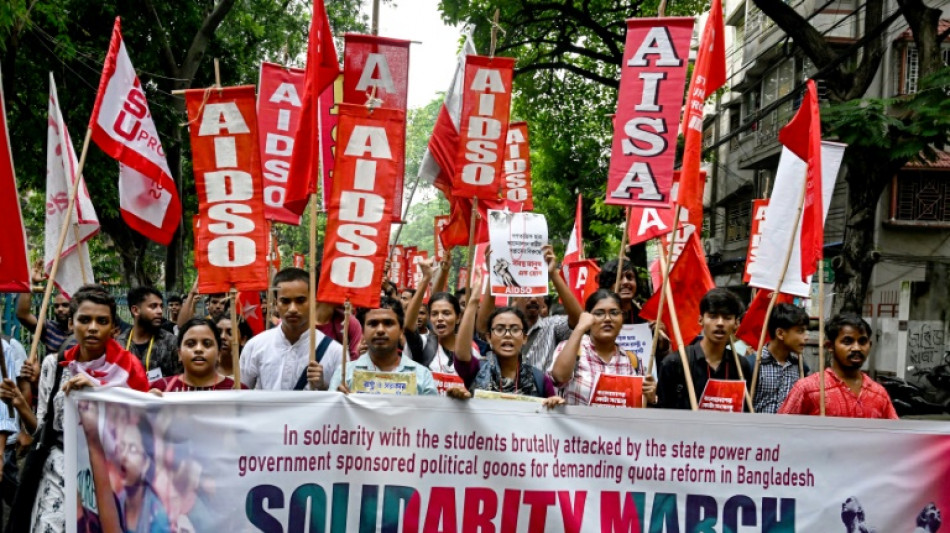
Bangladesh students vow to resume protests unless leaders freed / Photo: Dibyangshu SARKAR - AFP

 Vessel operator seeks witnesses after Vancouver grounding

 Shrini Srivastava joins crew of Varanasi-Delhi Vande Bharat Sleeper service

 Nearly Half of Australian Workers Overqualified, Survey Finds

 RBI eases export-declaration compliance for individual service exporters

 Reliance shares remain in focus after near-12% surge

 Coal India prepares possible $1 billion Mahanadi Coalfields listing

 Capital-markets shares rally as Motilal Oswal and Angel One lead gains

 Reliance rally puts historical one-year return pattern in focus

 Saudi Aramco quarterly profit climbs 34.6% amid elevated oil prices

 Australia raises benchmark rate to highest level in 18 years

 Asian stocks retreat as AI worries outweigh steep oil-price drop

 Hamad International Airport stages emergency drills during WATAN 2026
A Bangladeshi student group has vowed to resume protests that sparked a lethal police crackdown and nationwide unrest unless several of their leaders are released from custody on Sunday.
Last week's violence killed at least 205 people, according to an AFP count of police and hospital data, in one of the biggest upheavals of Prime Minister Sheikh Hasina's 15-year tenure.
Army patrols and a nationwide curfew remain in place more than a week after they were imposed, and a police dragnet has scooped up thousands of protesters including at least half a dozen student leaders.
Members of Students Against Discrimination, whose campaign against civil service hiring rules precipitated the unrest, said they would end their weeklong protest moratorium.
The group's chief Nahid Islam and others "should be freed and the cases against them must be withdrawn", Abdul Hannan Masud told reporters in an online briefing late Saturday.
Masud, who did not disclose his location because he was in hiding from authorities, also demanded "visible actions" be taken against government ministers and police officers responsible for the deaths of protesters.
"Otherwise, Students Against Discrimination will be forced to launch tough protests" from Monday, he said.
Islam and two other senior members of the protest group were on Friday forcibly discharged from hospital in the capital Dhaka and taken away by a group of plainclothes detectives.
Earlier in the week Islam told AFP he was being treated at the hospital for injuries police inflicted on him during an earlier round of detention and said he was in fear for his life.
Home minister Asaduzzaman Khan told reporters Friday that the trio were taken into custody for their own safety but did not confirm if they had been formally arrested.
Police told AFP on Sunday that detectives had taken two others into custody, while a Students Against Discrimination activist told AFP that a third had been taken on Sunday morning.
At least 9,000 people have been arrested nationwide since the unrest began according to Prothom Alo, Bangladesh's largest daily newspaper.
- Jobs crisis -
Protests began this month over the reintroduction of a quota scheme reserving more than half of all government jobs for certain candidates.
With around 18 million young Bangladeshis out of work, according to government figures, the move deeply upset graduates facing an acute employment crisis.
Critics say the quota is used to stack public jobs with loyalists to the ruling Awami League.
The Supreme Court cut the number of reserved jobs last week but fell short of protesters' demands to scrap the quotas entirely.
Prime Minister Hasina has ruled Bangladesh since 2009 and won her fourth consecutive election in January after a vote without genuine opposition.
M.García--CPN