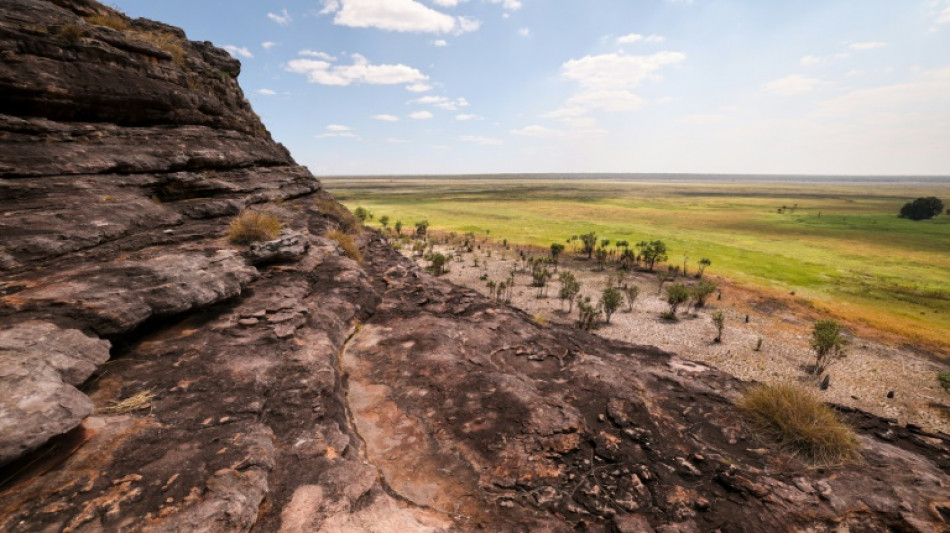
Australia bans uranium mining at Indigenous site / Photo: DAVID GRAY - AFP/File

 Vessel operator seeks witnesses after Vancouver grounding

 Shrini Srivastava joins crew of Varanasi-Delhi Vande Bharat Sleeper service

 Nearly Half of Australian Workers Overqualified, Survey Finds

 RBI eases export-declaration compliance for individual service exporters

 Reliance shares remain in focus after near-12% surge

 Coal India prepares possible $1 billion Mahanadi Coalfields listing

 Capital-markets shares rally as Motilal Oswal and Angel One lead gains

 Reliance rally puts historical one-year return pattern in focus

 Saudi Aramco quarterly profit climbs 34.6% amid elevated oil prices

 Australia raises benchmark rate to highest level in 18 years

 Asian stocks retreat as AI worries outweigh steep oil-price drop

 Hamad International Airport stages emergency drills during WATAN 2026
Australia moved Saturday to ban mining at one of the world's largest high-grade uranium deposits, highlighting the site's "enduring connection" to Indigenous Australians.
The Jabiluka deposit in northern Australia is surrounded by the heritage-listed Kakadu national park, a tropical expanse of gorges and waterfalls featured in the first "Crocodile Dundee" film.
Prime Minister Anthony Albanese said the national park would be extended to include the Jabiluka site -- which has never been mined -- honouring the decades-long desires of the Mirrar people.
"They were seeking a guarantee that there would never be uranium mining on their land," Albanese told a crowd of Labor Party supporters in Sydney.
"This means there will never be mining at Jabiluka," he added.
Archaeologists discovered a buried trove of stone axes and tools near the Jabiluka site in 2017, which they dated at tens of thousands of years old.
The find was "proof of the extraordinary and enduring connection Aboriginal and Torres Strait Islander have had with our land", Albanese said.
"The Mirrar people have loved and cared for their land for more than 60,000 years.
"That beautiful part of Australia is home to some of the oldest rock art in the world," he added.
Discovered in the early 1970s, efforts to exploit the Jabiluka deposit have for decades been tied-up in legal wrangling between Indigenous custodians and mining companies.
It is one of the world's largest unexploited high-grade uranium deposits, according to the World Nuclear Association.
Rio Tinto-controlled company Energy Resources of Australia previously held mining leases at Jabiluka.
The conservation of Indigenous sites has come under intense scrutiny in Australia after mining company Rio Tinto blew up the 46,000-year-old Juukan Gorge rock shelters in 2020.
Australia's conservative opposition has vowed to build nuclear power plants across the country if it wins the next election, overturning a 26-year nuclear ban.
P.Kolisnyk--CPN