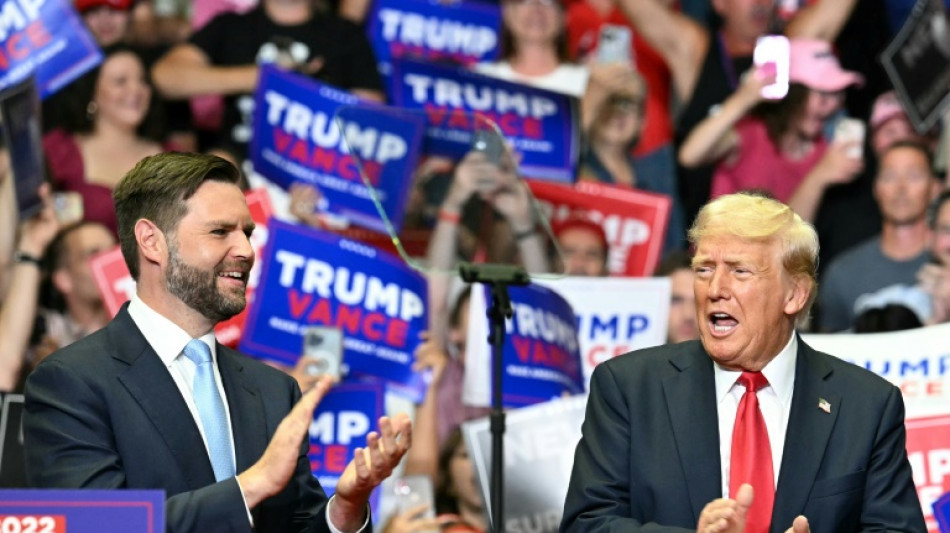
Trump offers tech sector policy flips ahead of election / Photo: Jim WATSON - AFP

 Vessel operator seeks witnesses after Vancouver grounding

 Shrini Srivastava joins crew of Varanasi-Delhi Vande Bharat Sleeper service

 Nearly Half of Australian Workers Overqualified, Survey Finds

 RBI eases export-declaration compliance for individual service exporters

 Reliance shares remain in focus after near-12% surge

 Coal India prepares possible $1 billion Mahanadi Coalfields listing

 Capital-markets shares rally as Motilal Oswal and Angel One lead gains

 Reliance rally puts historical one-year return pattern in focus

 Saudi Aramco quarterly profit climbs 34.6% amid elevated oil prices

 Australia raises benchmark rate to highest level in 18 years

 Asian stocks retreat as AI worries outweigh steep oil-price drop

 Hamad International Airport stages emergency drills during WATAN 2026
Fiercely against social media platform TikTok, cryptocurrency bitcoin and electric cars during his presidency, Republican presidential nominee Donald Trump has recently flip-flopped on several issues that are dear to Silicon Valley.
The presidential hopeful has, however, remained steadfast in some areas that are likely to be of concern to major US tech companies.
Here is a rundown of Trump's latest policy stance on five major tech sector issues.
- Electric vehicles -
"I love Elon Musk, I love him," Trump shouted Saturday during a campaign rally in Grand Rapids, Michigan, a state that is home to many US automakers.
That statement came after reports that Musk had pledged to donate $45 million monthly to the Republican after he narrowly survived an assassination attempt -- reports Musk later denied.
Trump has, however, spent years ridiculing electric cars, bashing them as too expensive and impractical, and denying climate change concerns that have driven demand for them.
"I'm constantly talking about electric vehicles, but I don't mean I'm against them; I'm all for them," he said, adding that the cars are not for everyone.
If elected, however, Trump has said he wants to end federal subsidies that encourage buying electric cars.
The move is not likely to hurt Tesla, some of whose models are not eligible for the rebates, but would hit its US competitors.
- TikTok -
Trump tried in vain to ban Chinese-owned video app TikTok on national security grounds during his presidency, and spoke out against China routinely during his failed bid for reelection in 2020.
Trump expressed concerns -- echoed by political rivals -- that the Chinese government might tap into US TikTok users' data or manipulate what they see on the platform.
He even called for a US company to buy TikTok, with the government sharing in the sale price.
Now that US President Joe Biden's administration has signed a law to ban the app for the same reasons, unless it is sold, Trump has reversed course.
"Now (that) I'm thinking about it, I'm for TikTok, because you need competition," he recently told Bloomberg.
"If you don't have TikTok, you have Facebook and Instagram -- and that's, you know, that's Zuckerberg."
Facebook, founded by Mark Zuckerberg and part of his Meta tech empire, was among the social media networks that banned Trump after attacks on the US Capitol on January 6, 2021, driven by concerns that he would use the platform to promote more violence.
- Crypto -
Trump's sudden support for cryptocurrencies appears to stem from a belief, expressed to Bloomberg, that "if we don't do it, China is going to figure it out -- or somebody else."
He has spun from calling bitcoin a "scam" and a disaster waiting to happen to saying in a post on his Truth Social platform that cryptocurrencies should be "MADE IN THE USA!!!"
The about-face, and his selection of crypto-industry proponent J.D. Vance as his running mate, has won Trump favor in an industry that feels it has been treated harshly by the Biden administration.
"A Trump presidency is the only path forward to help the US regulatory regime for crypto," said Digital Future founder Michelle Bond.
Trump has not explained how he intends to support the crypto sector.
- Imported talent and tech -
Trump took numerous measures that handicapped Silicon Valley during his time in the White House.
Among them was signing executive orders restricting visas for foreign workers whose skills are key to US-based tech companies.
Trump also imposed high tariffs that penalized companies such as Apple that depend on China for their supply chain.
This policy, which has largely continued under Biden, is likely to remain in place if Trump regains power.
On the campaign trail, Trump has suggested that he would expand his protectionist policies to include countries other than China as well.
On Tuesday, Musk said Tesla had put on hold plans to build a factory in Mexico because of concerns about potential tariffs under Trump.
- Taxes -
During his presidency, Trump's tax cuts mainly benefitted the wealthy, including tech titans.
In the run-up to the election, Biden -- and his successor as the presumptive Democratic nominee Kamala Harris -- said they wanted the rich to pay more in taxes.
Trump, however, says he wants to lower corporate taxes, even with tech giants reaping billions in profits.
Trump's administration had taken aim at tech giants Google, Amazon, Apple and Facebook through antitrust actions, but his focus on enforcing such regulations is not expected to remain as tight if elected to a second term.
O.Hansen--CPN