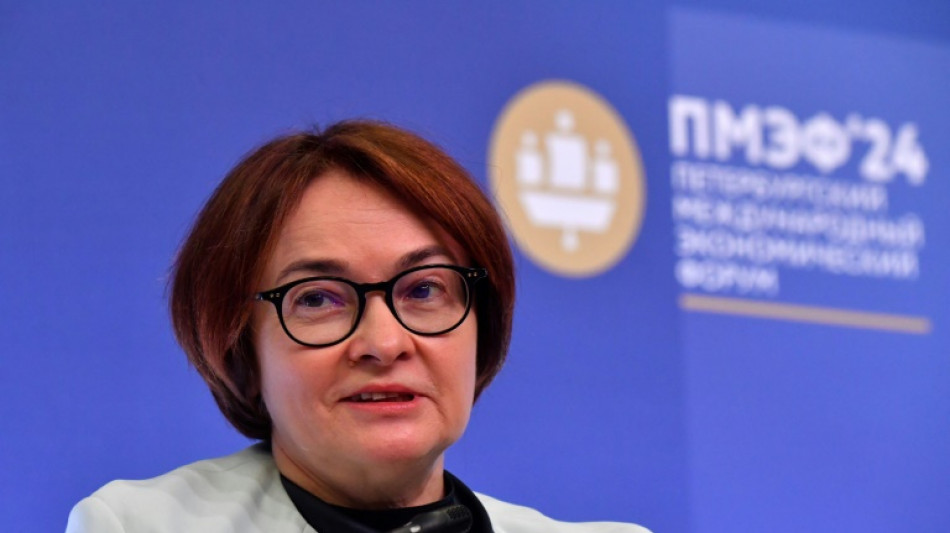
Russian central bank hikes key rate to fight inflation / Photo: Olga MALTSEVA - AFP/File

 Vessel operator seeks witnesses after Vancouver grounding

 Shrini Srivastava joins crew of Varanasi-Delhi Vande Bharat Sleeper service

 Nearly Half of Australian Workers Overqualified, Survey Finds

 RBI eases export-declaration compliance for individual service exporters

 Reliance shares remain in focus after near-12% surge

 Coal India prepares possible $1 billion Mahanadi Coalfields listing

 Capital-markets shares rally as Motilal Oswal and Angel One lead gains

 Reliance rally puts historical one-year return pattern in focus

 Saudi Aramco quarterly profit climbs 34.6% amid elevated oil prices

 Australia raises benchmark rate to highest level in 18 years

 Asian stocks retreat as AI worries outweigh steep oil-price drop

 Hamad International Airport stages emergency drills during WATAN 2026
Russia's central bank raised its key interest to 18 percent on Friday, the sixth hike in just over a year as it seeks to tame soaring price rises.
Governor Elvira Nabiullina said Russian businesses were facing higher costs and payment problems as the West puts pressure on Russia's trading partners to stop helping it circumvent sanctions.
Domestic prices have risen fast since Moscow launched its full-scale military offensive against Ukraine in February 2022, as massive government spending and skyrocketing wages have pushed up demand across the economy.
"Inflation has accelerated and is running substantially above the Bank of Russia's April forecast," the regulator said in a statement.
"The growth of domestic demand continues to significantly outpace the ability to expand the supply of goods and services. In order for inflation to begin to decline again, additional tightening of monetary policy is required," it added.
The interest rate was previously at 16 percent and Nabiullina kept open the possibility of further hikes.
Nabiullina said the economy was showing stubborn signs of "overheating" and pointed to trading difficulties as another factor driving up inflation.
"The risks of secondary sanctions have indeed increased. We see this in the difficult situation with payments," she said during a press conference, saying Russian importers were facing higher transaction costs.
The United States has threatened banks and firms in the likes of China, Turkey and the United Arab Emirates with harsh penalties -- so-called "secondary sanctions" -- if they help Russia import goods the West has sanctioned over the Ukraine conflict.
- Spending spree -
Russia is set to spend almost nine percent of its GDP on defence and security this year, according to President Vladimir Putin -- a figure unprecedented since the days of the Soviet Union as the country ramps up arms production to fight in Ukraine.
The surge in public expenditure, combined with record labour shortages in many sectors, has created an inflationary spiral that Russia has been unable to shake off.
Moscow's federal budget has jumped almost 50 percent over the last three years -- from 24.8 trillion rubles ($289 billion) in 2021, before the Ukraine offensive, to a planned 36.6 trillion rubles ($427 billion) this year.
Since so much spending is being directed by the state, which is less responsive to higher borrowing costs, analysts fear interest rate rises may not be an effective tool against inflation.
Consumer prices are a sensitive topic in Russia, where many people have virtually no savings and memories of hyperinflation and economic instability run deep.
The Kremlin said Thursday it was concerned by high levels of inflation and that "measures" were being implemented to tackle the problem.
P.Petrenko--CPN