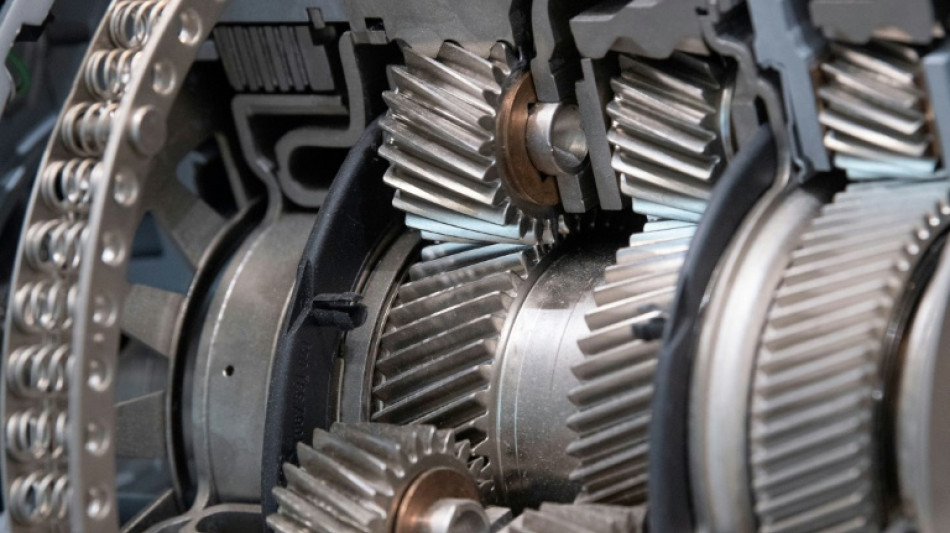
Electric car woes force German supplier ZF to axe jobs / Photo: THOMAS KIENZLE - AFP/File

 Vessel operator seeks witnesses after Vancouver grounding

 Shrini Srivastava joins crew of Varanasi-Delhi Vande Bharat Sleeper service

 Nearly Half of Australian Workers Overqualified, Survey Finds

 RBI eases export-declaration compliance for individual service exporters

 Reliance shares remain in focus after near-12% surge

 Coal India prepares possible $1 billion Mahanadi Coalfields listing

 Capital-markets shares rally as Motilal Oswal and Angel One lead gains

 Reliance rally puts historical one-year return pattern in focus

 Saudi Aramco quarterly profit climbs 34.6% amid elevated oil prices

 Australia raises benchmark rate to highest level in 18 years

 Asian stocks retreat as AI worries outweigh steep oil-price drop

 Hamad International Airport stages emergency drills during WATAN 2026
German car parts manufacturer ZF said Friday it would cut a fifth to a quarter of jobs in Germany as it struggled with the switch to electric vehicles and foreign competition.
"The number of employees in Germany is to be successively reduced by 11,000 to 14,000 from the current level of around 54,000 by 2028," ZF said in a statement.
The decision to significantly reduce the size of its domestic workforce was needed to "respond to the changes in the mobility sector, particularly in the field of electromobility", ZF said.
The move was "difficult but necessary", ZF chief executive Holger Klein said in a statement.
"The seriousness of the situation calls for decisive action to be able to adapt the company to the tougher market and competitive environment," Klein said.
Restructuring the auto supplier in Germany was needed to "strengthen our competitiveness and consolidate our position as one of the world's leading suppliers", Klein said.
Strong competition, cost pressures and weak demand for electric vehicles meant the restructuring would focus on ZF's electric motors division, the group said.
The emerging market, in which Chinese manufacturers have taken the lead, was "highly competitive", ZF said.
Building the motors for electric cars had "low margins" and the group was struggling to "cross-finance purely electric drives" from its efforts in conventional and hybrid vehicles, ZF said.
The switch to electric vehicles was eating away at demand for "transmissions for conventional and hybrid vehicles", an area where German suppliers have traditionally excelled, it said.
At the same time, "the current glaring weakness in demand for purely electric vehicles" meant ZF had been left with overcapacity in areas backed with high investments.
Despite the difficulties, "the future belongs to electromobility", CEO Klein said.
ZF would continue to "invest heavily in this area", he promised, but would have to explore cooperation with other firms in the area to remain competitive.
- 'Leaner' -
As part of the restructuring, the Friedrichhafen-based supplier said it would "increase its investments" in the areas of in-car technology, vehicle chassis, industrial tech and aftermarket services.
ZF's network in Germany would be made "leaner" after recent acquisitions had seen it gradually expand, the group said.
The ultimate extent of the job cuts would depend on "the further development of the markets", ZF said.
EU plans to outlaw the sale of new fossil fuel-powered cars from 2035, means some jobs in the industry will inevitably become redundant.
Meanwhile, Chinese manufacturers have grabbed the advantage in electric vehicles and are hauling in a growing share of the market.
The Chinese battery-maker CATL has grown in short order to become the world's third largest auto supplier.
The double shock delivered by the end of combustion engines and rising Chinese competition has piled pressure on European suppliers.
Besides ZF, parts makers like Bosch, Continental and Webasto have been among the companies in the sector to have announced job cuts.
Y.Uduike--CPN