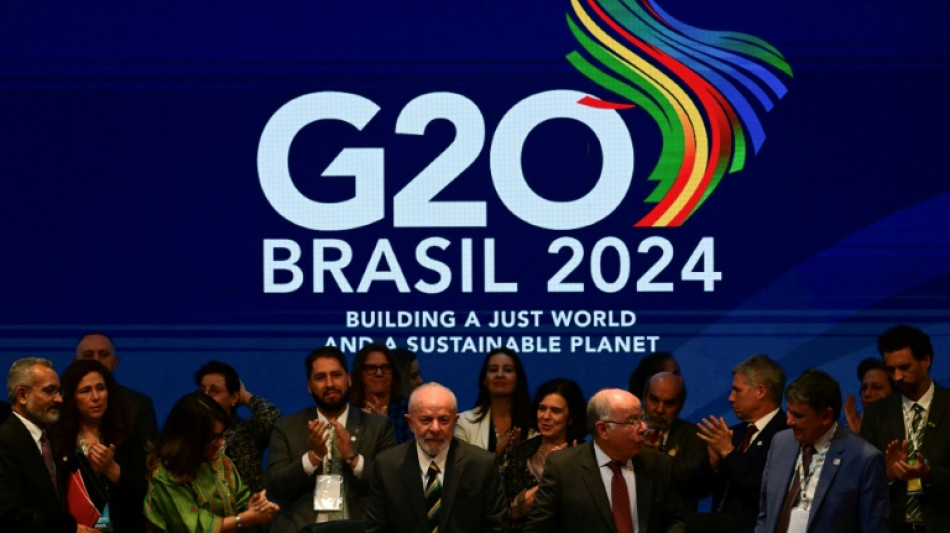
In Rio, G20 finance ministers to mull taxing the super-rich / Photo: Pablo PORCIUNCULA - AFP

 Qatar media bodies discuss support for humanitarian initiatives

 Bezos grant helps Seattle nonprofit move thousands of families toward housing

 US stocks fall before midterm Election Day as technology shares weaken

 BLS Polymers makes strong market debut at ₹248 per share

 Petrol and diesel prices remain broadly steady across major Indian cities

 Derek Tierney Outlines Ten-Year Strategy for National Digital Health System

 BLS Polymers shares open 65.3% above IPO price

 ITC shares rise as analysts anticipate gradual cigarette-business recovery

 The Digital Burden: Why Instant Messaging Feels Like a Full-Time Job
Faced with growing global inequality, G20 finance ministers meeting Thursday in Rio de Janeiro will tackle the thorny issue of taxes for the super-rich, a topic that has divided member states.
It is a key priority of Brazil's leftist president, Luiz Inacio Lula da Silva, who this year heads the grouping of the world's major economies, the European Union and African Union, which will discuss taxing billionaires in an afternoon session.
"Some individuals control more resources than entire countries," Lula said Wednesday at the launch of an initiative to fight world hunger, another project topping his G20 agenda.
"At the top of the pyramid, tax systems are no longer progressive, but regressive."
Global inequality has continued to widen in recent years according to a study by the NGO Oxfam published Thursday: the richest one percent of the world have earned more than $40 trillion in a decade, but their taxation is at "historically" low rates.
French economist Gabriel Zucman, a consultant with the G20 on taxation issues, estimates that the tax rate for billionaires represents 0.3 percent of their wealth.
In a recent report commissioned by the G20, he called for super-wealthy individuals to be taxed the equivalent of two percent of their fortune.
However, not all G20 countries are keen on the idea.
- 'Irrelevant' -
US Treasury Secretary Janet Yellen opposed international negotiations on the subject during a G7 finance meeting held in May in Italy.
Germany's finance ministry considers the idea of a minimum wealth tax to be "irrelevant."
The initiative is backed by France, Spain, South Africa, Colombia and the African Union.
In addition to international taxation, G20 finance ministers will also discuss the global economic situation in their last meeting before a summit on November 18 and 19.
On Friday, the ministers will tackle the financing of the climate transition and debt.
Founded in 1999, the Group of 20 assembles 19 of the world's largest economic powers, as well as the European Union and the African Union.
The organization was originally focused on global economic issues but has increasingly taken on other pressing challenges -- even though member states do not always agree on what should be on the agenda.
Brazil's presidency said in a statement that some members of the G20 considered that crises such as the conflicts in Ukraine and Gaza "have an impact on the global economy and should be addressed at the G20, while others believe that the G20 is not the place to discuss these issues."
Divisions within the G20, of which Russia is also a member, has made drafting a joint communique at the outcome of meetings a challenge.
The last meeting of finance ministers in Sao Paulo failed to issue such a statement.
Brazil hopes to publish three texts after the meeting, said Tatiana Rosito, a senior official at the economy ministry.
Aside from a joint final communique, this would include a document on "international cooperation in tax matters" and a separate communique from Brazil on geopolitical crises.
"It is likely, based on my experience of previous G20s," that future ministerial-level meetings will publish separate statements in this manner, European Commissioner for International Partnerships, Jutta Urpilainen, told reporters Wednesday.
Aiming for a single text "would not allow us to adopt anything," she said.
A.Zimmermann--CPN