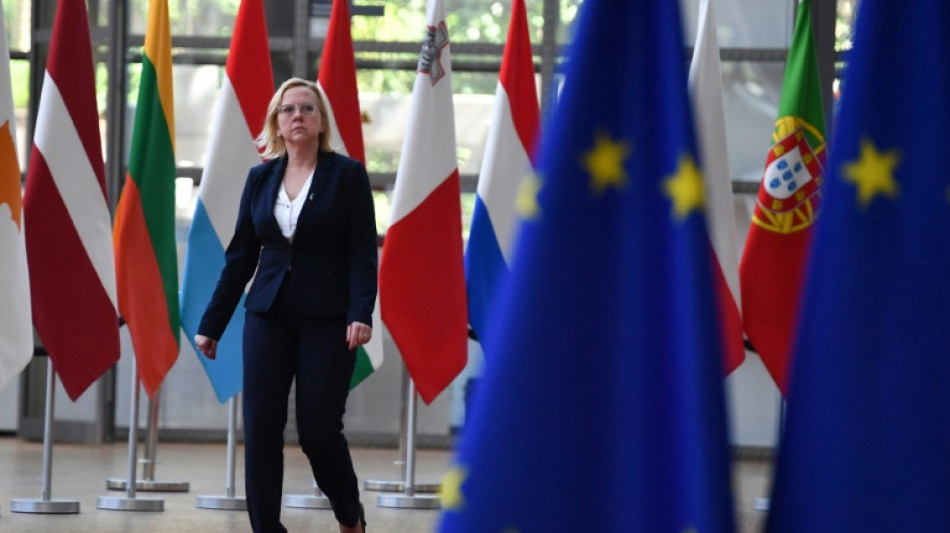
EU shores up defence against Russia energy threats / Photo: JOHN THYS - AFP

 Nintendo producer 'all nervous' as Zelda classic remake hits shelves

 Three killed by storm in southern India

 Two hundred 'Cruise for life' passengers stranded in Cambodia

 Billionaire Ambani's Jio jumps 21% in market debut after record India IPO

 Sri Lanka's Tamil farmers fight to reclaim land after civil war

 'They don't care about us': Trump food aid cuts leave Americans struggling and angry

 Palestinian activist Khalil returns to Columbia after US detention

 Youths testify about 'despair' in unprecedented Canadian climate trial

 Storied Paris department store seeks bankruptcy protection

 Boeing shares tumble after it releases cautious growth forecast

European Union ministers met Monday to respond to Russia cutting gas supplies to Poland and Bulgaria -- and discuss plans for a possible oil embargo to punish Moscow for invading Ukraine.
The energy ministers from the 27 member states were coordinating efforts to counter what Brussels has branded the Kremlin's bid to "blackmail" the West with threatened energy shortages.
The EU is also working on a phased ban on Russian oil imports, hoping to cut off funding for its war effort and assert energy independence from Moscow.
"We will support full sanctions on all Russian fossil fuels. We already have coal -- now it's time for oil," said Anna Moskwa, Poland's environment minister.
But Poland is among the more hawkish member states. Others, such as Germany, are wary of the economic hurt a wider ban on Russian energy would bring.
So no decision on an oil embargo was expected Monday. Diplomats and European Commission experts are still working towards a proposal for an eventual sixth sanctions package.
Instead, the ministers discussed technical ways to wean their economies off Russian energy supplies.
They also looked at how to support countries that have provoked the Kremlin's wrath, such as Bulgaria and Poland, whose gas deliveries were halted last week.
France's ecological transition minister Barbara Pompili, whose country holds the EU presidency, said she had called the emergency meeting to "ensure our solidarity with our colleagues from Bulgaria and Poland."
Russia's President Vladimir Putin has demanded "unfriendly countries" -- which includes all EU states -- pay for their gas in rubles, which Warsaw and Sofia refused.
Doing so would involve western clients depositing in euros or dollars in a bank run by Russian state energy giant Gazprom, to be converted into rubles and moved to a second Gazprombank account.
The European Commission says that could breach EU sanctions on Russia. But Germany and Austria have been cautious about rejecting the Kremlin's payment terms.
"We appeal to countries not to support Putin's decree, not to support the initiative to pay in rubles," Moskwa said.
- Face saver? -
Germany's minister for economic affairs and climate Robert Habeck said Berlin would follow EU policy even if it imposed costs on its economy.
But he also suggested the dual Gazprombank accounts plan could be "a face-saving solution for Putin".
France's Pompili said: "We will continue to pay in euros the contracts which were stipulated in euros, or in dollars those which were stipulated in dollars."
The European commissioner for energy, Kadri Simson, said Russia's decision to cut off the two EU members showed that Moscow was not a "reliable supplier".
She denied Russian reports that some EU countries have agreed to make ruble payments.
On Sunday, sources told AFP the EU will propose, perhaps as early as this week, a phased-out ban on imports of Russian oil -- but not gas -- in a fresh round of sanctions against Russia.
Several diplomats said the ban on oil was made possible after a U-turn by reluctant Germany.
The ban requires unanimous backing and could yet be derailed, with Hungary expected to mount strong opposition as it is dependent on Russian oil and close to the Kremlin.
Other countries are worried that a ban on oil would increase prices at the pump when consumer prices are already sharply on the rise because of the war.
"We must be very attentive to market reactions," one official told AFP on condition of anonymity. "There are solutions and we will get there in the end, but we must act with great care."
The sixth package of anti-Russian measures will also target the country's largest bank, Sberbank, which will be excluded from the international SWIFT messaging system, the diplomats said.
O.Hansen--CPN