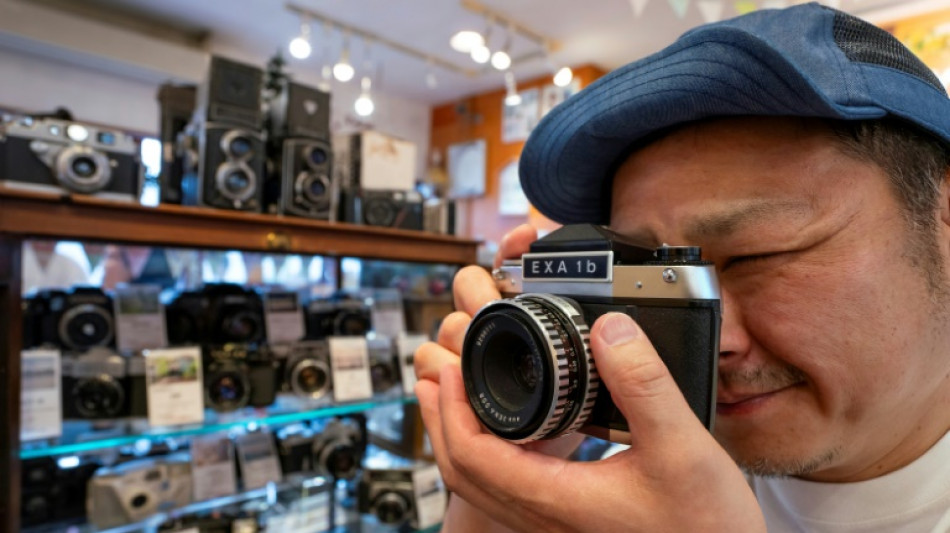
New Japan film camera aimed at 'nostalgic' young fans / Photo: Kazuhiro NOGI - AFP

 Qatar media bodies discuss support for humanitarian initiatives

 Bezos grant helps Seattle nonprofit move thousands of families toward housing

 US stocks fall before midterm Election Day as technology shares weaken

 BLS Polymers makes strong market debut at ₹248 per share

 Petrol and diesel prices remain broadly steady across major Indian cities

 Derek Tierney Outlines Ten-Year Strategy for National Digital Health System

 BLS Polymers shares open 65.3% above IPO price

 ITC shares rise as analysts anticipate gradual cigarette-business recovery

 The Digital Burden: Why Instant Messaging Feels Like a Full-Time Job
Keita Suzuki leads a group of young analogue photography fans around a coastal city in Japan, stopping to snap pastel hydrangea blooms with bulky vintage film cameras.
The participants later share their lush retro-looking snaps online -- a trend a top Japanese camera brand wants to capture with its first new film model in two decades.
Instead of pressing a smartphone button, more and more young people "want to experience the original act of taking a photograph: winding the film up, looking through the viewfinder and releasing the shutter", Suzuki told AFP.
Another "beauty" of film photography is that with limited physical film, you must think carefully about which memories to "lock in" to each photograph, he said.
Suzuki advertises his tours on social media and has seen a growing interest from teens and 20-somethings loading 35mm film and taking it to be developed for the first time.
Yuriko Yamada was one of around 20 people who joined a recent gathering in Kamakura near Tokyo.
"Digital photos are clear and clean, but film ones have faint, soft colours, which I prefer," the 34-year-old said.
"It takes time to see the final product, but I really enjoy the process," she added. "It feels nostalgic."
Japan's biggest camera brands stopped making analogue film models in the 2000s as digital ones became dominant.
Countless camera sellers in Japan's big cities have since stepped up to fill the void, refurbishing old models for a new generation of analogue enthusiasts.
Despite the surge in popularity, many of those on the photo tour said they still find it difficult to repair their old cameras because the parts are no longer being produced.
- 'Many hurdles' -
To meet rising demand from new film fans, the $500 Pentax 17 -- the brand's first analogue model in 21 years -- was launched in Europe and the United States in June, and Japan this month.
The camera has a classic black appearance but takes half-frame photos, meaning a 24-exposure film yields 48 shots, which are portrait-orientated like phone photos.
It has been so popular in Japan that pre-orders sold out, according to manufacturer Ricoh Imaging Company.
Product planner and designer Takeo Suzuki, nicknamed TKO -- a revered figure among photography fans -- said Ricoh had been "surprised" by the "huge" global response.
Plans to release a new analogue camera were hatched around 2020, but weren't easy to realise.
"This was a completely new project, so it was like groping in the dark," Suzuki said.
"There were so many hurdles, but we received a lot of support from many people."
Pentax engineers used archive drawings of past cameras, some on paper, to try and make manual winders and other analogue technology.
But they struggled, so the company asked retired colleagues to come back to help.
"They taught us tips and tricks that were not on the blueprints, but were really recipes in the engineer's head," Suzuki said.
By doing so, they "revived the old technology little by little".
- 'Spark conversations' -
Instant and disposable film cameras made by Ricoh's rival Fujifilm have also become popular as the trend for sharing old-fashioned photos on social media grows.
Sales of the palm-sized Instax, launched in 1998 as a competitor to Polaroid, stagnated for several years in the 2000s due to the shift to digital cameras.
But they are rising again in part thanks to an expanded range including sleek, classic designs made to appeal to men and older customers, the company says.
"People enjoy prints as a communication tool, because they spark conversations," said senior Fujifilm manager Ryuichiro Takai, who is responsible for the Instax business.
Young customers at Popeye Camera, a specialist film photography shop in Tokyo's Jiyugaoka district, seem to agree.
Yoshinobu Ishikawa took over the family business in 2000, when the rise of digital cameras had nearly forced the shop's closure.
Back then, "young people found it difficult to enter" as mostly older male customers would be having "intimidating, technical conversations" with staff, he said.
But now Ishikawa actively courts them with fun items such as stickers to decorate photos and leather camera straps, as well as a custom developing service -- speaking to customers beforehand about the style they want.
"Young people see film photography shared on social media, and they want to try it themselves," he said.
Yamada, the photo tour participant, says she feels "more and more into film photography".
"It's inconvenient, but I feel it's something new."
S.F.Lacroix--CPN