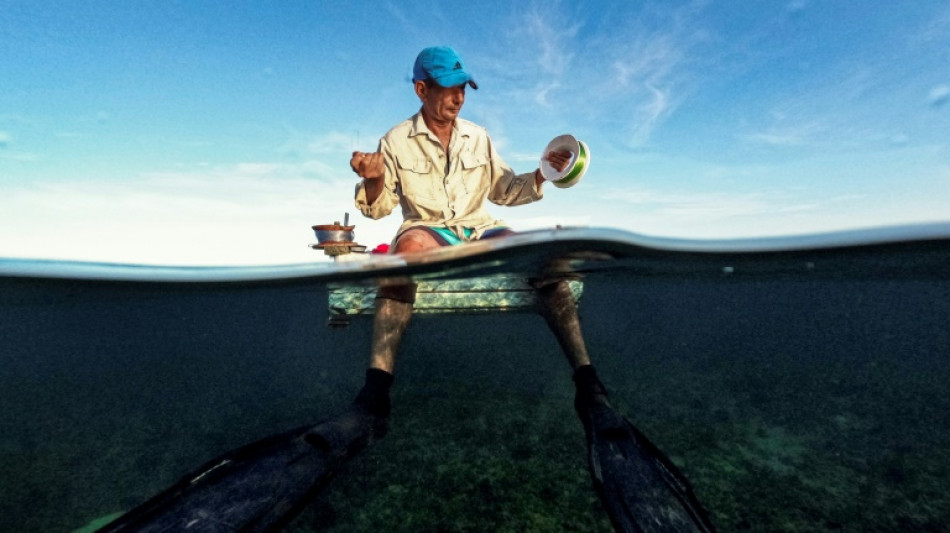
With no money or fuel, Cuban fishermen improvise on floating rafts / Photo: YAMIL LAGE - AFP

 Qatar media bodies discuss support for humanitarian initiatives

 Bezos grant helps Seattle nonprofit move thousands of families toward housing

 US stocks fall before midterm Election Day as technology shares weaken

 BLS Polymers makes strong market debut at ₹248 per share

 Petrol and diesel prices remain broadly steady across major Indian cities

 Derek Tierney Outlines Ten-Year Strategy for National Digital Health System

 BLS Polymers shares open 65.3% above IPO price

 ITC shares rise as analysts anticipate gradual cigarette-business recovery

 The Digital Burden: Why Instant Messaging Feels Like a Full-Time Job
Small white squares dot the ocean off Havana, an unlikely fleet of fishermen bobbing on makeshift polystyrene rafts they use to make up for a lack of fuel or money to buy a proper boat.
"In the past, we fished a lot with the inner tubes of truck tires, but the danger was that they would burst. With these rafts, there is no danger. They do not capsize," said Coli Rivera, 54, returning from several hours of fishing off the village of Santa Fe, near Havana.
At first glance, the vessel made of a few polystyrene sheets and planks screwed together, looks precarious and likely to capsize at the first wave or gust of wind.
However, it has become a widespread fishing method on the Havana coast and it is not uncommon to come across residents bring the skiffs home on wheels after a day on the water.
"We always go out when the weather is nice and there is no offshore wind because it can carry us out to sea," said Rivera, a night watchman at a school who has used his raft for several years.
Fishing on the small skiffs is officially banned by authorities, who keep tight control of the coast for security reasons and to block illegal emigration.
However, it remains tolerated in the capital, where it supplements incomes and provides food to residents.
Cuba is suffering through its gravest economic crisis in thirty years, marked by chronic shortages of fuel and other necessities.
- 'Fishing is luck' -
Fishermen mostly set off in pairs on their makeshift boats, which are one meter wide and about four meters long.
While one steers with an oar, the other provides propulsion with flippers on their feet.
Their main catch is barracuda and parrotfish.
"A normal boat costs a lot of money. We can't afford it," said Rivera, adding that the raft does not need fuel.
At summertime in the village of Santa Fe, the skiffs are left out to dry in front of houses or stored on the roofs while waiting for the next trip out to sea.
In winter, winds and big waves prevent their use.
Despite their simple design, the rafts can last for up to ten years. Fishermen say one only has to replace salt-corroded screws from time to time.
Omar Martin, 46, who has lived in Santa Fe for more than a year, bought his second-hand raft for 10,000 Cuban pesos (about $80 at the official exchange rate).
Having set out to sea at 2 am, the tire repairman brought back only a few small fish, too small to sell.
He will give them to his neighbors.
"The fishing was very bad. It depends on the weather. Fishing is luck," he told AFP.
U.Ndiaye--CPN