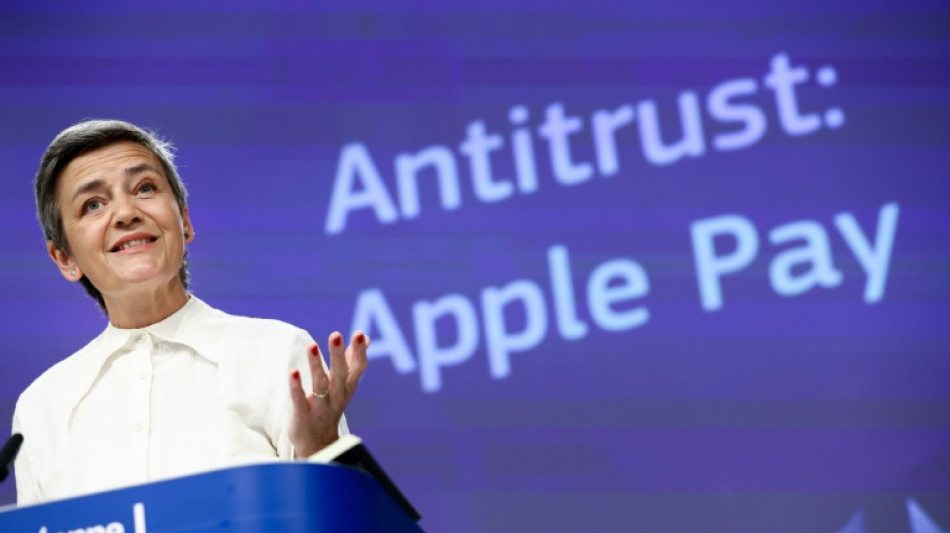
EU targets Apple Pay in latest Big Tech antitrust case / Photo: Kenzo TRIBOUILLARD - AFP

 Nintendo producer 'all nervous' as Zelda classic remake hits shelves

 Three killed by storm in southern India

 Two hundred 'Cruise for life' passengers stranded in Cambodia

 Billionaire Ambani's Jio jumps 21% in market debut after record India IPO

 Sri Lanka's Tamil farmers fight to reclaim land after civil war

 'They don't care about us': Trump food aid cuts leave Americans struggling and angry

 Palestinian activist Khalil returns to Columbia after US detention

 Youths testify about 'despair' in unprecedented Canadian climate trial

 Storied Paris department store seeks bankruptcy protection

 Boeing shares tumble after it releases cautious growth forecast

The EU accused Apple on Monday of blocking rivals from its popular "tap-as-you-go" iPhone payment system, opening a fresh battlefront between the US tech giant and Brussels.
"The preliminary conclusion that we reached today relates to mobile payments in shops, by excluding others from the game," said Margrethe Vestager, the EU's antitrust chief.
"Apple has unfairly shielded its Apple Pay wallets from competition. If proven this behaviour would amount to abuse of a dominant position, which is illegal under our rules," Vestager told reporters.
The European Commission, the bloc's competition watchdog, specifically charged the iPhone maker with preventing competitors trying to enter the contact-less market "from accessing the necessary hardware and software ... to the benefit of its own solution, Apple Pay".
The accusation is the latest salvo against US tech giants by EU regulators, who have also taken aim at Apple's music streaming and e-book businesses.
The company is also a main target of the Digital Markets Act, a landmark EU law that will prohibit Apple and other US tech giants from privileging their own services in its products and platforms.
The EU's outline of the case came after the commission launched an investigation in 2020 that was fuelled by complaints from European banks that resist paying a fee to Apple in order to reach their customers via apps.
The battle comes as tech giants eye personal finance as a new moneymaker, with Google, Amazon and Facebook owner Meta also seeking ways to replace credit cards or the need of carrying a wallet.
Launched in 2014, Apple Pay allows iPhone or Apple Watch users to make payments at retailers by touching their devices to the same terminals currently used for credit and debit cards.
- 'Many options' -
The technology at the heart of concerns in the Apple Pay case is "near-field communication", or NFC, which permits devices to communicate within a very short range of each other, usually less than 10 centimetres (four inches).
On iPhones, the use of NFC is blocked for payments except by Apple Pay and any company wanting to use the technology must pass through Apple for a fee.
Vestager said that by restricting the access to the NFC to themselves, "this market is really not developed because it's not possible for other app developers to get access to the NFC."
Apple said that its first priority was security and that the Apple Pay system offered a level playing field between all actors using its products.
"Apple Pay is only one of many options available to European consumers for making payments, and has ensured equal access to NFC while setting industry-leading standards for privacy and security," the company said.
"We will continue to engage with the commission to ensure European consumers have access to the payment option of their choice in a safe and secure environment," it added.
There is no deadline for the EU's continued investigation. If found guilty, Apple would have to remedy its practices or face fines that could reach as high as 10 percent of annual sales.
A.Agostinelli--CPN