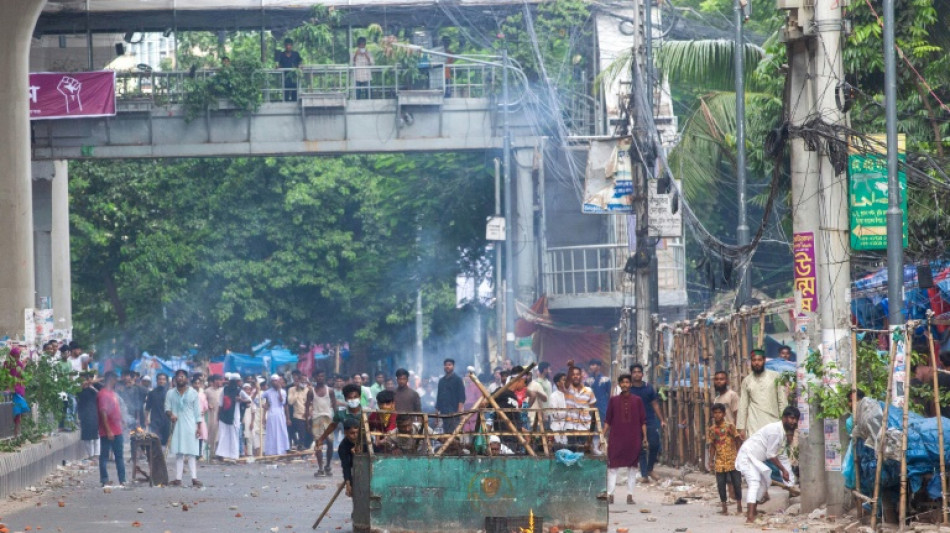
Bangladesh court to rule on job quotas that sparked unrest / Photo: - - AFP

 Qatar media bodies discuss support for humanitarian initiatives

 Bezos grant helps Seattle nonprofit move thousands of families toward housing

 US stocks fall before midterm Election Day as technology shares weaken

 BLS Polymers makes strong market debut at ₹248 per share

 Petrol and diesel prices remain broadly steady across major Indian cities

 Derek Tierney Outlines Ten-Year Strategy for National Digital Health System

 BLS Polymers shares open 65.3% above IPO price

 ITC shares rise as analysts anticipate gradual cigarette-business recovery

 The Digital Burden: Why Instant Messaging Feels Like a Full-Time Job
Bangladesh's top court was due to rule Sunday on the future of civil service hiring rules that sparked nationwide clashes between police and university students, killing 133 people.
What began as a protest against politicised admission quotas for sought-after government jobs snowballed this week into some of the worst unrest of Prime Minister Sheikh Hasina's tenure.
Soldiers are patrolling cities across Bangladesh after riot police failed to restore order, while a nationwide internet blackout since Thursday has drastically restricted the flow of information to the outside world.
The Supreme Court was meeting later Sunday to issue a verdict on whether to abolish the contentious job quotas.
Hasina, whose opponents accuse her government of bending the judiciary to her will, hinted to the public this week that the scheme would be scrapped.
But after the mounting crackdown and a rising death toll, a favourable verdict is unlikely to mollify white-hot public anger.
"It's not about the rights of the students anymore," business owner Hasibul Sheikh, 24, told AFP at the scene of a Saturday street protest, held in the capital Dhaka in defiance of a nationwide curfew.
"Our demand is one point now, and that's the resignation of the government."
The catalyst for this month's unrest is a system that reserves more than half of civil service posts for specific groups, including children of veterans from the country's 1971 liberation war against Pakistan.
Critics say the scheme benefits families loyal to Hasina, 76, who has ruled the country since 2009 and won her fourth consecutive election in January after a vote without genuine opposition.
Hasina's government is accused by rights groups of misusing state institutions to entrench its hold on power and stamp out dissent, including by the extrajudicial killing of opposition activists.
- 'Made the situation worse' -
With Bangladesh unable to provide adequate employment opportunities for its 170 million people, the quota scheme is a pronounced source of resentment among young graduates facing an acute jobs crisis.
Hasina inflamed tensions this month by likening protesters to the Bangladeshis who had collaborated with Pakistan during the country's independence war.
"Rather than try to address the protesters' grievances, the government's actions have made the situation worse," Crisis Group's Asia director Pierre Prakash told AFP.
Hasina had been due to leave the country on Sunday for a diplomatic tour to Spain and Brazil but abandoned her plans after a week of escalating violence.
Since Tuesday at least 133 people, including several police officers, have been killed in clashes around the country, according to an AFP count of victims reported by police and hospitals.
The US State Department warned Americans on Saturday not to travel to Bangladesh and said it would begin removing some diplomats and their families from the country due to the civil unrest.
Y.Uduike--CPN