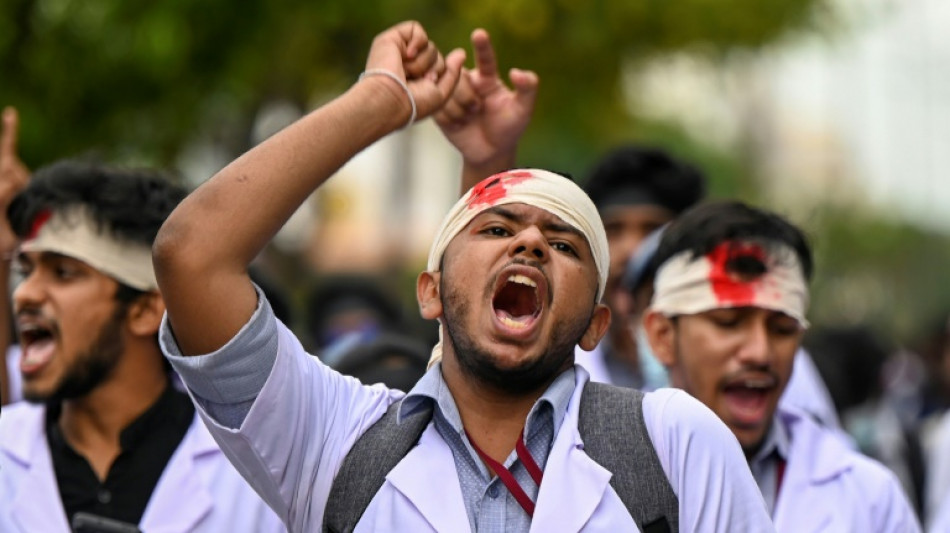
Crisis-hit Sri Lanka says IMF bailout three months away / Photo: Ishara S. KODIKARA - AFP

 Nintendo producer 'all nervous' as Zelda classic remake hits shelves

 Three killed by storm in southern India

 Two hundred 'Cruise for life' passengers stranded in Cambodia

 Billionaire Ambani's Jio jumps 21% in market debut after record India IPO

 Sri Lanka's Tamil farmers fight to reclaim land after civil war

 'They don't care about us': Trump food aid cuts leave Americans struggling and angry

 Palestinian activist Khalil returns to Columbia after US detention

 Youths testify about 'despair' in unprecedented Canadian climate trial

 Storied Paris department store seeks bankruptcy protection

 Boeing shares tumble after it releases cautious growth forecast

An International Monetary Fund bailout package for crisis-hit Sri Lanka could take up to three months to arrive, the country's central bank chief said on Friday, as anti-government protests over the economic crisis continue to escalate.
The island nation of 22 million people has been rocked by months of acute food, fuel and medicine shortages, prompting widespread protests calling for President Gotabaya Rajapaksa to resign.
Central bank chief Nanadalal Weerasinghe said he was hopeful of a staff-level agreement with the IMF within two months, but a final deal would take another three weeks.
"The key objective is to achieve debt sustainability before an IMF program," Weerasinghe said, adding that experts will be named shortly to renegotiate Sri Lanka's external debt estimated at $51 billion.
Two weeks ago, Sri Lanka announced it was defaulting on its foreign debt after running out of foreign exchange to import even the most essential supplies.
Weerasinghe told reporters in Colombo that he expected about $3.0 billion from an eventual International Monetary Fund program, but the country would first have to carry out painful reforms.
"The current tax structure is not sustainable. We must go back at least to the level of taxation we had before 2019," he said, referring to a series of tax breaks implemented by Rajapaksa in an election pledge that propelled him to power in November 2019, but devastated state revenue.
Official data released Friday showed year-on-year inflation at 29.8 percent in April, a seventh consecutive record-high -- five times above the 5.7 percent in September.
Weerasinghe warned inflation could jump even more as fuel and food prices increased sharply with the local currency losing over 40 percent of its value in a month.
Census and statistics department figures showed food inflation in April was also a record 46.6 percent higher, up from 30.2 percent in March and 9.0 percent a year ago.
Under pressure, the president has reportedly told dissidents within his coalition government that he is willing to consider forming a unity government but the opposition has refused to join an administration with the powerful Rajapaksa family still in power.
The President has meanwhile told legislators that neither he nor his elder brother Mahinda, the prime minister, will step down as demanded by anti-government demonstrators across the country.
Millions of state and private-sector workers staged a crippling strike on Thursday -- bringing the entire country to a standstill for the first time since demonstrations began -- adding pressure on the Rajapaksas to quit over corruption and mismanagement.
-No new loans-
The president announced Tuesday that the World Bank had agreed to grant $600 million to alleviate the economic crisis.
But the international lender on Friday denied finalising any fresh loans.
A World Bank spokesperson told AFP that talks were underway to "leverage" money from ongoing projects and "repurpose" them to buy medicines and food for school children.
A total of $10 million from the ongoing Covid-19 project were "being released directly to suppliers" for the immediate purchase of essential medicines and medical supplies to address acute shortages in the country, the spokesperson said.
M.Mendoza--CPN